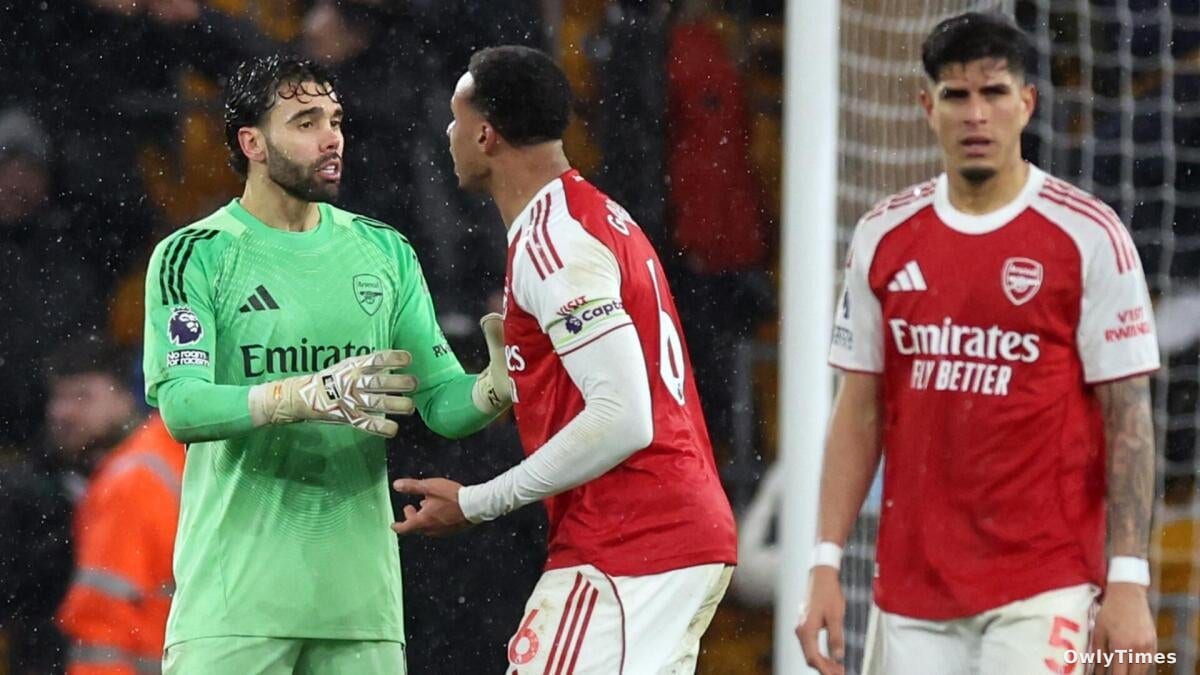

The chipped panelling of the away dressing room at Molineux Stadium felt particularly cold last Saturday, a fitting temperature for the post-match mood. Mikel Arteta’s face, usually a study in controlled intensity, held a flicker of something close to disbelief as he dissected Arsenal’s 2-1 defeat to Wolverhampton Wanderers. It wasn’t just the loss – a dent to the title race, certainly – but how they lost. Another goal, another spectacular strike finding its way past David Raya, another reminder that opponents seem to save their best for the Gunners. This isn’t simply a bad run of form; it’s a bizarre statistical anomaly that’s forcing a reckoning with the very foundations of Arsenal’s defensive strategy, and raising questions about luck, goalkeeper positioning, and the sheer audacity of opposing players.
The culprit this time was Hugo Bueno, a left-back whose first Premier League goal was a whipped beauty that nestled into Raya’s far post. It joined a growing gallery of improbable strikes conceded this season: Eli Junior Kroupi’s pearler, Dominik Szoboszlai’s free-kick artistry, Matheus Cunha’s bending effort, and Patrick Dorgu’s howitzer. While you wouldn’t necessarily crown Bueno’s goal as the pick of that bunch, the sheer volume of these ‘goals of the season’ contenders against Arsenal is what’s turning heads – and raising eyebrows in the analytics community. It’s a pattern that transcends mere bad luck, hinting at a deeper vulnerability in the way Arsenal defends space.
The numbers are startling. Six of the 20 goals Arsenal have conceded in the Premier League this season have an expected goals (xG) value of just 0.04 – meaning a shot of that quality is expected to be scored only once in every 25 attempts. All of these low xG goals have come from outside the box, and while eight teams have conceded more long-range efforts than the Gunners, only Brighton comes close to Arsenal’s 30% of goals conceded originating from distance. This isn’t about conceding easy chances; it’s about consistently being undone by moments of brilliance, or, more accurately, moments of incredibly low-probability success. Expand the criteria to shots worth less than 0.1 xG, and a staggering half of the goals conceded by Arsenal fall into that category. Think Daniel Ballard charging forward to score, Trevoh Chalobah’s audacious flick, or even a deflected shot turned in by a Wolves player.
Based on the original CBS Sports report.
This isn’t a case of a leaky defense overall. Arsenal has allowed just 19 shots and five goals from shots worth 0.2 xG or more – the most impressive marks in recent Premier League history. They excel at protecting the most dangerous areas, forcing opponents into low-percentage shots. But that very focus on box defense seems to be creating space for those long-range attempts, and the results are statistically anomalous. The combined xG value of the 20 goals conceded is just 3.15, while no Premier League team since the 2020-21 season has experienced such a significant overperformance – a six-fold difference between goals conceded and expected goals against. It feels like a curse, and the data confirms it: Arsenal goals against are disproportionately spectacular.
Arteta himself acknowledged the peculiarity, unprompted, referencing the 0.02 xG value of Bueno’s goal. “To predict somebody with an 0.02 expected goal shot… nobody can really understand that,” he said, a hint of frustration creeping into his voice. He’s searching for answers, admitting it’s “probably a bit of both” – a combination of bad luck and a tactical element that can be addressed on the training ground. The issue, as Arteta points out, isn’t just the difficulty of stopping a spectacular strike, but the quality of the players in the league capable of producing them. He wryly suggested that perhaps they should give Cole Palmer of Chelsea “no daylight” in their upcoming match. But beyond individual brilliance, a pattern is emerging in how opponents are exploiting Arsenal’s defensive shape.
A closer look reveals a recurring theme: half-cleared corners and slow reactions to runners from deep. Against Wolves, Piero Hincapie was too slow to track Hugo Bueno’s run inside, leaving him space to shoot. Similar issues arose with Kroupi’s goal, where Arsenal’s six-on-five advantage in the backline dissolved into confusion, with no one taking ownership of the situation. Even Matheus Cunha’s goal benefited from space created by a hesitant defensive line. While Arsenal excels at blocking shots inside the box, they don’t swarm long-range shooters with the same ferocity, allowing 47.3% of those shots to be classified as “low pressure.” This is a departure from their usual defensive dominance and a potential area for improvement.
The question of David Raya’s role has inevitably surfaced. While Raya is an outstanding sweeper keeper and excels in close-range situations, his height – or lack thereof – has come under scrutiny. At 6’0”, he’s shorter than the average Premier League goalkeeper, and some wonder if he could have gotten a glove to Bueno’s strike. However, Raya’s statistics don’t paint a clear picture of decline. He concedes a similar number of goals from outside the box as the average goalkeeper, and his save percentage from range has historically been above average. The issue isn’t necessarily Raya’s individual ability, but rather the confluence of factors – the quality of the shots, the space afforded to the shooters, and perhaps a touch of misfortune.
Ultimately, Arsenal’s defensive success has been built on preventing opponents from entering the penalty area. If conceding long-range shots is the trade-off, it’s a risk they’ve been willing to take, based on the principles of modern football analytics. But Arteta isn’t content with simply accepting that trade-off. He wants to be the best in all aspects of defense, constantly refining their approach and closing down those spaces. The current situation isn’t a crisis, but a challenge – a reminder that even the most sophisticated defensive systems are vulnerable to the unpredictable nature of the game. The question now is whether Arsenal can adapt, tighten their perimeter defense, and stop the spectacular goals from raining down, or will they continue to be the unfortunate backdrop for opponents’ moments of glory? And, crucially, will this statistical anomaly continue to haunt their title aspirations?