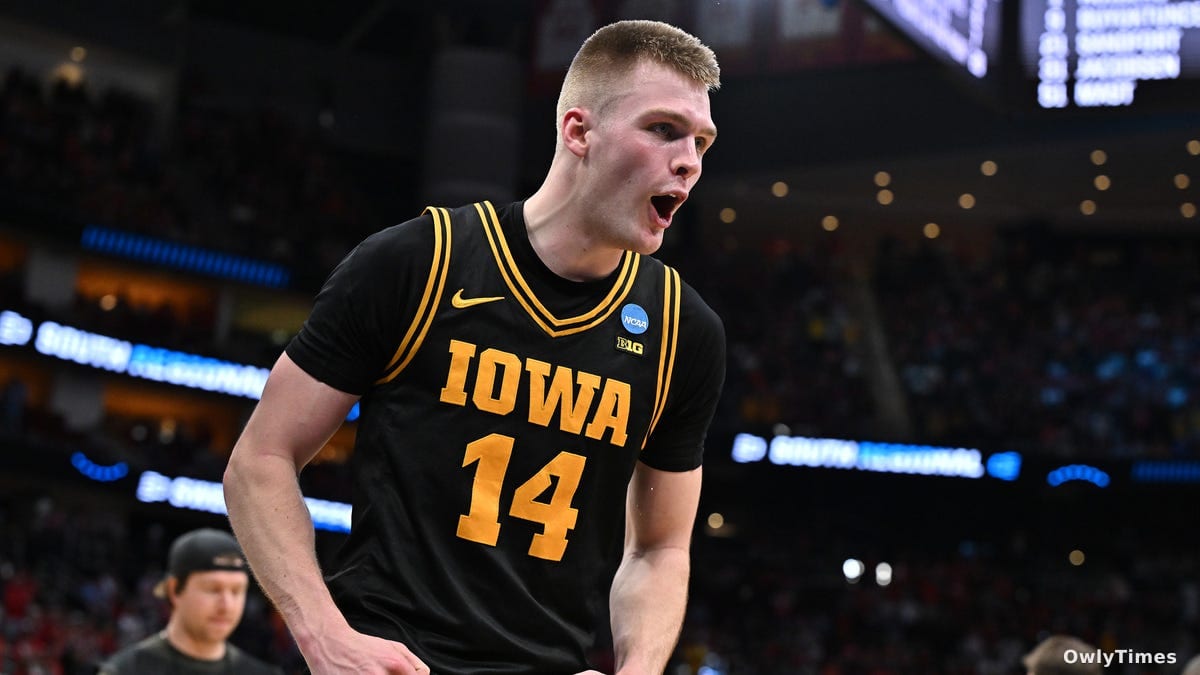

The atmosphere inside the huddle wasn’t just about the next play; it was about the weight of nearly four decades of history. When Alvaro Folgueiras let fly that corner three-pointer with just 4.5 seconds remaining against Florida, he wasn’t just sinking a basket—he was shattering a 27-year-old psychological ceiling. As the ball swished through the net to secure a 73-72 upset, the collective exhale from the Hawkeye faithful felt like a decade’s worth of pent-up ambition finally finding release. It is a moment that now sits in the hallowed halls of University of Iowa lore, resting comfortably alongside the iconic shots of Steve Waite and Kevin Gamble.
As the calendar rolls into mid-May, the 2025-26 academic year stands as a rare, shimmering outlier in the annals of Iowa athletics. For the first time in 38 years, the university saw its football, men’s basketball, and women’s basketball programs all finish ranked in the top 20 simultaneously. It is a statistical anomaly that hasn't been mirrored since 1987-88, a period when the expectations were fundamentally different. Beyond the final rankings—with Kirk Ferentz’s football team landing at 17th, Jan Jensen’s women’s squad at 16th, and Ben McCollum’s men at 15th—lies a story of profound cultural restoration at a campus that had grown weary of its own status quo.
The Architect of a New Hawkeye Identity
The arrival of Ben McCollum signaled a definitive shift in the men’s basketball program, one that moved away from the apathy that had settled over Carver-Hawkeye Arena in the final years of the previous coaching regime. The narrative arc of his first season wasn't defined by the blowout wins, but by the deliberate effort to reconnect with the student body. When fans stormed the court following a 57-52 victory over Nebraska on February 17, it wasn't just about the standings; it was a physical manifestation of a fan base choosing to believe again. This wasn't just about wins; it was about the intentional, daily labor of players bumping fists and engaging with the crowd, building a reservoir of goodwill that sustained them through their eventual run to the program’s first Elite Eight since 1987.
Grit and the Art of the Overachiever
While the men’s program focused on revival, the women’s basketball team became the embodiment of the "blue-collar blue-blood" ethos. Navigating a season that saw them limited in numbers following Taylor McCabe’s ACL tear in late January, the Hawkeyes leaned on an unlikely, gritty chemistry. The emergence of Ava Heiden, who exploded from a freshman reserve to a first-team All-Big Ten star, underscored a broader trend of internal development. Her 27-point performance against Nebraska on Presidents Day wasn't just a box-score entry; it was the moment the ceiling for this team shifted. They weren't predicted to finish in the conference's top five, yet they managed six total top-15 wins, proving that tactical discipline can often outpace preseason projections.
The Cost and Reward of Excellence
Football, too, underwent a metamorphosis. The image of Kirk Ferentz being doused with an orange sports drink after reaching 206 Big Ten wins—a mark that eclipsed Woody Hayes—was the season's ceremonial high, even as NCAA administrative penalties later adjusted his record to 209-128. Yet, the real story was the evolution of an offense that had long been criticized for its stagnation. Watching Mark Gronowski execute a high-stakes, bootleg keeper against Penn State—a play call pulled from the archives and hidden away for months—spoke to a new era where the Hawkeyes were finally demanding to be the reason they won, rather than relying solely on the defensive wall.
As the program looks toward the future, the integration of high-level recruits like McKenna Woliczko—who notably opted for Iowa over South Carolina—suggests that this year of overachievement was not a fluke, but a foundation. The next reading of the roster’s depth and the sustained engagement of the Carver-Hawkeye Arena crowd will determine whether this 2025-26 surge was a singular historic anomaly or the new baseline for a program that has spent the last year reminding everyone why it belongs in the national conversation.

