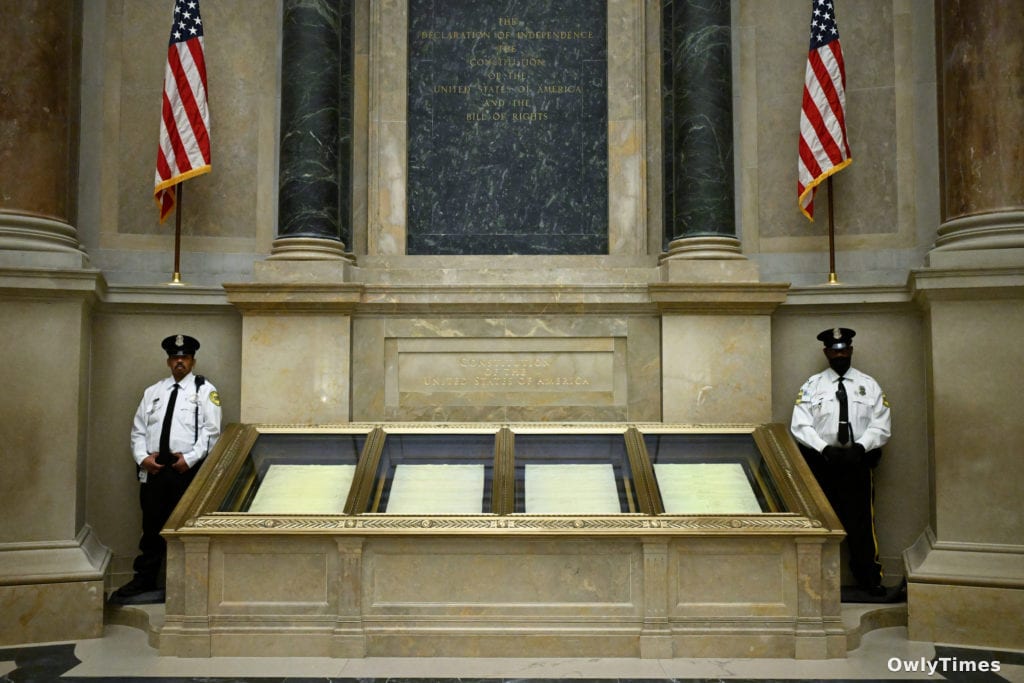

The deployment of historically significant American documents across the country via the “Freedom Plane” isn’t simply a patriotic commemoration; it’s a calculated effort to reassert national identity and project a specific narrative of American history ahead of a potentially contentious election year. While presented as a non-partisan celebration of the nation’s 250th anniversary, the dual-track planning – a congressionally chartered “America 250” commission alongside a White House-led “Freedom 250” initiative – reveals a power struggle for control of the historical narrative and, by extension, the political messaging surrounding it. The very act of removing these artifacts from the heavily guarded National Archives, traditionally symbols of institutional authority, and placing them in “the heartland,” as described by Matt Naylor, president of the National WWI Museum and Memorial, is a deliberate attempt to bypass established gatekeepers and connect directly with a broader electorate.
The choice of documents is itself telling. The 1783 Treaty of Paris, the 1774 Articles of Association, and a draft of the Constitution – all foundational texts – emphasize themes of unity, revolution, and the establishment of a governing framework. This isn’t a random selection; it’s a curated presentation of American origins designed to resonate with a specific understanding of national purpose. Jim Byron, senior advisor to the acting archivist, frames the initiative as inspiring through “tangible history,” but inspiration is rarely neutral. It’s directed, shaped by the context in which it’s presented. The inclusion of items like handwritten notes on the Constitution suggests an emphasis on the process of nation-building, potentially downplaying the compromises and inherent contradictions within the founding documents themselves – a tactic frequently employed in appeals to national pride.
This article draws on reporting from PBS.
This strategy echoes historical precedents, most notably the “American Freedom Train” of 1975-1976. That bicentennial tour, while also aiming to inspire patriotism, included a far broader range of artifacts, from pop culture icons like Judy Garland’s dress to athletic achievements like Jesse Owens’ Olympic medals. The current focus on core founding documents signals a more pointedly political intent. The Freedom Train operated in a period of post-Watergate national introspection; the Freedom Plane launches during a period of heightened polarization and a contested understanding of American values. The 1975 tour aimed to unite a fractured nation through shared cultural touchstones; the 2026 initiative appears geared towards reinforcing a particular vision of American identity.
The overlapping jurisdictions of “America 250” and “Freedom 250” are not merely bureaucratic redundancy. They represent a direct contest for influence. Reports of pressure on the Smithsonian, as highlighted by the Associated Press, to showcase plans for exhibits to President Trump, underscore the administration’s desire to control the narrative. The announced “Patriot Games” sporting event – a high school athletic competition culminating in a UFC fight at the White House – further illustrates this strategy. It’s a deliberate attempt to inject a populist, nationalistic fervor into the commemoration, appealing directly to a base of support and framing the anniversary within a broader political agenda. The sheer scale of planned activities, including a “Great American State Fair,” suggests a desire to overwhelm the public with displays of national pride, potentially preempting critical examination of the nation’s complex history.
Who benefits and who loses from this carefully orchestrated commemoration? The Trump administration clearly benefits from controlling the narrative and leveraging the anniversary for political gain. Conservative constituencies likely to respond positively to a strong, nationalistic message also stand to benefit. The National Archives, while ostensibly participating, risks being perceived as a tool of political messaging, potentially eroding public trust in its role as a neutral custodian of history. Those advocating for a more nuanced and critical examination of American history – acknowledging the legacies of slavery, inequality, and systemic injustice – risk being marginalized. The early enthusiasm demonstrated by schools booking visits, as reported by Naylor, suggests a receptive audience, but it also raises questions about the extent to which diverse perspectives will be included in the accompanying educational materials and discussions. The political chess move to watch next is whether the congressionally chartered “America 250” commission will successfully assert its independence and offer a counter-narrative to the White House’s “Freedom 250” initiative, or whether the latter will effectively dominate the national conversation leading up to July 4th, 2026.





