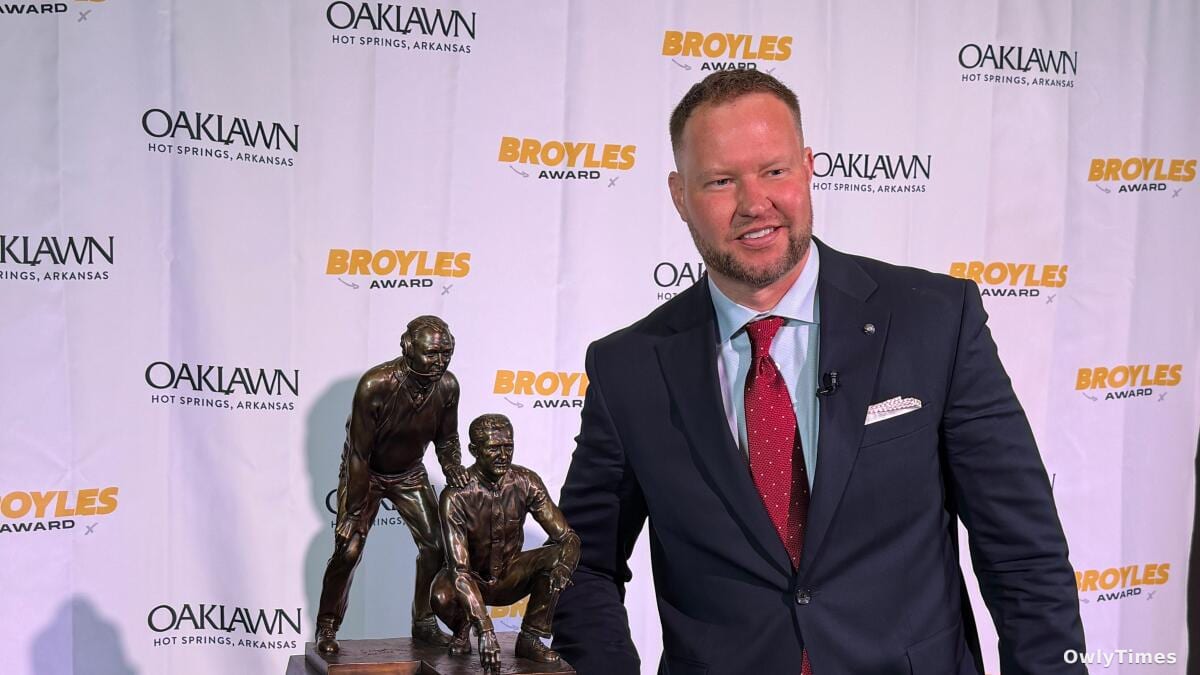

The champagne hadn’t even fully dried on the Indiana Hoosiers’ national championship banner when Bryant Haines was already dissecting film. It was Valentine’s Day weekend in Hot Springs, Arkansas, and he was a guest of honor at the Broyles Award ceremony, a celebration of the nation’s top assistant coaches. But even amidst the accolades, the newly minted award winner – a year after prematurely announcing his family’s biggest news on that very stage – was fixated on the second half against Miami, haunted by 10 yards per rush. This isn’t a story about a coach basking in glory; it’s about a man seemingly allergic to it, a portrait of a winning mentality so deeply ingrained it borders on the surreal.
A Season Beyond Belief: From Losingest to Champions
Indiana football wasn’t supposed to be here. Before the 2023-24 season, the program held the dubious distinction of being the losingest in college football history. Then came Curt Cignetti, and with him, Bryant Haines, his defensive coordinator and now Broyles Award recipient. The Hoosiers didn’t just win; they dominated, finishing with a perfect 16-0 record. To put that in perspective, Indiana hadn’t had a winning season since 2019, and hadn’t reached 10 wins since 1987. This wasn’t a gradual climb; it was an avalanche, a disruption of the established order that left even Haines struggling to process. “A moment will hit me where I feel like, man, we did do something really unique and special, but I honestly think that the full totality of what we did won't truly settle in for a year,” he admitted to the crowd last week. The sheer improbability of it all – a team built on relentless preparation and a refusal to dwell on past failures – is what makes this story resonate far beyond the gridiron.
Based on the original CBS Sports report.
The Price of Loyalty in a Transfer-Heavy Era
Haines’s story isn’t just about football strategy; it’s a quiet rebellion against the current landscape of college athletics. While the transfer portal churns and coaches chase the next big payday, Haines signed a three-year, $9.3 million contract to stay with Cignetti, becoming the highest-paid assistant coach in the nation. In an era where loyalty feels like a relic, Haines openly embraces it. “One, there's a lot of money involved now. Two, I still believe in loyalty,” he stated. This isn’t simply about financial security, though the contract is significant. It’s about a shared philosophy, a trust built over years of consistent success – a 108-28 record alongside Cignetti since 2014. Haines isn’t chasing head coaching opportunities; he’s content refining his craft, obsessing over “X’s and O’s” and “attack plans.” This commitment to the process, to the team, feels almost radical in a sport increasingly driven by individual ambition.
The Broyles Award: A Stepping Stone or a Destination?
The Broyles Award isn’t just a trophy; it’s a launching pad. Nineteen of the 30 previous winners have gone on to become head coaches, and Haines has already fielded interest from other programs. But he’s resisting the pull, choosing stability and a proven system over the uncertainty of leading his own team. This decision speaks volumes about his priorities. He’s not driven by ego or the desire for recognition; he’s driven by the challenge of building a dominant defense, of outsmarting opponents, of perfecting his craft. The fact that he revealed his wife, Kira’s, pregnancy on the Broyles Award stage last year – a moment of pure, unscripted joy – underscores this point. It wasn’t about him; it was about sharing his life with the people he respected. Returning this year, hoisting the 70-pound award with Kira and their seven-month-old daughter, Grace (who, Haines proudly declared, is “16-0” in life), felt less like a culmination and more like a continuation.
Beyond the Headlines: What Does Sustained Success Look Like?
The Indiana Hoosiers’ story is a powerful reminder that winning isn’t just about talent; it’s about culture, loyalty, and a relentless focus on the process. Haines’s refusal to get caught up in the hype, his immediate return to film study even during a celebratory weekend, is emblematic of this approach. But the real question now is whether Indiana can sustain this success. Can Cignetti and Haines replicate their formula in the face of increased expectations and the ever-present threat of the transfer portal? Will Haines remain committed to his coordinator role, or will the lure of a head coaching position eventually prove too strong? The college football landscape is constantly shifting, and Indiana’s improbable run has raised the stakes. We’ll be watching closely to see if the Hoosiers can defy the odds once again, and whether Bryant Haines will continue to prioritize the pursuit of perfection over the pursuit of power.