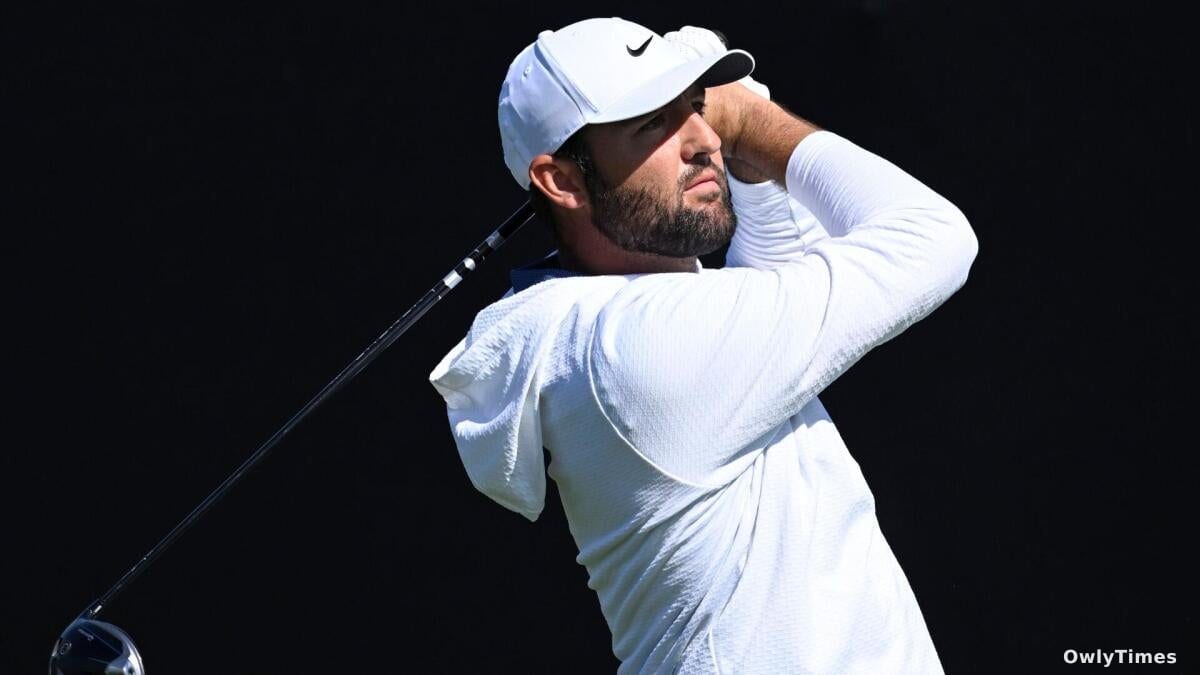

The air in Houston hung thick and humid even for early April, the kind of oppressive heat that clings to you like a second skin. It wasn’t the heat of the Masters looming just around the corner, but a distinctly Texan warmth, amplified by the buzz surrounding Scottie Scheffler’s return to his home state for the 2026 Houston Open at Memorial Park Golf Course. But beneath the surface of the expected Scheffler coronation, a quiet disruption is brewing – one powered not by a star’s charisma, but by an algorithm’s cold, calculated predictions. This isn’t just about who will win a golf tournament; it’s a microcosm of how data is reshaping our understanding of skill, chance, and the very nature of competition.
The odds paint a predictable picture: Scheffler at a commanding +350, a testament to his current dominance. Only defending champion Min Woo Lee (+1500) offers a remotely competitive number, while established names like Sam Burns (+2700) and a returning Brooks Koepka (+2700) trail behind. But the narrative shifts dramatically when you consider the simulations run by SportsLine’s proprietary model, spearheaded by DFS pro Mike McClure. This isn’t a gut feeling or a pundit’s hunch; it’s the result of 10,000 simulated tournaments, a digital echo of every possible outcome. And the echo is saying something surprising: Lee, the defending champ, isn’t even projected to finish in the top five.
This isn’t simply a contrarian take for clicks. McClure’s model has a proven track record, having correctly predicted 16 major championships entering the weekend, including a remarkable four consecutive Masters victories. In a sport steeped in tradition and reliant on subjective assessment, the model’s success forces a reckoning. Are we too quick to rely on reputation and current form, overlooking subtle statistical advantages that a computer can identify? The Houston Open, traditionally a warm-up for Augusta, is becoming a testing ground for a new kind of golf analysis. The model is also highlighting Nicolai Hojgaard (+3300) as a top-three contender, a pick that flies in the face of his recent struggles at The Players Championship. This isn’t about dismissing a bad week, but about recognizing a pattern of consistent performance elsewhere – a nuance easily lost in the immediate aftermath of a disappointing finish.
Original reporting: CBS Sports.
The rise of predictive analytics in golf isn’t new, but its influence is accelerating. Daily Fantasy Sports (DFS) platforms like FanDuel and DraftKings, where millions are wagered based on projected scores, have fueled the demand for sophisticated modeling. The fact that new users are being enticed with promotions like $200 in bonus bets from DraftKings and up to $300 back in bonus bets for 10 days from FanDuel underscores the industry’s investment in attracting data-driven players. But the implications extend beyond the financial realm. It’s changing how players prepare, how coaches strategize, and how fans consume the game. The model is even identifying potential longshots – players going off at +4000 or higher – who could make a significant run, including a staggering +6000 underdog. This isn’t about picking winners; it’s about identifying value, about recognizing that in a game of probabilities, even the longest odds aren’t zero.
The Houston Open, then, is more than just a prelude to the Masters. It’s a bellwether for the future of golf, a moment where the human element – the pressure, the intuition, the sheer will to win – is being challenged by the relentless logic of algorithms. Will Scheffler validate his status as the overwhelming favorite? Or will the model’s surprising predictions come to fruition, revealing hidden potential and disrupting the established order? The question isn’t just who will lift the trophy on Sunday, but whether we’re ready to embrace a future where the most accurate predictions come not from a seasoned commentator, but from a machine learning to see the game in a way we can’t. And as more and more money flows into data analytics, will the advantage shift irrevocably towards those who can decipher the code, potentially leveling the playing field – or further widening the gap between the haves and have-nots in professional golf?

