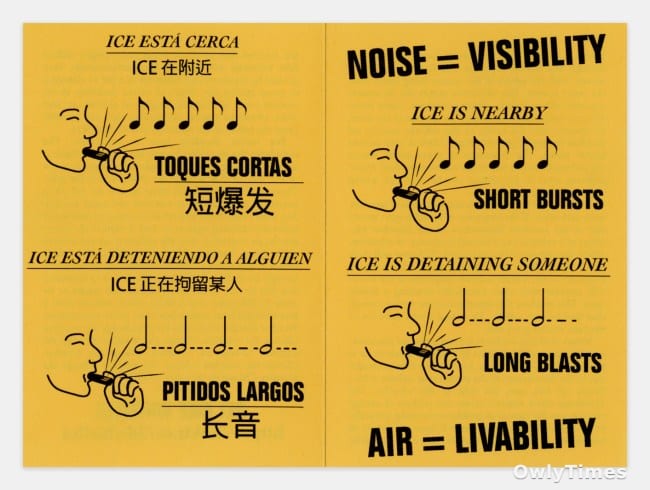

The emergence of a decentralized, 3D-printed whistle network represents a calculated shift in how civilian populations respond to state-led enforcement operations. By leveraging low-cost, distributed manufacturing, activists have effectively gamified the surveillance environment, forcing federal agencies to operate within a landscape where their movements are audibly tracked and broadcast in real-time. This is not merely an act of protest; it is a tactical reconfiguration of urban space designed to neutralize the element of surprise that Immigration and Customs Enforcement (ICE) relies upon to execute detentions.
The Calculus of Audible Resistance
The strategic motivation behind this mobilization is rooted in the "Whistle Crew," a loose collective organized by Dan Sinker. Since the initial surge of activity in January 2026 during the siege of Minneapolis, the network has focused on creating a standardized acoustic warning system. The distribution of over one million whistles to cities including Minneapolis, Portland, and Los Angeles indicates a sophisticated logistical operation that bypasses traditional supply chains.
Who benefits from this arrangement? The immediate beneficiaries are the communities targeted for detention, who gain precious minutes to disperse or seek safety. Conversely, the primary loser in this dynamic is the federal enforcement apparatus, which now finds its operational efficiency degraded by the very communities it seeks to monitor. Much like the use of signal fires in historical military maneuvers, the whistle acts as a low-tech, high-reliability communication node that resists digital surveillance or signal jamming.
Manufacturing Dissent in Brooklyn
The impact of this effort is visible in local economies of resistance, particularly in New York. Near his Brooklyn studio, artist Paul Chan has documented multiple raids on an industrial building since the start of 2026, as well as the detention of at least four fathers at a local public high school. By integrating these whistles into the institutional setting of Greene Naftali—where visitors can obtain them at the front desk—Chan has successfully blurred the line between aesthetic practice and tactical tool.
The production of these plastic devices, each measuring approximately 1 1⁄2 × 1⁄2 × 1⁄2″, relies on a "ragtag" coalition of mechanical engineers, cosplayers, and romance authors. This diversity of participants creates a resilience that is difficult for authorities to disrupt; there is no single factory to shut down and no centralized database to subpoena. The reliance on additive manufacturing—3D printing—allows the supply to scale rapidly in response to spikes in enforcement activity, ensuring that the "Whistle Crew" remains ahead of the federal deployment curve.
The Limits of Acoustic Defense
The tension here lies in the contradiction between the state’s desire for absolute control and the population’s ability to generate friction through noise. While the whistle network provides a vital early-warning system, it also highlights the precariousness of life in cities where the sound of a plastic whistle has become a "lingua franca." The presence of these whistles in major art institutions, such as the Hirshhorn Museum and Sculpture Garden where Chan’s work is currently featured, signals a broader cultural integration of these tactical tools.
The next indicator of this movement’s trajectory will be the rate of whistle deployment reported via linktr.ee/3dwhistles. As the federal presence in urban centers continues to evolve, the capacity of this network to sustain its supply chain will determine whether this acoustic resistance remains a viable long-term strategy for community protection.





