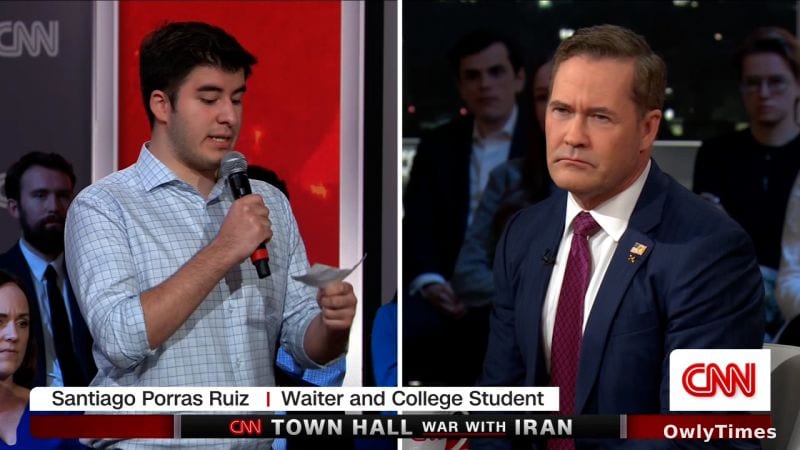

Is anyone actually paying attention to how we’re funding potential war with Iran, or are we all just letting the geopolitical chess pieces distract us from the checkbook? The recent CNN town hall, featuring a pointed question from a New York student to United States Ambassador to the United Nations Mike Waltz, isn’t just about escalating tensions in the Middle East – it’s about a fundamental disconnect between Washington’s foreign policy and the financial realities faced by everyday Americans. The real story here isn't the strategic implications of conflict with Iran—it's the quiet erosion of public trust when the cost of distant battles lands squarely on the shoulders of those least equipped to bear it.
The exchange, highlighted by CNN, saw the student directly ask Ambassador Waltz how a war “half a world away” could possibly benefit someone working a restaurant job and attending college in New York. It’s a brutally honest question, one that cuts through the usual rhetoric of national security and strategic interests. While Ambassador Waltz offered standard talking points about protecting global shipping lanes and deterring aggression, the underlying anxiety remains: who ultimately pays for these interventions? The answer, predictably, is us. A recent estimate suggests a potential conflict with Iran could easily exceed $200 billion, a figure currently being debated – and largely approved – by GOP lawmakers, as CNN reported. That’s not abstract economic policy; that’s potentially $200 billion diverted from infrastructure, education, or, yes, student loan forgiveness.
This isn’t a new phenomenon, of course. The post-9/11 wars in Iraq and Afghanistan, estimated to have cost upwards of $8 trillion, were often framed as necessary evils. But the long-term consequences – the national debt, the social costs of veteran care, the opportunity cost of investing in domestic priorities – were rarely front and center in the public discourse. What’s different now is the growing awareness, particularly among younger generations, that these conflicts aren’t fought in a vacuum. They’re funded by taxes, by cuts to social programs, and by a future mortgaged to pay for past decisions. The student’s question wasn’t hostile; it was a demand for accountability. It was a challenge to the assumption that national security automatically trumps economic well-being.
The current administration’s approach further complicates matters. The easing of sanctions on Iranian oil, described by Ambassador Waltz as “very temporary,” feels less like a strategic maneuver and more like a desperate attempt to stabilize global oil prices – a move that ultimately benefits consumers at the pump, but also potentially funds the very regime the US claims to oppose. This inherent contradiction highlights a larger truth: foreign policy is rarely clean or simple. It’s a messy web of competing interests, unintended consequences, and political compromises. And the public, often left in the dark, is expected to foot the bill without a clear understanding of the rationale. The fact that President Trump recently lashed out at NATO allies for their reluctance to contribute more to defense spending, as reported by CNN, underscores the US’s disproportionate burden in global security.
Reporting from CNN informs this analysis.
The media’s coverage, while extensive, often falls into the trap of focusing on the geopolitical drama – the troop deployments, the diplomatic negotiations, the potential for escalation. Less attention is paid to the economic implications for the average American. We hear about the potential for cyberattacks and disruptions to global trade, but rarely about how these disruptions will translate into higher prices at the grocery store or job losses in specific sectors. This isn’t a deliberate omission; it’s a reflection of the inherent bias towards covering events that are perceived as “newsworthy” – and a war with Iran certainly qualifies. But it’s a bias that ultimately serves to obscure the true cost of conflict.
Looking ahead, expect to see this tension – between geopolitical ambition and economic reality – intensify. The $200 billion price tag for a potential war with Iran isn’t a one-time expense. It’s a down payment on a decades-long commitment, a commitment that will require ongoing funding, political will, and a willingness to accept the inevitable consequences. The question isn’t whether we can afford a war with Iran, but whether we’re willing to honestly assess the true cost – and whether the benefits, however defined, outweigh the sacrifices demanded of ordinary Americans. Watch closely for the next round of budget negotiations; the real battle won’t be over military strategy, but over who ultimately pays for it.





