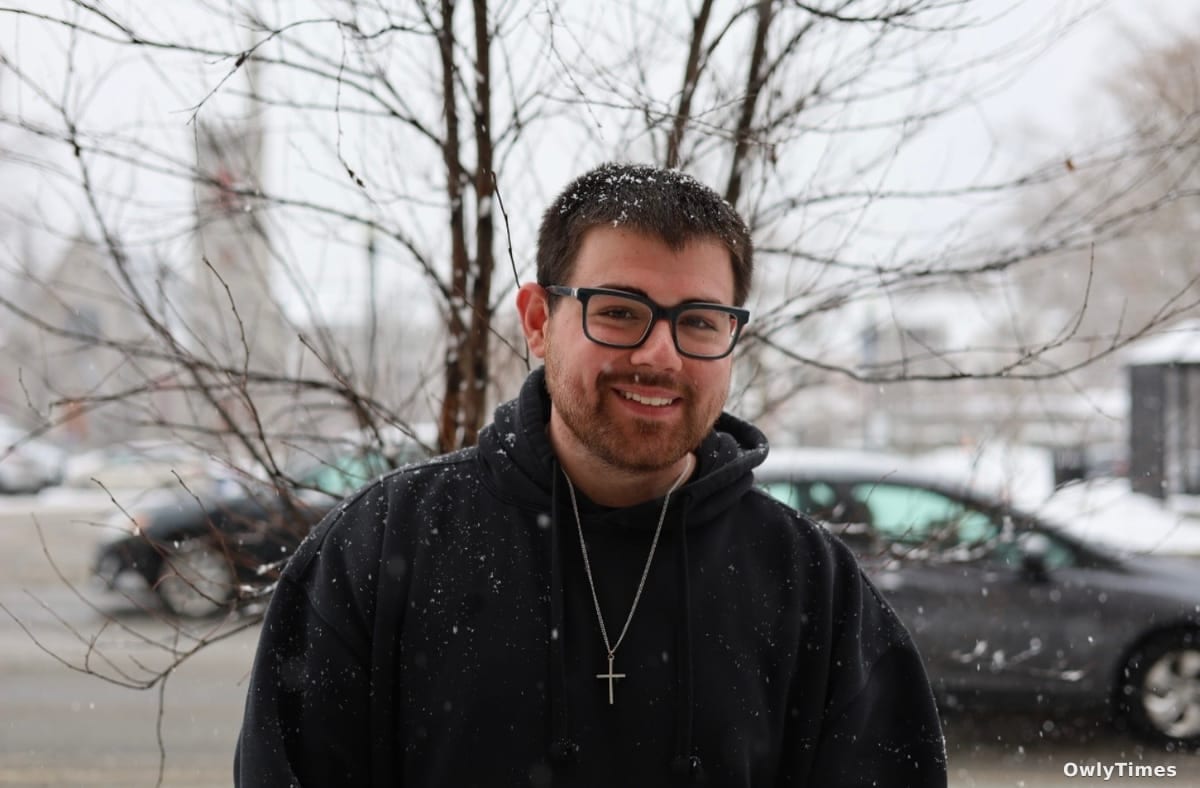

Campus politics often mirrors the macro-political sphere, where leaders must choose between performative activism and transactional diplomacy. For Shane Dillon '26, the outgoing president of the Association of Amherst Students (AAS), the strategic calculus has always favored the latter. Rather than positioning the student government as an ideological adversary to the college administration, Dillon treated his various offices as a laboratory for quiet negotiation, leveraging insider relationships to reshape policy from within.
The Insider-Diplomat Model of Student Power
This calculated approach to power became clear during Dillon's early clashes with the administration. When a dispute arose over a White-Out Rave poster during his freshman year, it served as the entry point for a long-term partnership with Angie Tissi-Gassoway, the vice president for student affairs and dean of students. Instead of launching a public campaign against the administration's mandatory Brief Alcohol Screening and Intervention for College Students (BASICS) training, Dillon took his grievances directly to the negotiating table. He challenged the structural logic of the program, successfully brokering compromises that shifted the policy's operation toward health and counseling centers rather than purely disciplinary channels.
In this framework of insider negotiation, the question of who benefits and who loses becomes paramount. The administration benefits by co-opting a charismatic student leader into a collaborative feedback loop, gaining a reliable interlocutor who can "discern student culture" before unrest boils over. Dillon, too, benefits, establishing himself as an indispensable power broker who can deliver concrete, incremental policy adjustments. However, the losers in this equation are often the broader, more radical elements of the student body. By keeping negotiations behind closed doors, the public friction that often drives rapid, systemic institutional change is neutralized in favor of slow, administrative compromises.
The Campaign Machine and State-Level Ambitions
Dillon’s political instincts were not forged in a vacuum, but rather on the campaign trails of western Massachusetts. According to The Amherst Student's profile, Dillon's entry into political organizing began in high school with an internship for Springfield mayor Dominic J. Sarno and work for Congressman Richard Neal. The true test of his strategic capacity came when city council candidate Zaida Govan tapped him to serve as her sole campaign manager, a massive responsibility for a high school student that ultimately yielded a victorious campaign.
This success propelled Dillon into state-level politics. In the summer of 2022, he ran the social media campaign in Hamden County for Maura Healey's gubernatorial bid. Healey’s historic run as the first openly lesbian nominee for governor of Massachusetts—alongside Oregon's Tina Kotek—served as a profound personal catalyst for Dillon, prompting him to publicly embrace his own queer identity. The relationship matured from volunteer work to direct executive access; after writing a personal letter to Healey, Dillon received a direct phone call from her while standing in his robe in North Residence Hall during Amherst’s Summer Bridge Program. By 2024, Dillon was officially sworn into Healey’s Youth Advisory Council, cementing his role as a key youthful stakeholder in her administration's orbit.
The Contradictions of the Public and Private Worlds
Yet, Dillon’s political trajectory contains a striking structural contradiction. Despite spending four years climbing the ranks of the AAS—serving as a senator in his freshman and junior years, vice president as a sophomore, and president as a senior—he claims he has no intention of running for public office in the future. Dillon notes that the primary academic lesson he took from Amherst College is the stark divide between the public and private worlds. In his view, public politicians are merely leaves on a larger grapevine, forced to sell their souls to private institutions.
This tension reveals a classic political parallel. Much like the backroom party bosses of the early 20th century who eschewed the ballot box to pull the levers of power from the shadows, Dillon prefers the role of the campaign manager over the candidate. He openly admits he wants to be the strategist behind the scenes, steering campaigns and driving policy changes without the vulnerability of public scrutiny. It is a pragmatic assessment of modern American governance: real power often lies not with the face on the poster, but with the hand that coordinates the ground game.
The Next Political Chess Move
As Dillon prepares to exit the campus stage, the immediate political transition at Amherst is already underway. On Feb. 15, 2025, Dillon quietly signaled the passing of the torch to the next generation of AAS leaders, offering an early, confidential congratulations to candidate Joey Supik in a Valentine Dining Hall booth a day before the official election results were made public. Dillon’s departure will test whether his cooperative, relationship-driven model of student governance can survive without his personal diplomatic touch.
The final metric of Dillon’s immediate legacy, however, will play out on a highly visible stage. The political chess move to watch next is this year's Amherst commencement ceremony. There, Dillon’s high school guidance counselor and long-time mentor, Addison Stoddard—the educator who first placed Amherst on his radar—is scheduled to receive the prestigious Phebe and Zepheniah Swift Moore Teaching Award. How the student body and administration interact during this highly structured transition will serve as the first real reading of whether Dillon’s four-year project to bridge the emotional and policy divides at Amherst has left a lasting institutional footprint, or if campus politics will slip back into a state of friction.





