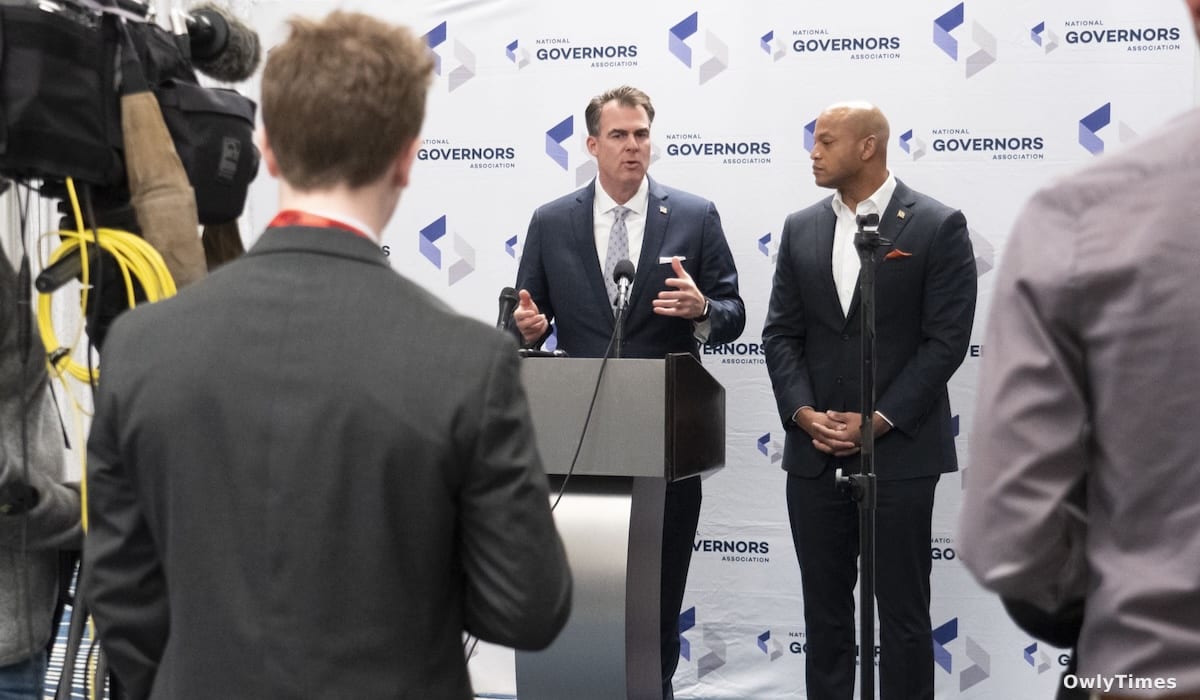

The strategic calculation at play during last week’s National Governors Association (NGA) Winter Meeting wasn’t about policy breakthroughs, but about positioning. Kevin Stitt, Governor of Oklahoma and current NGA chair, leveraged the platform – and the freedom of a looming term limit – to signal a shift in power dynamics within the Association and, more broadly, within the fractured landscape of American federalism. Stitt’s candor about the “disgusting” realities of political maneuvering, delivered alongside Wes Moore of Maryland, wasn’t a spontaneous outburst; it was a calculated move to establish himself as a voice for pragmatic governance unburdened by electoral pressures, a contrast to the increasingly polarized national climate.
The core of this shift lies in a simple equation: who benefits and who loses from a de-emphasis on partisan loyalty? Stitt benefits directly. With one year remaining in his final term, he’s freed from the constraints of fundraising and appeasing primary voters, allowing him to advocate for policies based on Oklahoma’s needs rather than national Republican orthodoxy. Moore, as the incoming NGA vice chairman, also stands to gain, positioning himself as a leader capable of bridging divides. Those who lose are the national party apparatuses – both Republican and Democrat – that rely on governors to toe the line and reinforce existing narratives. The brief disruption caused by the White House’s initial invitation list, reportedly based on party affiliation, underscores this tension. President Trump’s early departure from the breakfast meeting following the Supreme Court ruling on tariffs further highlighted the competing priorities at play – national political theater versus state-level economic concerns.
Based on the original nondoc.com report.
The NGA meeting, themed “Reigniting the American Dream,” explicitly prioritized state-driven economic successes and government oversight, a subtle rebuke of federal overreach. This echoes a historical pattern: periods of national political gridlock often see a resurgence of state power. The 1980s, under President Reagan, witnessed a similar dynamic, with states taking the lead on issues like welfare reform and environmental regulation as the federal government pursued a more limited role. Stitt’s emphasis on energy independence and affordable electricity for Oklahomans – “most Americans just want to take their kids to piano lessons” – is a direct appeal to this sentiment, framing policy through the lens of constituent needs rather than ideological purity. This isn’t a rejection of federal involvement entirely, but a demand for a more collaborative, less prescriptive relationship.
Stitt’s willingness to publicly discuss immigration, specifically advocating for states to control workforce permits, is a particularly revealing example of this newfound freedom. This position challenges both national Republican rhetoric focused on border security and Democratic calls for comprehensive immigration reform, instead prioritizing the immediate economic needs of rural Oklahoma businesses. The fact that he raised this issue during a panel discussion, rather than in a press release tailored for a national audience, suggests a genuine attempt to foster dialogue among his peers. This approach aligns with Wes Moore’s call for a “rational approach to governance,” urging governors to move beyond the “binary system” of red and blue politics.
The data presented by veteran pollster Frank Luntz – that 40 percent of Americans have lost personal relationships over politics – adds a critical layer to this analysis. Luntz’s observation that state-elected officials still hold a majority of public trust is not accidental. Governors, unlike members of Congress or the President, are often seen as more directly accountable to their constituents, less entangled in the national political drama. Stitt’s “car speeding towards the cliff” metaphor encapsulates this frustration: a system obsessed with symbolic battles while ignoring fundamental problems. The question now is whether this sentiment can translate into concrete policy changes, or if it will remain a rhetorical flourish. The political chess move to watch next is how Wes Moore utilizes his incoming chairmanship to build on this momentum – specifically, whether he can translate Stitt’s call for pragmatism into tangible bipartisan initiatives when he assumes the NGA’s leadership in 2027.





