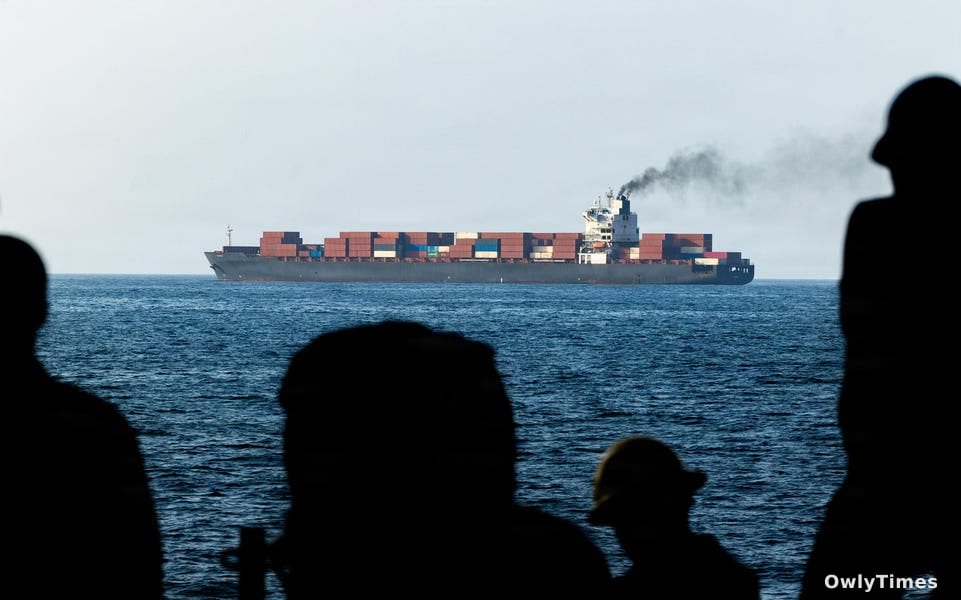

The seizure of the M/V Touska by United States Marines on April 19 represents a pivot from routine sanctions enforcement to the revival of a dormant instrument of naval warfare: prize law. By explicitly citing a blockade breach as the justification for the capture, the U.S. is signaling a strategic shift. The administration is moving beyond the standard administrative penalties used against sanctioned vessels since 2018, opting instead for a legal framework that treats the vessel as a legitimate prize of war. This move is less about the ship itself and more about establishing a precedent for belligerent rights that have remained largely theoretical for 80 years.
The Calculus of Belligerence
The strategic value of invoking prize law lies in the message it sends to neutral commercial shipping. While the U.S. has interdicted other Iran-linked vessels previously, those actions were framed as sanctions enforcement. By escalating the M/V Touska case to a prize law issue, the U.S. creates a high-stakes deterrent. Any ship attempting to reach Iranian ports now faces the prospect of being condemned by a prize court, with title to the ship and its cargo potentially transferring permanently to the U.S. government.
Who benefits and who loses? The U.S. military gains a powerful tool to disrupt supply chains, potentially forcing "flag of convenience" states to reconsider their associations with illicit vessels to avoid the legal scrutiny of a prize tribunal. Conversely, the losers are global shipping insurers and neutral merchant fleets. These entities now face an environment where a vessel’s transit can be legally severed not just by sanctions, but by a formal act of war, significantly increasing the risk profile for maritime commerce in the Arabian Sea.
Historical Precedents and Modern Risks
Prize law has not been formally applied since World War II, a fact that highlights the gravity of this escalation. The legal architecture required to adjudicate these seizures has atrophied; no U.S. prize courts have been established since 1956. This creates a procedural vacuum. If the U.S. proceeds, it must either revive these dormant judicial mechanisms or justify the destruction of the captured property if adjudication becomes impracticable.
The situation is further complicated by the geopolitical optics surrounding the ship’s cargo. President Trump has publicly suggested the vessel was carrying a "gift from China," a claim China has formally rejected. This tension mirrors the broader strategic friction between the two powers. If the U.S. successfully builds the institutional "muscle memory" to enforce prize law against Iranian assets, it effectively creates a blueprint for a future conflict with China, whose massive merchant fleet frequently utilizes dual-use vessels.
The Global Reaction
The ripple effects of this seizure extend far beyond the immediate standoff near the Strait of Hormuz. Iran has already characterized the boarding as "armed piracy," setting the stage for a tit-for-tat escalation. There is a tangible risk that adversaries will mirror this behavior, using the U.S. invocation of prize law as a pretext to justify their own interdictions of U.S.-flagged vessels under similar legal terminology.
The immediate process to monitor is the U.S. military’s next move regarding the vessel’s disposition. While the ship’s current location remains undisclosed, the eventual choice between standard sanctions adjudication and the formation of a prize tribunal will serve as the definitive indicator. The next reading of the U.S. government’s procedural filings in federal court will confirm whether the administration intends to fully operationalize this centuries-old doctrine or if the "prize law" rhetoric is merely a temporary signal of resolve.





