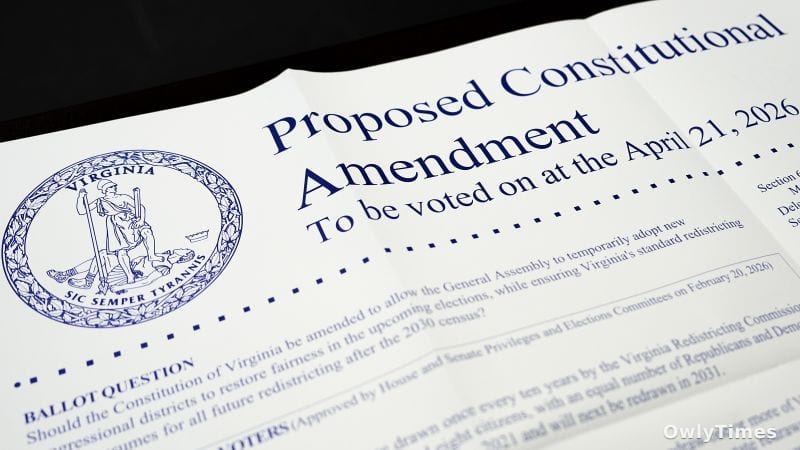

The decision by Democratic officials in Virginia to petition the US Supreme Court on Monday for the reinstatement of a favorable congressional map represents a calculated maneuver in the broader, high-stakes game of electoral advantage ahead of this year's midterm elections. This emergency appeal is not merely a local dispute; it is a strategic attempt to offset a Republican advantage gained through other redistricting efforts, leveraging the nation's highest court as a final arbiter in the intricate dance of partisan line-drawing. The core strategic calculus here is to secure four additional House seats for Democrats, potentially reducing Republican representation in Virginia to a single district, thereby shifting the balance of power in a crucial election year.
Virginia's Map Becomes a National Battleground
The immediate impetus for the Democrats' appeal is a decision by the state Supreme Court last week that nullified an April referendum. This referendum sought to redraw Virginia’s US House map, a move that the Democrats assert would have lawfully delivered those four additional seats. By asking the US Supreme Court to halt that state court order specifically for this year’s midterm election, Democrats, led by Virginia Attorney General Jay Jones, are pushing for an immediate electoral impact. This gambit highlights the "who benefits, who loses" framework distinctly: Democrats stand to gain significant congressional power, while Republicans would see their influence in the state's delegation severely diminished. The Supreme Court of Virginia ruled that the process used to create the referendum violated the state constitution, specifically requiring the General Assembly to vote twice on a proposed constitutional amendment with a general election intervening. Republicans argued that the first vote, taken in late October 2025, was invalid because early voting for the general election was already underway. This procedural dispute, now elevated to the federal level, underscores the granular details upon which electoral fates can hinge.
Redistricting: A Recurring Political Chess Match
This Virginia case arrives as the US Supreme Court is already deeply immersed in a "flood of redistricting" appeals from states across the country, with both major parties aggressively seeking to maximize their advantage in the fall election. Several southern states, in particular, have moved to redraw their maps following a blockbuster decision in late April that severely weakened the scope of the landmark Voting Rights Act of 1965 [ While Virginia's redistricting was not explicitly based on this Voting Rights Act decision, Democrats viewed their efforts as a crucial countermeasure to the electoral advantages Republicans had gained elsewhere. The court's role in these battles is not new, echoing historical struggles over fair representation and the judiciary's often-uncomfortable position in overtly political disputes. For instance, the justices recently approved Alabama's request to use a map enacted in 2023 that includes only one district where Black voters have an opportunity to elect a candidate of their choice, demonstrating the court's direct influence on electoral outcomes.
SCOTUS Under Scrutiny in an Election Year
The Virginia appeal will initially be handled by Chief Justice John Roberts, who oversees emergency appeals from Virginia and other states within the 4th US Circuit Court of Appeals. Roberts has requested a response in the case by Thursday evening, setting a tight deadline that underscores the urgency of these electoral disputes. The Supreme Court itself has become a battleground of internal debate regarding its perceived political impact on the midterms. Liberal Justice Ketanji Brown Jackson recently exchanged sharp words with Justice Samuel Alito over the expedited timeline for Louisiana's map redraw, with Jackson accusing the court of sacrificing "principles" for political influence, a charge Alito dismissed as "insulting." Days later, Roberts publicly lamented what he described as a widespread misunderstanding of the court's work as political, asserting, "People think we’re making policy decisions... I think they view us as truly political actors, which I don’t think is an accurate understanding of what we do." This tension between the court's asserted non-partisanship and its undeniable role in shaping political outcomes is central to understanding the current redistricting landscape.
The Democrats' argument to the Supreme Court frames the Supreme Court of Virginia's decision as causing "profound and immediate" irreparable harm, asserting it has "deprived voters, candidates, and the commonwealth of their right to the lawfully enacted congressional districts." This plea, however, faces an uphill battle, as the state court's ruling was based on state, not federal, law. The next political chess move to watch is Chief Justice Roberts' initial disposition of the emergency appeal, particularly as the Thursday evening deadline for a response looms. His handling will signal whether the Supreme Court intends to wade further into state-level redistricting disputes based on interpretations of state constitutional processes, or if it will maintain a more hands-off approach, allowing the state Supreme Court's ruling to stand. The court's broader trajectory in this flood of redistricting cases will continue to define the electoral playing field for the upcoming midterms and beyond.





