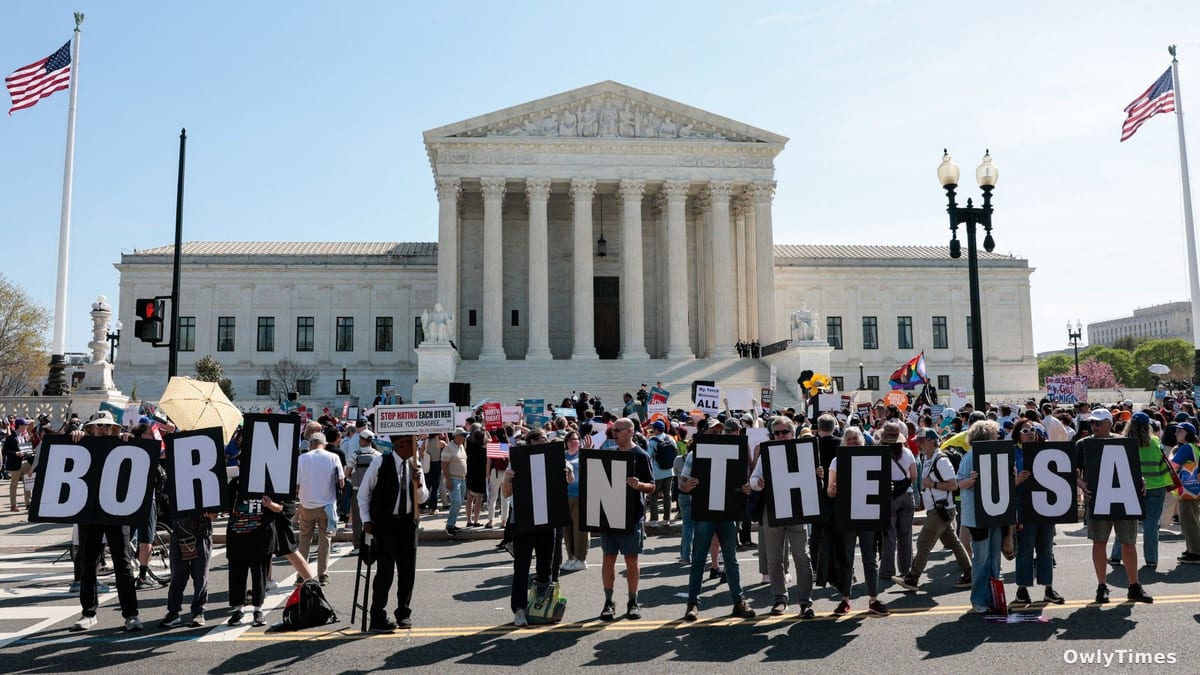

250,000 Potential Non-Citizens: The Economic Ripple of a Supreme Court Shift
A figure of 250,000 hangs in the balance as the Supreme Court weighs the constitutionality of President Trump’s executive order challenging birthright citizenship. This isn’t merely a legal debate; it’s a potential economic disruption with implications stretching from labor markets to social security contributions, and a clear demonstration of how legal challenges can translate into quantifiable financial consequences. The case, Trump v. Barbara, alongside Watson v. RNC, reveals a strategic effort to redefine fundamental aspects of American citizenship, and the financial implications are only beginning to be understood.
Source material: theweek.com.
The core of the dispute centers on the 14th Amendment’s citizenship clause – “All persons born or naturalized in the United States, and subject to the jurisdiction thereof, are citizens of the United States.” For over a century, this has been interpreted to grant birthright citizenship to nearly everyone, barring children of diplomats or invading forces. President Trump’s 2020 executive order attempts to narrow this definition, requiring proof of parental citizenship or permanent residency. Every lower court has struck down the order, yet the case reached the Supreme Court, fueled by a conservative legal strategy and, notably, the unprecedented personal attendance of President Trump during oral arguments. This move, described by the New York Times as adding “drama” to an “emotionally charged” session, underscores the political weight attached to the outcome.
The potential denial of citizenship to 250,000 newborns annually isn’t an abstract number. Consider the long-term economic impact. These individuals, if denied citizenship, would likely face limited access to education, employment, and healthcare, effectively reducing their potential lifetime earnings. A 2018 study by the Center for American Progress estimated that denying citizenship to children of undocumented immigrants would reduce U.S. GDP by $2.2 billion over their lifetimes. This loss isn’t evenly distributed; industries reliant on lower-wage labor, such as agriculture and construction, would likely experience the most immediate impact. Furthermore, these individuals contribute to Social Security and Medicare through payroll taxes, even if they are not eligible for full benefits – a loss of revenue the system would need to absorb.
Parallel to the birthright citizenship case, Watson v. RNC highlights a different, but related, attempt to restrict voting access. The Republican National Committee is challenging a 2020 Mississippi law allowing votes postmarked by Election Day to be counted if received within five days. While seemingly focused on election integrity, the case raises concerns about suppressing voter turnout, particularly among demographics with limited access to traditional voting methods. The potential economic consequence here is less direct, but significant. Reduced voter participation can lead to policies that don’t accurately reflect the needs of the population, potentially hindering economic growth and exacerbating inequality. The fact that the court’s conservative majority appears poised to strike down the Mississippi law, while simultaneously entertaining arguments against birthright citizenship, reveals a clear pattern: a focus on restricting access to the rights and benefits of citizenship.
The legal argument hinges on the interpretation of “domiciled,” a term rooted in the 1898 Wong Kim Ark case. Sauer, representing the administration, argues that undocumented immigrants and temporary visitors are not “domiciled” and therefore their children aren’t citizens. This argument, if accepted, would effectively rewrite over a century of legal precedent. However, the historical context of Wong Kim Ark is crucial: Wong’s parents were legal U.S. residents. Applying that precedent to undocumented immigrants represents a significant departure, and one that several justices, including Chief Justice Roberts, appeared to question during oral arguments. The potential ramifications extend beyond undocumented immigrants, as highlighted by Scott Titshaw and Stephen Yale-Loehr in The Hill, potentially impacting children of same-sex couples and those born through surrogacy.
What this means for your wallet: anticipate increased uncertainty in labor markets if birthright citizenship is curtailed. Businesses reliant on a stable workforce, particularly in sectors like agriculture and construction, may face increased labor costs and supply chain disruptions. More broadly, the ongoing legal battles surrounding citizenship and voting rights signal a potential shift in the social contract, one that could lead to increased social unrest and economic instability. Investors should watch for companies with significant exposure to these vulnerable demographics and assess their risk profiles accordingly. The question isn’t simply if the court will uphold the executive order, but how broadly it will interpret the “domiciled” clause, and what unintended consequences that interpretation will unleash.





