
Beyond Mimicry: What Ape “Pretend Play” Reveals About the Roots of Human Foresight
The capacity to imagine “what if?” is often considered a defining characteristic of human intelligence. We plan for the future, learn from past mistakes, and navigate complex social situations by mentally simulating possibilities. But how deeply rooted is this ability? A recent study, spearheaded by Chris Krupenye and detailed in his published work, suggests that the foundations of imaginative play – and the foresight it enables – may extend far beyond our species, challenging long-held assumptions about the uniqueness of the human mind. This isn’t simply about apes mimicking human behavior; it’s about observing evidence of genuine, internally-driven “pretend” scenarios, and the implications are profound for understanding the evolution of cognition.
Source material: NPR.
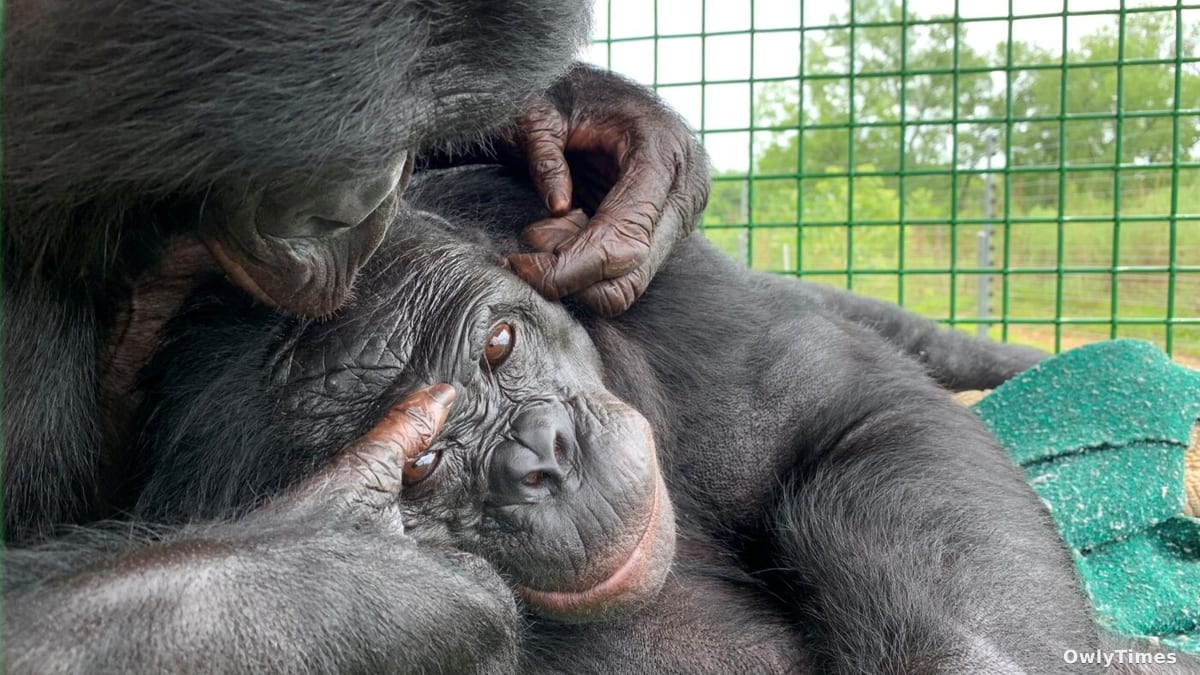
The research, as reported by NPR’s Nate Rott, centered around Kanzi, a bonobo renowned for his exceptional communication skills. For decades, scientists have documented Kanzi’s ability to understand spoken English and respond using lexigrams – visual symbols representing words. However, Krupenye’s team wasn’t interested in Kanzi’s linguistic prowess, but rather in his capacity for mental representation. They designed a series of experiments that moved beyond simple imitation, probing whether Kanzi could anticipate the consequences of actions within a fabricated scenario. Specifically, they presented Kanzi with situations requiring him to understand that objects could represent other objects – a core component of imaginative play. For example, Kanzi was asked to retrieve a “broom” to sweep up a mess, even when presented with a different object entirely, testing if he understood the role of the broom rather than simply recognizing its physical form.
What the study actually found, and what often gets lost in broader headlines, isn’t that Kanzi is “playing pretend” in the same way a human child does. It’s more nuanced. Kanzi demonstrated an ability to understand and respond appropriately to requests involving objects used in novel, symbolic ways – a skill that requires a degree of mental flexibility previously thought to be uniquely human. In one key test, Kanzi successfully retrieved an object to fulfill a request that involved a deliberately misleading instruction. This wasn’t about understanding language; it was about understanding the intention behind the request and mentally simulating the action needed to fulfill it, even when the presented tools didn’t directly match the expected ones. The success rate, while not perfect, was significantly above chance, indicating that Kanzi wasn’t simply guessing. This is a crucial distinction; random success would not suggest an understanding of symbolic representation.
The Challenge of Measuring Internal Mental States
However, interpreting these findings requires careful consideration. The biggest hurdle in studying animal cognition is, inevitably, accessing their internal mental states. We can observe behavior, but inferring the underlying thought processes is inherently challenging. Krupenye’s team addressed this by meticulously controlling the experimental setup and employing a rigorous statistical analysis to rule out alternative explanations, such as learned associations or simple stimulus-response patterns. They also accounted for the possibility that Kanzi was responding to subtle cues from the researchers, a common concern in animal behavior studies. Yet, despite these precautions, we can’t definitively know what Kanzi is “thinking.” The study provides compelling evidence for a capacity for symbolic understanding, but it doesn’t offer a direct window into Kanzi’s subjective experience.
Implications for Understanding Cognitive Evolution
The significance of this research extends beyond Kanzi himself. If the capacity for imaginative play – and the foresight it enables – isn’t exclusive to humans, it suggests that this ability evolved earlier in the primate lineage than previously believed. This has implications for our understanding of the cognitive pressures that shaped the evolution of intelligence. Was the development of imaginative play a crucial stepping stone towards more complex forms of cognition, such as planning, problem-solving, and social reasoning? The study doesn’t answer this question directly, but it provides a valuable piece of the puzzle. It also prompts us to reconsider the criteria we use to define intelligence and to appreciate the cognitive abilities of other species. The 2023 study builds on decades of work with Kanzi, and represents a shift in focus from what apes can learn, to how they learn and represent information internally.
Limitations to Consider and Future Directions
It’s important to acknowledge the limitations of this study. The sample size was small – the research focused primarily on Kanzi, and generalizing these findings to all bonobos, or even all great apes, requires further investigation. Additionally, the experimental tasks were designed to be relatively simple, and it’s possible that Kanzi’s abilities are more limited than the study suggests. More complex scenarios, requiring more elaborate mental simulations, might reveal the boundaries of his cognitive capacity. Finally, the study doesn’t address the neural mechanisms underlying Kanzi’s abilities. Identifying the brain regions involved in symbolic representation and imaginative play could provide further insights into the evolutionary origins of these cognitive processes.
Looking ahead, researchers are planning to expand this line of inquiry by studying other great apes, including chimpanzees and gorillas, to determine whether Kanzi’s abilities are unique to bonobos or represent a more widespread primate trait. They are also exploring the use of neuroimaging techniques to investigate the neural correlates of imaginative play in apes. Perhaps the most compelling question now is: if we can demonstrate that other apes possess the capacity for imaginative play, what does that tell us about the evolution of consciousness itself? Will future research reveal that the ability to mentally simulate “what if?” is not a uniquely human gift, but a fundamental aspect of animal cognition, shaped by millions of years of evolutionary pressure?





