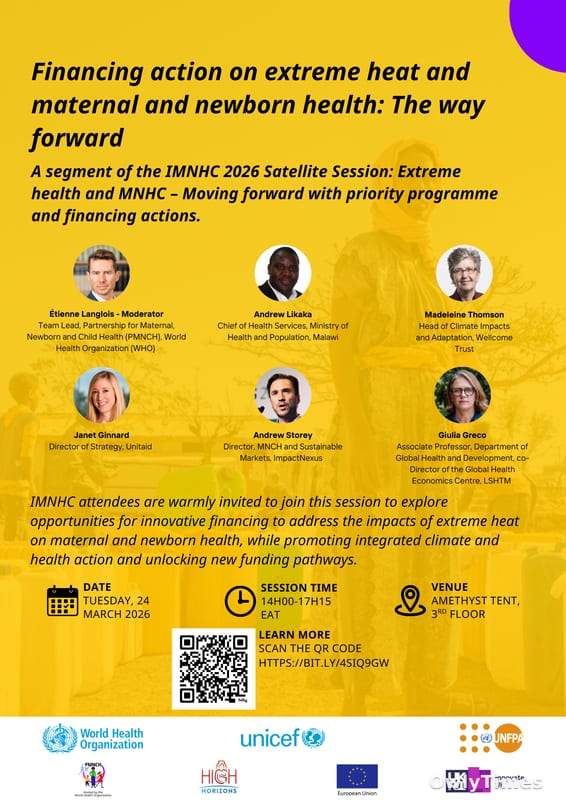

The Hidden Costs of Rising Temperatures: Why Maternal Health is Now a Climate Finance Issue
For decades, climate change has been framed as a future threat – a looming crisis for our grandchildren. But a growing body of evidence, and a new focus within global health financing, reveals the crisis is already here, and disproportionately impacting the most vulnerable among us: pregnant women and newborns. The upcoming segment, “Financing Action on Extreme Heat and Maternal and Newborn Health: The Way Forward,” isn’t simply adding maternal health to the climate agenda; it’s recognizing that failing to address rising temperatures is a failure to protect maternal and newborn wellbeing, and that traditional public health funding models aren’t equipped to handle this convergence. This isn’t about predicting future impacts, but responding to documented increases in preterm births, stillbirths, and maternal mortality directly linked to heat exposure.
This article draws on reporting from pmnch.who.int.
The core issue isn’t simply that heat is uncomfortable, but that it physiologically stresses both mother and fetus. Dr. Sonja Cottee, a researcher at the University of New South Wales, has demonstrated a clear correlation between heat waves and increased rates of preterm birth, particularly in areas with limited access to cooling infrastructure. A 2022 study published in Environmental Health Perspectives found that for every 1°C increase above 32°C, the risk of preterm birth rose by 5%. While headlines often focus on dramatic climate events like floods and droughts, these sustained periods of extreme heat represent a chronic, insidious threat, particularly in low- and middle-income countries where adaptive capacity is limited. The segment’s focus on financing isn’t about finding new money for climate change or maternal health, but about recognizing that these are increasingly inseparable and require a unified financial strategy.
This shift in perspective is crucial because current funding streams are siloed. Traditional maternal and newborn health programs, often funded by organizations like UNICEF and the World Health Organization, focus on access to healthcare, skilled birth attendants, and nutritional support. Climate finance, largely channeled through the Green Climate Fund and bilateral aid, prioritizes mitigation and adaptation measures like renewable energy and flood defenses. The segment highlights the need to “unlock and scale climate finance” for health, which means demonstrating how investments in heat-smart innovations – things like cool roofs, improved ventilation in healthcare facilities, and early warning systems for heat waves – directly contribute to improved maternal and newborn outcomes. This requires a new metric for success: not just reduced carbon emissions, but lives saved.
However, framing maternal health as a climate issue isn’t without its complexities. There’s a risk of “medicalizing” climate change, placing the burden of adaptation solely on healthcare systems rather than addressing the root causes of greenhouse gas emissions. Furthermore, the focus on low- and middle-income countries, while justified given their heightened vulnerability, could inadvertently reinforce existing power imbalances in global health financing. It’s essential that any climate-linked funding for maternal health is driven by the priorities and needs identified by those communities, not imposed from outside. The segment’s emphasis on “country experiences” is a positive step, but the details of how those experiences will inform funding decisions remain to be seen.
The Role of Domestic Resource Mobilization
A key component of the proposed financing approach is mobilizing domestic resources within affected countries. This isn’t simply about asking governments to spend more on healthcare, but about restructuring existing budgets to prioritize climate-resilient health systems. Dr. Maria Rodriguez, a health economist at the Inter-American Development Bank, argues that many countries already have the financial capacity to address these challenges, but lack the political will or the technical expertise to reallocate funds effectively. This requires strengthening health information systems to accurately track heat-related maternal and newborn morbidity and mortality, and building capacity within finance ministries to assess the economic costs of inaction. The segment’s discussion of domestic resource mobilization is particularly relevant given the current global economic climate, where traditional aid flows are under pressure.
Heat-Smart Innovations and System Resilience
The segment also emphasizes the role of “heat-smart innovations” in building resilient health systems. This goes beyond simply providing air conditioning in hospitals, although that’s a crucial first step. It includes designing healthcare facilities with passive cooling strategies, training healthcare workers to recognize and manage heat-related complications during pregnancy, and developing community-based early warning systems to alert pregnant women to impending heat waves. Importantly, these innovations need to be affordable and accessible, particularly in rural areas. The segment’s focus on innovation suggests a move away from solely relying on large-scale infrastructure projects towards more localized, community-driven solutions.
Looking ahead, the critical question isn’t whether climate change impacts maternal and newborn health – the data already confirms this. The real question is whether the global health and finance communities can overcome the existing silos and develop a truly integrated financing approach. Will we see a measurable shift in climate finance towards health interventions, and will that funding be directed to the communities most in need? The success of “Financing Action on Extreme Heat and Maternal and Newborn Health: The Way Forward” will be judged not by the promises made, but by the concrete changes it catalyzes in funding priorities and on-the-ground outcomes for mothers and newborns facing a warming world.





