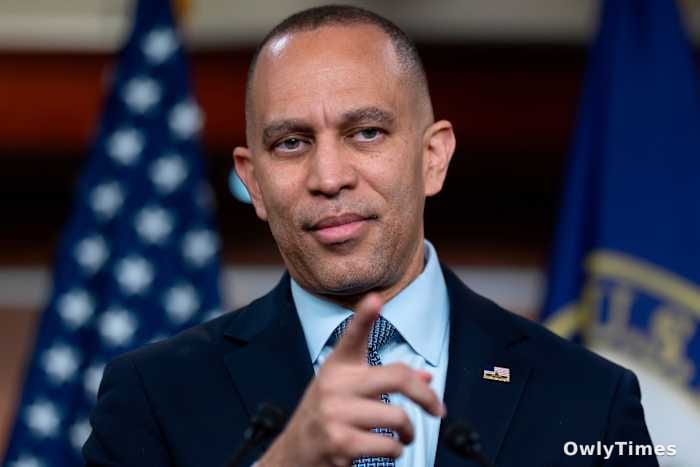

The strategic calculus underpinning the race for control of the House of Representatives has shifted dramatically, moving from traditional voter mobilization to a fierce, judicially-driven cartographic battle. What began as Democratic efforts to counter Republican redistricting maneuvers has been fundamentally reset by a series of court rulings, forcing House Minority Leader Hakeem Jeffries, D-N.Y., to confront an enlarging map of Republican-friendly seats and a direct challenge to Black political representation. This pivot signifies a recognition that the path to the speaker's gavel is now less about electoral enthusiasm and more about the boundaries drawn by judicial decree.
Judicial Rulings Reshape the Electoral Map
Just weeks ago, Democrats celebrated a hard-won victory in Virginia, where a redrawn map appeared to counter Republican redistricting efforts. "F— around and find out," Jeffries declared after the election, confident in the Democrats' ability to fight fire with fire. However, that triumph proved fleeting. Back-to-back court rulings have since wiped out those Democratic gains in Virginia and now threaten to erode majority-Black congressional districts across the Deep South. These decisions have served as a wake-up call for Democrats, who had been favored to win back the House this November, buoyed by President Donald Trump’s dipping approval ratings.
The immediate beneficiaries of these judicial interventions are the Republicans, who see their prospects for retaining or expanding their slim House majority significantly bolstered. House Speaker Mike Johnson on Wednesday dismissed the Democratic play for Virginia as a "crazy overreach" that "failed spectacularly," highlighting the partisan satisfaction with the judicial outcomes. Conversely, Democrats find themselves losing ground they believed they had secured, facing a more difficult electoral landscape where the number of seats they need to flip has potentially doubled from three to six. This dynamic places immense pressure on Jeffries, who is poised to make history as America’s first Black speaker of the House, but now confronts a House map increasingly designed to his party’s disadvantage.
The Cost of Cartographic Warfare
The redistricting battles are not just about lines on a map; they are also about significant financial and strategic investments. Jeffries's aligned outside group has already spent some $60 million, with a substantial portion allocated to the Virginia fight alone. This outlay represents a considerable hit to Democratic resources, particularly as they prepare to confront Trump's Republicans in a broader national contest. Democratic strategist Jesse Ferguson articulated the new reality, noting, "It sort of crystallizes the election is now a contest between one side that has the money and the maps, and the other that has the voters and the candidates." This highlights a fundamental tension: Democrats argue Republicans are relying on gerrymandering rather than policy solutions to win elections, with Jeffries quoting Trump Republicans as not "giv[ing] a damn" about Americans' financial struggles.
The financial drain and the judicial setbacks have forced Democrats to recalibrate their approach. During a closed-door meeting on Wednesday, Jeffries described the challenge in almost existential terms, calling the court rulings against the Voting Rights Act and the Virginia measure "disgusting." He urged his colleagues to exceed Republican "diabolical intensity" with "righteous intensity at all times," emphasizing that "Failure is not an option." This reflects the party's belief that they cannot fully rely on the courts to act as a check on GOP power plays, necessitating a more aggressive, self-reliant strategy. The initial push, including Jeffries's trips to Austin and Chicago to support Texas Democrats and his involvement in California Democrats' voter initiative that netted five seats, underscored this proactive stance, as Rep. Jared Huffman, D-Calif., recalled, "We had to very quickly make a decision, set a course and take a risk."
Echoes of History in Representation Battles
The current assault on Black political representation, particularly in the Deep South, draws stark parallels to historical struggles. Jeffries himself invoked "the Jim Crow era, the ghost of the Confederacy," describing an "unprecedented assault" on voting rights that threatens to eliminate districts held by some of the most senior Black lawmakers in Congress. This historical echo underscores the gravity of the court rulings, particularly the Supreme Court's decision affecting majority-Black districts, which has empowered Republican legislatures to redraw maps with renewed zeal. The veteran Democratic legislator from South Carolina, Rep. James Clyburn, whose own seat is at risk, directly blamed the justices, not Jeffries, for the outcome, stating, "What the hell, he can't control the courts." This sentiment highlights the perceived judicial activism that has become a central feature of the contemporary political landscape.
The strategic implications extend beyond the immediate electoral cycle. While the current year's maps are largely set, Jeffries has already begun to pivot towards 2028, recognizing that the fight against redistricting is a long-term engagement. This forward-looking approach suggests a deeper understanding of the enduring power of electoral cartography in shaping legislative outcomes. The next political chess move will involve Democrats redoubling their efforts to confront the GOP redistricting battle ahead of the next census and subsequent election cycle, preparing an "overwhelming response" to safeguard political representation.
The original reporting on these developments from WSLS.com provides further context on the challenges faced by Jeffries. () For a deeper understanding of the political figure at the center of this battle, Hakeem Jeffries's Wikipedia page offers a comprehensive overview of his career and legislative priorities. ()
The political chess move to watch next will not be confined to the ballot box this November, but rather how the Democratic party begins to strategically position itself for the 2028 redistricting cycle. The intensity of their organizational efforts, resource allocation, and legal strategies in the intervening years will reveal whether Jeffries can turn his vow of "righteous intensity" into a concrete defense against what he views as an assault on the democratic process.





