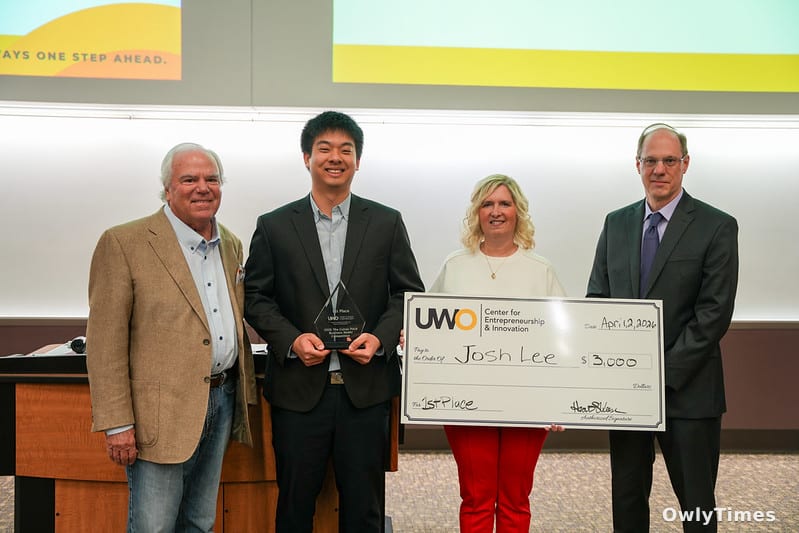

$6,250 in prize money awarded at the 2026 Culver’s Business Model Competition at UW-Oshkosh isn’t just a windfall for four students; it’s a signal of where venture capital is quietly shifting within the Wisconsin startup ecosystem – towards highly specific, B2B software solutions and localized experiential services. While headlines often focus on splashy tech breakthroughs, the winning pitches reveal a pragmatic focus on solving immediate, demonstrable problems for defined customer bases. Josh Lee’s “Titan Academic Advisor” took the top prize of $3,000, a figure that, while substantial for a student competition, represents a fraction of the $28.8 million in venture funding Wisconsin startups secured in Q1 2026, according to the Wisconsin Technology Council. However, the type of problem Lee is tackling – academic planning – is a pain point for universities nationwide, suggesting a scalable market opportunity.
Follow the money: Lee’s business model hinges on annual subscription fees paid by universities, a recurring revenue stream favored by investors. This contrasts sharply with the more volatile revenue models of consumer-facing startups. He envisions a platform that streamlines course selection, degree pathway planning, and progress tracking, features universities are increasingly willing to pay for as they grapple with declining enrollment and demands for improved student retention. The $3,000 prize isn’t just seed money; it’s validation of a business model that directly addresses a budgetary pressure point for higher education institutions. Gabe Torres’s second-place finish with “Nexum–Unified Athlete Management” ($1,500) further reinforces this trend. Developed in collaboration with the UWO football staff, Nexum isn’t chasing a broad consumer market; it’s offering a specialized performance platform directly to coaches and athletic departments.
The competition’s results also highlight a surprising resilience in the “experience economy.” Kellen Grall’s WI Marquee Co., securing $1,000 for third place, isn’t a tech play at all. It’s a rental company providing large-format marquee letters for events. This success demonstrates that even in a digitally-driven world, demand for tangible, memorable experiences remains strong. Grall’s focus on high schools, universities, and corporate events taps into a consistent, localized market. The company’s revenue model – direct rental fees – is straightforward and requires relatively low overhead, a characteristic attractive to early-stage investors. This is a notable divergence from the often-capital-intensive strategies of tech startups.
Source material: uwosh.edu.
Interestingly, the People’s Choice award, worth $250 and bragging rights, went to Andrew Fassbinder’s Fassbinder Fox River Honey. While the monetary value is modest, Fassbinder’s pitch – suggesting a honey-flavored custard collaboration with Craig Culver’s restaurants – demonstrates an understanding of brand alignment and potential for cross-promotion. This isn’t simply about selling honey; it’s about leveraging a local brand to expand market reach. The fact that Culver, a successful entrepreneur himself, was present at the competition underscores the importance of real-world business acumen, even in a pitch competition focused on innovation. The competition, run by the Center for Entrepreneurship and Economic Development at UWO, clearly prioritizes practical, viable business models over purely disruptive ideas.
What this means for your wallet: The success of these ventures suggests a potential shift in the local job market. While large tech companies continue to dominate headlines, the growth of these smaller, specialized businesses could create opportunities for students and recent graduates in areas like software development, marketing, and event management. More importantly, watch for universities to increasingly adopt subscription-based software solutions like Titan Academic Advisor to address enrollment challenges. This could translate to higher tuition fees, but also potentially improved student services and outcomes. The question now is whether these student entrepreneurs can translate their initial success into sustainable, scalable businesses – and whether Wisconsin’s venture capital community will continue to prioritize pragmatic solutions over purely speculative ventures.