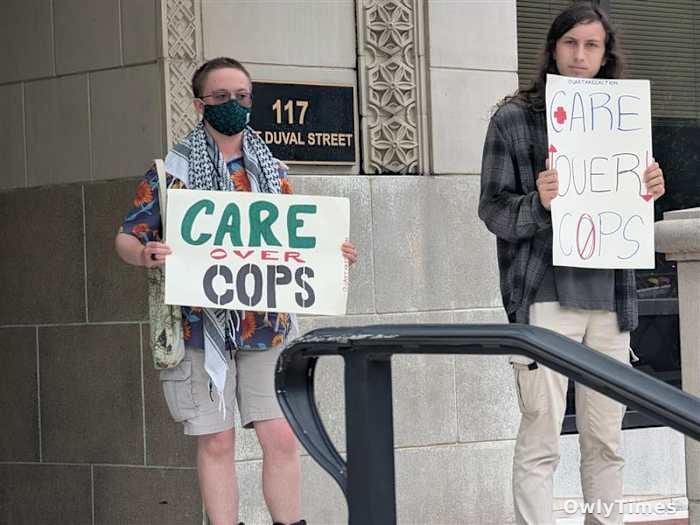

How should a community respond when a person is experiencing a mental health crisis? This fundamental question lies at the heart of a burgeoning movement in Jacksonville, Florida, where local groups are advocating for a paradigm shift in emergency response. The traditional reliance on law enforcement in such sensitive situations is increasingly being challenged by calls for specialized, compassionate interventions, prompting a critical re-evaluation of public safety protocols.
Demanding a Shift Towards Care-Centric Crisis Response
On a recent Tuesday, the Jacksonville Community Action Committee (JCAC), alongside other local organizations, rallied outside City Hall. Their urgent message, encapsulated in the "Care Not Cops" event, articulated a clear demand: the establishment of a permanent mental health emergency response team. This proposed team would comprise trained professionals, distinct from police officers, tasked with responding to specific 911 calls involving individuals in crisis. The rationale, as articulated by Kiana Blaylock of the JCAC, is stark: "Just so that mental health is not a death sentence for the people of Jacksonville." This statement underscores a profound concern that current approaches may, in some instances, exacerbate rather than alleviate distress, potentially leading to tragic outcomes.
What the JCAC is advocating for, versus what general headlines might suggest, is not a wholesale abandonment of law enforcement, but rather a targeted re-allocation of resources for specific crisis scenarios. Their demands include not only the creation of a dedicated mental health response team but also increased accountability for officers when force is used during mental health-related incidents. As Blaylock emphasized in a News4JAX report, "I think it’s important to keep pushing because JSO is always going to highlight their good moments. So somebody has to keep them accountable." This highlights the tension between public perception, official narratives, and the lived experiences that fuel advocacy for systemic change.
Navigating the Complexities of High-Stakes Interventions
The calls for reform come amidst heightened scrutiny of the Jacksonville Sheriff’s Office (JSO) responses to recent high-profile crisis situations, which illustrate the varied and often unpredictable nature of these emergencies. At the end of April, a video posted by JSO showcased a successful de-escalation on the Dames Point Bridge. Officer Antonio Richardson was seen calmly engaging with a man on the edge, saying, "Just touch my hand. Look at my hand. Touch my hand," ultimately pulling him to safety. This incident, which JSO highlighted, concluded with a powerful public service announcement urging those struggling with suicidal thoughts to contact the Suicide and Crisis Lifeline by calling or texting 988, a national resource designed to provide immediate support. More information on this vital service can be found at 988lifeline.org.
However, the complexities of these situations were also starkly revealed last week during an hours-long standoff behind a Walmart at San Pablo Road and Atlantic Boulevard. The incident began when an armed and suicidal man barricaded himself in a truck. According to JSO, it ended with police shooting the man after he emerged holding weapons and refused commands to drop them. He was hospitalized and is expected to be Baker Acted and face charges. The Baker Act, formally the Florida Mental Health Act of 1971, allows for involuntary examination of individuals who pose a threat to themselves or others due to mental illness, and its application here underscores the severe nature of the incident. Further details on the Baker Act are available from the Florida Department of Children and Families.
Limitations to Consider in Crisis Response
These contrasting outcomes underscore the immense challenges faced by first responders. While the JCAC advocates for a specialized approach, law enforcement officers are often the first, and sometimes only, available responders to situations that quickly escalate into threats to public safety. Sheriff T.K. Waters articulated this reality following the Walmart incident: "It’s important to work as best we can to get those folks out... Get them out safely, get them treatment. But in this situation, like I said before he introduced a firearm and like I’ve said before you can’t just introduce firearms to a situation like this. It’s going to end up the way that it ended up." This statement highlights the inherent dangers and split-second decisions officers must make when confronted with an armed individual, even if that individual is in crisis. The limitations of a purely non-law enforcement approach become apparent when immediate physical threats are present, requiring a nuanced understanding of when and how different response teams should be deployed.
Charting a Path Forward: Integrated Care and Accountability
The critical next steps for Jacksonville involve a collaborative examination of how these varied scenarios can be addressed with an integrated, rather than siloed, approach. The JCAC's call for the city to invest in systems that prioritize care and de-escalation offers a clear direction. This would likely involve not only funding for dedicated mental health response teams but also enhanced training for existing law enforcement on crisis intervention techniques, alongside clear protocols for when to defer to specialized units.
The ongoing discussions and proposed policy changes will be crucial indicators of the city's commitment to evolving its emergency response framework. Future developments will likely involve pilot programs, funding allocations, and public hearings that will reveal the extent to which Jacksonville is able to bridge the gap between traditional policing and a more comprehensive, public health-oriented approach to mental health crises. The ultimate goal is to ensure that every individual in crisis receives the most appropriate and safest intervention possible, aligning public safety with compassionate care.





