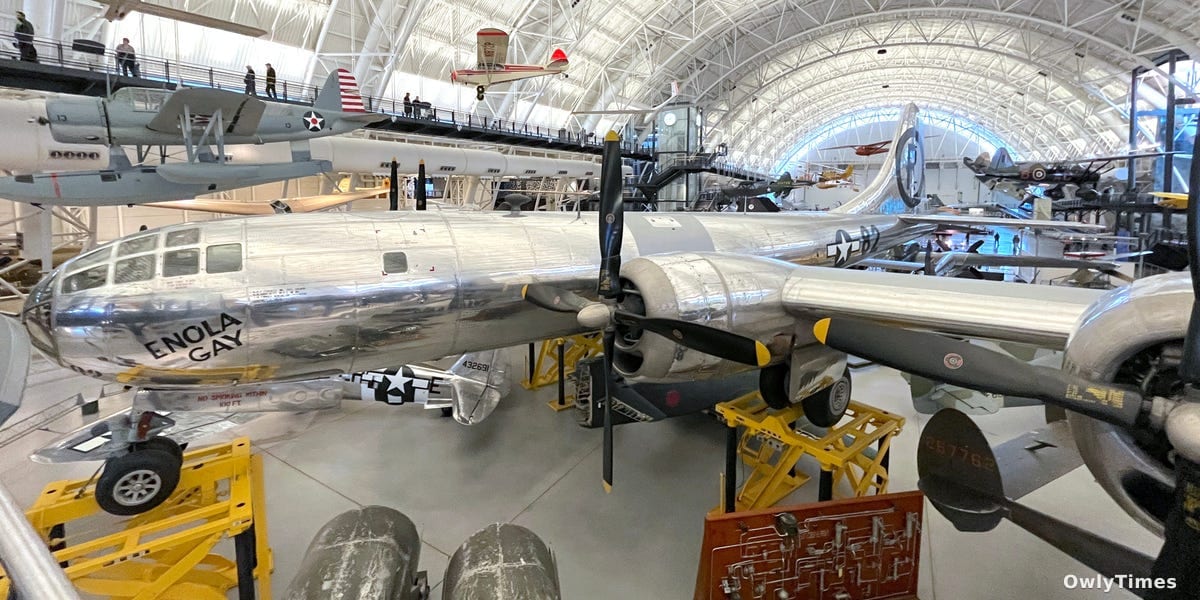

The sheer scale of historical reckoning is often measured in physical space. It’s not simply that the story of the atomic bombing of Hiroshima is immense, but that the aircraft central to that event – the Enola Gay, a Boeing B-29 Superfortress – is physically too large to comfortably inhabit the nation’s most prominent museum. Currently residing at the Steven F. Udvar-Hazy Center in Chantilly, Virginia, a sprawling annex of the Smithsonian National Air and Space Museum, the Enola Gay’s presence isn’t just about displaying a piece of aviation history; it’s about confronting a legacy that continues to shape geopolitical realities and ethical debates. The plane’s current location, and the decades of controversy surrounding its display, reveal a deeper tension: how do we, as a society, memorialize events that simultaneously represent technological achievement and unimaginable devastation?
The Enola Gay gained notoriety on August 6, 1945, when, piloted by Paul Tibbets, it dropped the “Little Boy” atomic bomb on Hiroshima, instantly killing an estimated 70,000 people. A second bomb, “Fat Man,” was dropped on Nagasaki three days later by the B-29 Bockscar, now displayed at the National Museum of the US Air Force in Dayton, Ohio. Japan surrendered on August 15th, effectively ending World War II. While the historical facts are stark, the narrative surrounding the bombings has been, and remains, intensely contested. The aircraft itself, stripped of its defensive weaponry to maximize payload capacity – even unpainted to save 850 pounds – embodies the singular, focused purpose of that mission. It’s a machine built for a single, horrific act, and its display demands a reckoning with that fact.
Source material: Business Insider.
The story of the Enola Gay’s exhibition is almost as fraught as the event it commemorates. Initial plans for a 50th-anniversary display in 1995 at the National Air and Space Museum on the National Mall sparked fierce backlash. Veterans’ groups advocated for a narrative emphasizing Japanese aggression and the bomb’s role in saving lives by swiftly ending the war. Conversely, anti-war activists and some historians argued for a more victim-centered approach, highlighting the immense human cost and questioning the justification for using such a devastating weapon. The Smithsonian Archives document multiple rewrites of the exhibit script, reflecting the intense pressure from competing interest groups. Headlines at the time often framed the controversy as a battle over “historical truth,” but the core issue was – and remains – a fundamental disagreement about moral responsibility and the weight of historical consequence.
What ultimately went on display in 1995, and remains largely unchanged today at Udvar-Hazy, is a deliberately minimalist presentation. The aircraft is presented with limited interpretive text, allowing visitors to draw their own conclusions. This approach, while intended to avoid further controversy, has also been criticized for its lack of context. The current exhibit doesn’t shy away from the facts – the bomb’s weight (9,700 pounds), the crew’s training at a remote airfield in Utah, the shockwaves felt by the Enola Gay even 11.5 miles from the blast – but it doesn’t offer a definitive judgment. This is a conscious choice, reflecting the Smithsonian’s desire to present history rather than prescribe a particular interpretation. However, it also places a significant burden on the visitor to independently grapple with the complex ethical and historical implications.
It’s important to consider the limitations of interpreting this history through a single artifact. The Enola Gay represents the culmination of years of scientific research, engineering innovation, and political decision-making. Focusing solely on the plane risks obscuring the broader context of the Manhattan Project, the wartime atmosphere, and the complex calculations that led to the decision to use the atomic bomb. Furthermore, the exhibit, while acknowledging the immense loss of life, doesn’t fully capture the long-term effects of radiation exposure and the ongoing trauma experienced by survivors, known as hibakusha. The US Department of Energy estimates that the death toll in Hiroshima may have exceeded 200,000 over five years due to the aftereffects of the bombing, a figure that has been revised upwards by Japanese and anti-nuclear scientists to 140,000. These numbers aren’t simply statistics; they represent individual lives irrevocably altered by a single event.
Looking ahead, the next crucial step in understanding this history isn’t about restoring the Enola Gay further, but about expanding the narrative surrounding it. Increased funding for oral history projects documenting the experiences of hibakusha and the American crew members involved in the Manhattan Project is essential. Furthermore, incorporating perspectives from international historians and ethicists can provide a more nuanced and comprehensive understanding of the event. The question isn’t simply where the Enola Gay is displayed, but how its story is told – and, crucially, whose stories are included in that telling. As the world grapples with the ongoing threat of nuclear proliferation, understanding the full weight of Hiroshima, and the legacy of the Enola Gay, is more critical than ever. Will future generations learn from this history, or are we destined to repeat its most devastating lessons?





