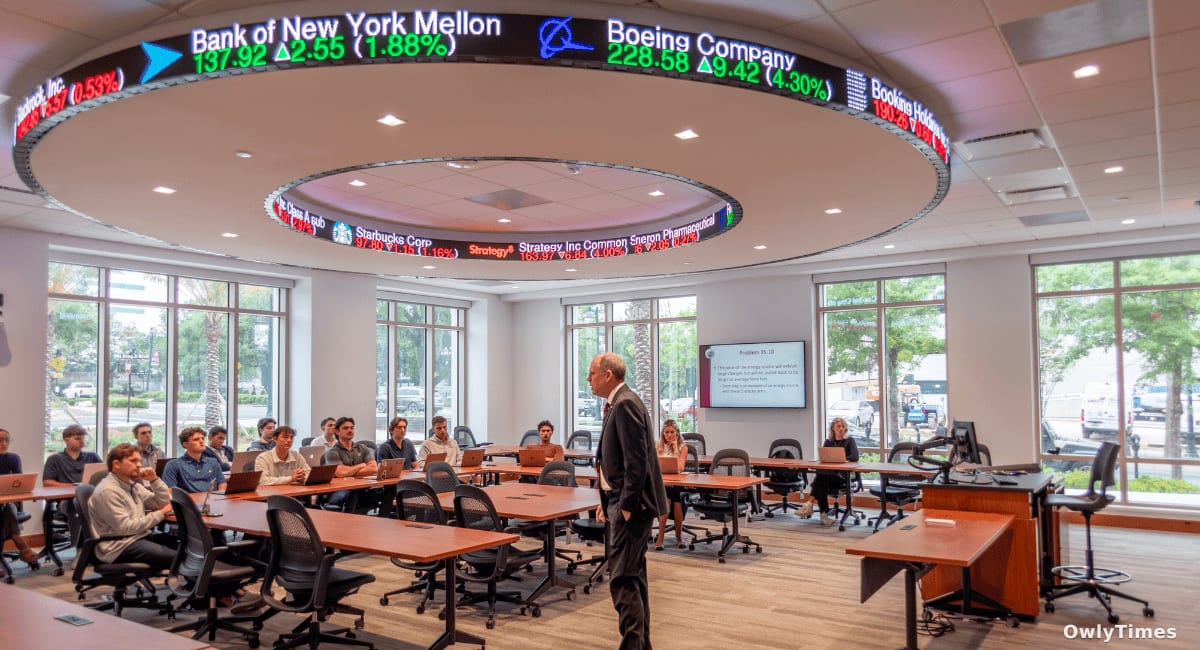

$11.5 million is the current valuation of the Student Investment Fund (SIF) at Florida State University’s Herbert Wertheim College of Business, a figure that underscores the professional-grade stakes now inherent in academic finance programs. This valuation represents a substantial expansion from the $1.3 million in seed capital provided by private donations and the Florida State University Foundation when the fund launched in 2008. By operating out of the Peter & Mary Lee Jones Trading Room, which houses the same Bloomberg terminals utilized by institutional trading desks, the program has effectively bridged the gap between classroom theory and the volatility of real-world asset management.
Scaling Academic Capital
Follow the money and you will find that the fund’s growth is not merely the result of market appreciation, but a calculated infusion of capital and structural evolution. Beyond the initial investment, the portfolio has been bolstered by an additional $3 million in foundation funding and $320,000 in philanthropic contributions. The 2022 integration of the Real Estate Investment Fund (REIF)—now valued at $2.7 million—further diversified the strategy, allowing students to manage assets under the guidance of Mariya Letdin, the Kyle Riva Associate Professor of Real Estate. This multi-asset approach is managed under an oversight board chaired by the dean, which includes both faculty and industry professionals, ensuring that the student-led decisions remain tethered to institutional standards.
Benchmarking Performance in a Crowded Field
The Center for Investment Research recently placed the Wertheim College’s SIF at No. 10 among all public schools in the nation for its 2025 performance. Within the broader context of North American universities, the fund secured the No. 23 spot, distinguishing itself as the only Florida-based business school to crack the Top 25. The competitive landscape is dense; the survey of over 500 institutions reveals that assets under management (AUM) for top-tier funds vary significantly, ranging from the $85.5 million managed by the University of Dayton to the $9.27 million held by the University of Tulsa. With the SIF closing the 2025 calendar year at $11.23 million in managed assets, the fund maintains a position that demonstrates significant scale relative to its peer group.
The Career Return on Investment
For students involved in the program, the "return" is measured in employability rather than just dividends. Steve Perfect, associate professor of finance and vice chair of the SIF oversight board, notes that the program is entirely student-driven, with Master of Science Finance (MSF) students serving as portfolio managers while top members of the Undergraduate Investment Group (UIG) function as analysts. Andrew Schrowang, MSF program coordinator and associate lecturer, emphasizes that the necessity of defending investment strategies and building financial models provides a distinct competitive advantage. Graduates are currently leveraging this experience to secure roles in investment banking, institutional asset management, and equity research. As finance remains the top major for undergraduate business students at the Wertheim College, the next reading of the fund’s AUM, alongside graduate placement rates, will indicate whether this model of experiential learning continues to produce the high-caliber talent currently demanded by the broader investment industry.