
The persistent hum of the universe has revealed another secret, ten years after we first “heard” it. While headlines proclaim yet another confirmation of Einstein’s theory of general relativity with the detection of gravitational waves from a black hole merger in 2025 – designated GW250114 – the real significance lies in what this event allows us to measure, not simply that it happened. This isn’t just about ticking a box on a century-old prediction; it’s about beginning to “hear” the echoes of black holes themselves, and using those echoes to test the very foundations of our understanding of gravity and the nature of spacetime.
The initial detection of gravitational waves, GW150914 on September 14, 2015, was revolutionary. It confirmed a prediction made by Einstein over a hundred years prior – that accelerating massive objects create ripples in the fabric of spacetime. That first signal, originating from the collision of two black holes roughly 30 times the mass of our Sun approximately 1.3 billion light-years away, released an astonishing amount of energy. To put it in perspective, had that energy been emitted as light, it would have outshone the Full Moon. The discovery, spearheaded by the LIGO collaboration founded by theorists like Kip Thorne and experimentalists like Rainer Weiss, opened a new window onto the cosmos, one that doesn’t rely on electromagnetic radiation. But GW150914 was, in many ways, a proof of concept. GW250114 is where the detailed work begins.
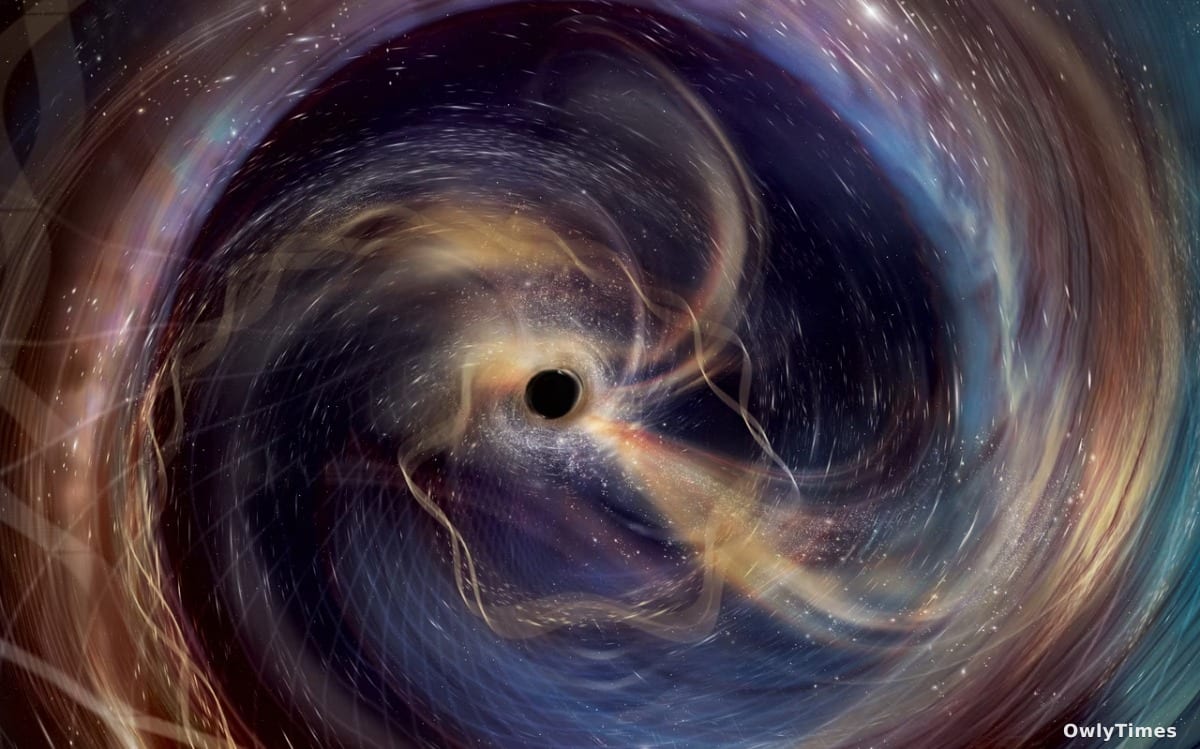
What sets GW250114 apart is the precision with which scientists can now analyze the “ringdown” phase of the merger – the period after the initial collision when the newly formed black hole settles into a stable state. According to the theory of general relativity, this settling isn’t instantaneous. The event horizon, the boundary beyond which nothing can escape, vibrates, emitting gravitational waves at specific frequencies. These frequencies, known as quasi-normal modes, are akin to the unique tones produced by a struck bell. Physicists at Cornell University and elsewhere have now successfully measured two of these fundamental harmonics and are beginning to constrain the existence of a third. This is a crucial step towards establishing a “gravitational spectroscopy,” a way to identify black holes and the theories that govern them based on their unique vibrational signatures.
Reporting from futura-sciences.com informs this analysis.
The concept of a black hole’s event horizon – a one-way membrane from which nothing, not even light, can escape – is central to Einstein’s theory. However, alternative theories of gravity do exist, including more recent proposals like “entangled relativity.” The detection of these quasi-normal modes, and their precise match to the frequencies predicted by the Kerr solution (which describes rotating black holes), provides strong evidence supporting the existence of a true event horizon. The fact that independent measurements of mass and angular momentum, derived from each observed harmonic, align further strengthens this conclusion. This isn’t simply confirming that black holes exist; it’s confirming what kind of objects they are.
However, it’s important to acknowledge the limitations to consider. While the observed frequencies align with the Kerr solution, the precision of these measurements is still evolving. The signal-to-noise ratio, while improving with each detection, remains a challenge. Furthermore, the analysis relies heavily on the accuracy of the theoretical models used to predict the quasi-normal modes. Any systematic errors in these models could potentially skew the results. The current measurements don’t entirely rule out subtle deviations from the Kerr solution, leaving room for alternative theories that might predict slightly different vibrational patterns. The debate surrounding the nature of black holes, and whether they might be replaced by exotic objects like gravastars, is far from settled.
The next steps in this research involve increasing the sensitivity of gravitational wave detectors like LIGO, Virgo, and KAGRA, and the planned space-based missions like LISA. These advancements will allow scientists to detect weaker signals, observe more events, and measure the quasi-normal modes with greater precision. Crucially, researchers are also working to refine the theoretical models used to predict these modes, incorporating potential quantum effects that might influence the behavior of the event horizon. Looking ahead, consider the implications if future observations reveal discrepancies between the predicted and observed frequencies. Would that necessitate a fundamental revision of our understanding of gravity, or simply point to the need for more sophisticated theoretical models? That’s the question the universe is now, quite literally, resonating with.