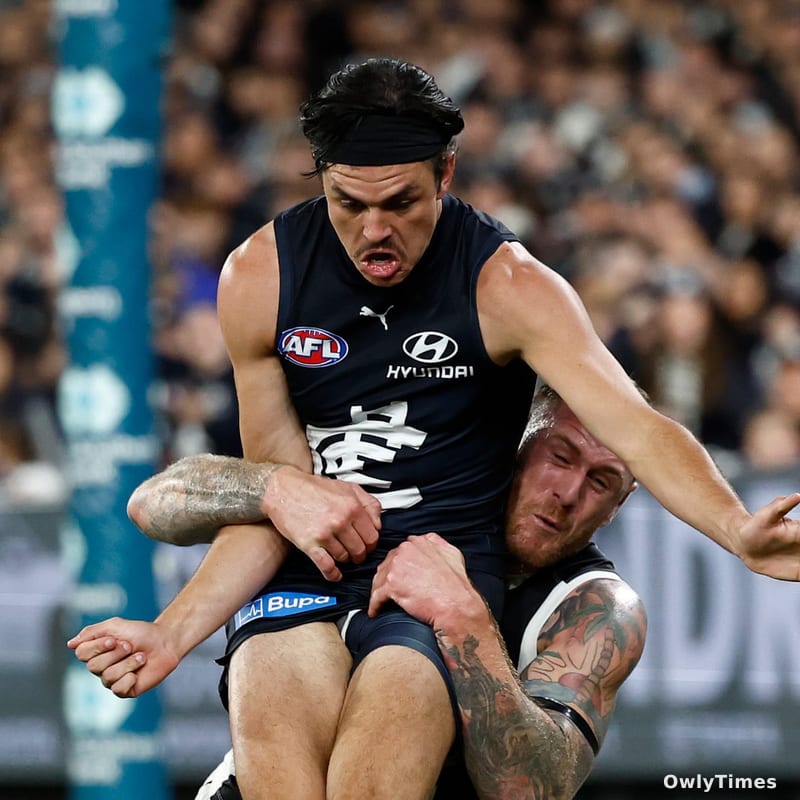

The intersection of high-stakes professional athletics and individual mental health often remains obscured by the intense performance demands of the sporting world. When an athlete’s behavior on the field shifts from standard tactical errors to signs of severe distress, the questions that follow are rarely about statistics or game outcomes. For Elijah Hollands, a 23-year-old midfielder for the Carlton Football Club, the events of a Thursday night match at the MCG have sparked a necessary, albeit painful, conversation about how organizations monitor the well-being of their players in real time.
Analyzing the Performance Gap
The scientific question at the heart of this incident is whether performance metrics can serve as early warning signs for cognitive or psychological distress. During his match against Collingwood, Hollands exhibited a performance profile that deviated sharply from his established baseline. Having played 75% of the match across the first three quarters, he failed to register a single statistic, eventually being credited with only one ineffective kick by Champion Data upon retrospective review. This statistical void, coupled with video footage appearing to show erratic behavior, suggests a significant disconnect between the player’s physical presence on the field and his functional engagement with the game.
Headlines have largely focused on the confusion surrounding his return to the field during the final quarter, but the medical reality is more nuanced. While Carlton chief executive Graham Wright confirmed that the club is investigating the circumstances of that evening, he has explicitly ruled out the influence of alcohol or illicit substances at this stage. Instead, the focus has shifted entirely to a "mental health episode," a term that encompasses a broad spectrum of acute psychological states. The challenge for clinical staff is determining the precise threshold where a player’s behavioral patterns cross from a "bad game" into a medical crisis requiring immediate intervention.
Limitations of In-Game Monitoring
It is vital to distinguish between what the public sees and what is clinically observable. While spectators and media observers noted Hollands’ confusion during the match, the club’s football department faced the difficult task of identifying these struggles in a high-pressure, high-noise environment. The limitation here is the lack of standardized protocols for identifying non-physical, acute mental health symptoms during active play. When Wright admitted he could not explain why Hollands was permitted to continue playing into the fourth term, he highlighted a gap in current sporting safety frameworks: the absence of a "mental health concussion protocol" equivalent.
This incident is particularly complex given Hollands’ history. Having previously taken personal leave twice last year to address mental ill-health and alcohol-related challenges, the player was already within a support structure. The fact that he was delisted and subsequently fought his way back onto the list through a summer training program—averaging 18.4 possessions in the six games leading up to this episode—demonstrates both his professional resilience and the persistent nature of his underlying health challenges.
Moving Toward Proactive Welfare
The AFL has requested a formal review of the circumstances surrounding the match, which will serve as the primary indicator for how the league intends to handle similar situations moving forward. The next step in this process is the completion of Carlton’s internal investigation into the weeks preceding the match. Whether this results in a shift in how clubs monitor the internal state of their players, rather than just their physical output, will be determined by the findings of this report. As Hollands receives care, the focus for the broader sporting community remains on the data points that don't show up on a scoreboard: the subjective, invisible markers of a player’s mental stability.





