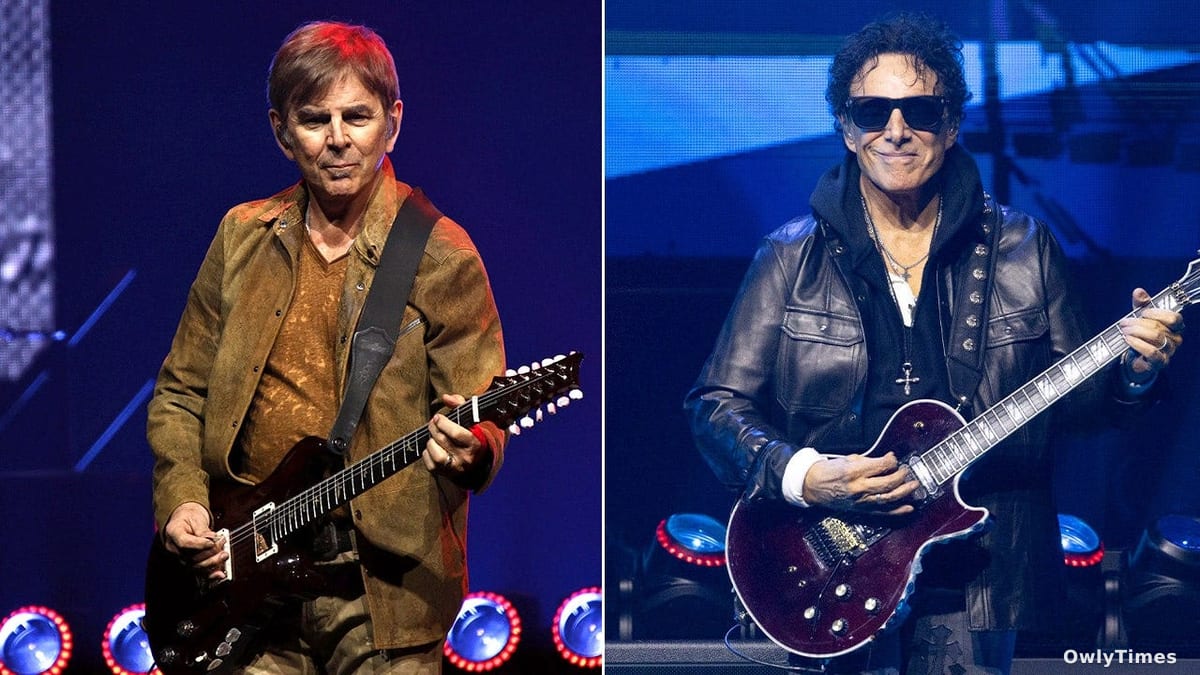

The calculus behind Journey’s current farewell tour isn’t simply about legacy or retirement; it’s a strategic maneuver to capitalize on a brand fractured by internal political conflict. While the band projects an image of unity on stage, the ongoing legal battles and deeply held ideological differences between founding members Neal Schon and Jonathan Cain reveal a power struggle extending far beyond band finances. The tour, launched in February, functions as a holding pattern – generating revenue and maintaining fan engagement while the core dispute over control of the Journey brand and its public image remains unresolved.
The fault line, as detailed in a recent Rolling Stone interview, isn’t merely artistic disagreement, but a direct collision with the increasingly polarized political landscape. Cain’s vocal support for President Trump, coupled with his appearances alongside figures like Kimberly Guilfoyle, Kari Lake, and Marjorie Taylor Greene at Mar-a-Lago in 2022, directly contravenes Schon’s long-held principle of keeping Journey politically neutral. This isn’t a case of bandmates disagreeing over policy; it’s a fundamental clash over the band’s identity and its relationship with a significant portion of its fanbase. Schon’s concern – “You’re going to lose half your fans when you do that” – isn’t just about ticket sales, it’s about preserving the broad appeal that built Journey into a multi-platinum act.
See the original Fox News story for the full account.
Who benefits and who loses in this scenario is sharply defined. Cain, through his alignment with a specific political faction, appears to be signaling a willingness to prioritize ideological conviction over maintaining a universally accepted brand image. His assertion that he “doesn’t care” about alienating fans reveals a calculated risk: consolidating support within a dedicated base, even at the expense of broader appeal. Schon, conversely, is positioned as the defender of Journey’s legacy, attempting to safeguard its inclusive identity. However, he’s also burdened with the legal complexities of co-owning the Journey trademark with Cain, a situation that grants his bandmate significant leverage. The legal disputes over the band’s corporate credit card and alleged misuse of funds are not isolated incidents, but symptoms of a deeper power imbalance.
This dynamic echoes historical precedents of artistic brands becoming entangled in political controversy. Consider the Dixie Chicks (now The Chicks), whose career suffered significantly after Natalie Maines criticized President George W. Bush in 2003. While the Chicks ultimately rebuilt their career, the initial backlash demonstrated the potential cost of publicly challenging prevailing political sentiments. However, the Journey situation differs in a crucial respect: the conflict isn’t originating from a single artist’s statement, but from a fundamental disagreement within the band’s leadership, creating a sustained internal tension that threatens the brand’s integrity. Gene Simmons of KISS recently offered a blunt assessment of this phenomenon, telling celebrities to “shut the f--- up” about politics, a sentiment reflecting a broader concern within the entertainment industry about alienating audiences.
The legal maneuvering further complicates the picture. Schon’s claim of receiving a “lawsuit every week” from Cain’s camp suggests a deliberate strategy of attrition, designed to exhaust Schon financially and emotionally. Cain’s request for a neutral third director to mediate disputes indicates a recognition of the impasse and a desire for external intervention, but also a potential attempt to shift the balance of power. The fact that both men remain actively involved in the tour despite these issues underscores the financial imperative to maintain the Journey brand’s momentum. As Schon wryly observes, despite the turmoil, “The music we’ve created together is amazing. And so, you have to celebrate that music with the fans.”
The political chess move to watch next isn’t whether Journey completes its farewell tour – it almost certainly will. It’s whether Jonathan Cain will attempt to leverage his co-ownership of the Journey trademark to exert greater control over the band’s future direction after the tour concludes. Will he seek to rebrand Journey with a more explicitly conservative or faith-based identity, or will Schon be able to maintain the band’s historically inclusive image? The answer to that question will determine whether Journey’s legacy endures as a unifying force in music, or becomes another casualty of the culture wars.





