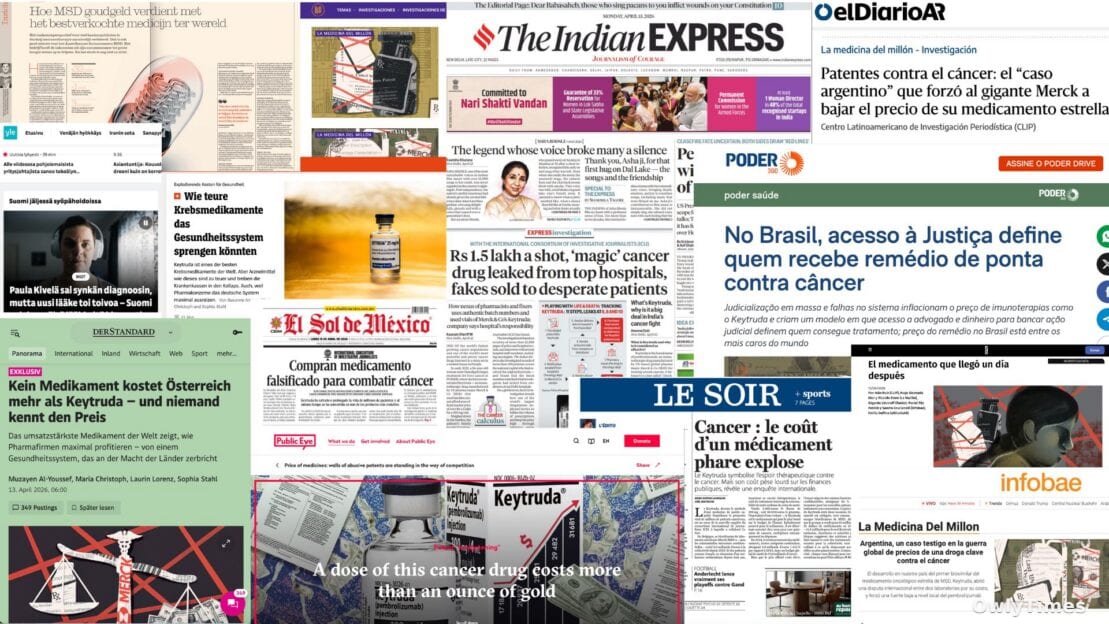

The scientific promise of Keytruda—a breakthrough immunotherapy—is currently eclipsed by a global economic friction: how do we balance the cost of life-saving innovation against the finite budgets of public health systems? An investigation by the International Consortium of Investigative Journalists (ICIJ), involving 47 media partners across 37 countries, has moved beyond the clinical efficacy of the drug to examine the mechanics of its monopoly. By synthesizing over 1,000 public records requests and hundreds of interviews with oncologists, regulators, and industry insiders, the resulting report, "The Cancer Calculus," reveals that the drug’s high price is not merely a reflection of research costs, but a result of strategic business decisions that strain healthcare infrastructure worldwide.
The core of the scientific inquiry centers on how the drug is administered. Dr. Daniel Goldstein, an Israel-based cancer specialist, has raised a significant point regarding the transition from weight-based dosing to a fixed 200 milligram dose for all patients. While the industry standard suggests this fixed dose is a matter of efficiency, Goldstein’s research—featured in Der Spiegel and ZDF—indicates that Keytruda could maintain identical efficacy at 25% lower doses. If these findings hold, the "fixed dose" strategy effectively functions like a wider tube on a toothpaste bottle, depleting the supply faster and driving up costs for insurers and governments that are already struggling to keep pace with the drug’s premium pricing.
The disparity between clinical necessity and economic reality is perhaps nowhere more visible than in Austria. As reported by Der Standard, Keytruda costs 6,800 euros (about $8,000) per dose, representing the nation’s single largest medication expense. In contrast, the research and advocacy organization Public Eye has estimated that a fair price for the drug could be as low as 80 euros (about $94) per dose. This gap highlights a dangerous lack of regulation, as Austria remains the only country in the European Union without a price ceiling for hospital drugs.
The report distinguishes between the marketing narrative of innovation and the reality of market access. Merck & Co. (known as MSD outside the U.S. and Canada) maintains that it has invested $44 billion into the drug’s development. However, the data from Argentina suggests that the introduction of competition can drastically alter the landscape. In January 2025, the local pharmaceutical company Elea launched a biosimilar version of pembrolizumab, Keytruda’s active ingredient. The impact was immediate: retail prices for Keytruda fell sharply, and a greater number of patients gained access to the medication, with Elea offering a price 56% lower than what MSD had previously charged the government. This serves as a critical, data-backed counterpoint to the idea that current prices are an immutable necessity of pharmaceutical development.
Limitations to these findings must be acknowledged, particularly regarding the complexity of global pharmaceutical supply chains. The investigation in India by The Indian Express uncovered a "burgeoning black market" where counterfeiters exploit systemic failures in hospital accountability, using authentic batch numbers to refill vials. These findings illustrate that even if drug costs were lowered, the integrity of the supply chain remains a profound hurdle to patient safety. Similarly, in Brazil, the "judicialization" of healthcare—where patients must sue the state to receive coverage—demonstrates that high costs create a "treatment gap," favoring the well-connected in urban centers over those in remote regions.
The next steps for this issue will be determined by the ongoing tension between market protection and public health accessibility. The investigation highlights that the path forward will likely be signaled by the next reading of retail price indices and government procurement contracts in regions where biosimilar competition is being tested. Whether other nations follow the Argentine model of encouraging local biosimilar production will be the primary indicator of whether the global "cancer calculus" is beginning to shift toward sustainability, or if the current high-cost status quo will continue to dictate who survives and who does not.





