
$5,468 and No WiFi: Korean Air’s Business Class Upgrade Reveals a Broader Industry Tension
A $5,468 round-trip ticket buys a significant level of expectation, yet Korean Air’s recent rollout of its Prestige Suites 2.0 business class reveals a growing disconnect between premium pricing and consistent premium experiences. While the new suites, sampled by this reporter on a Chicago-Bangkok route via Seoul, represent a substantial improvement in privacy and comfort – a move mirroring the industry-wide shift towards “business class as a private suite” – the continued charging for in-flight WiFi, even for top-tier passengers, highlights a cost-cutting strategy that risks eroding brand loyalty. This isn’t simply about convenience; it’s about the evolving value proposition of long-haul travel.
Original reporting: Business Insider.
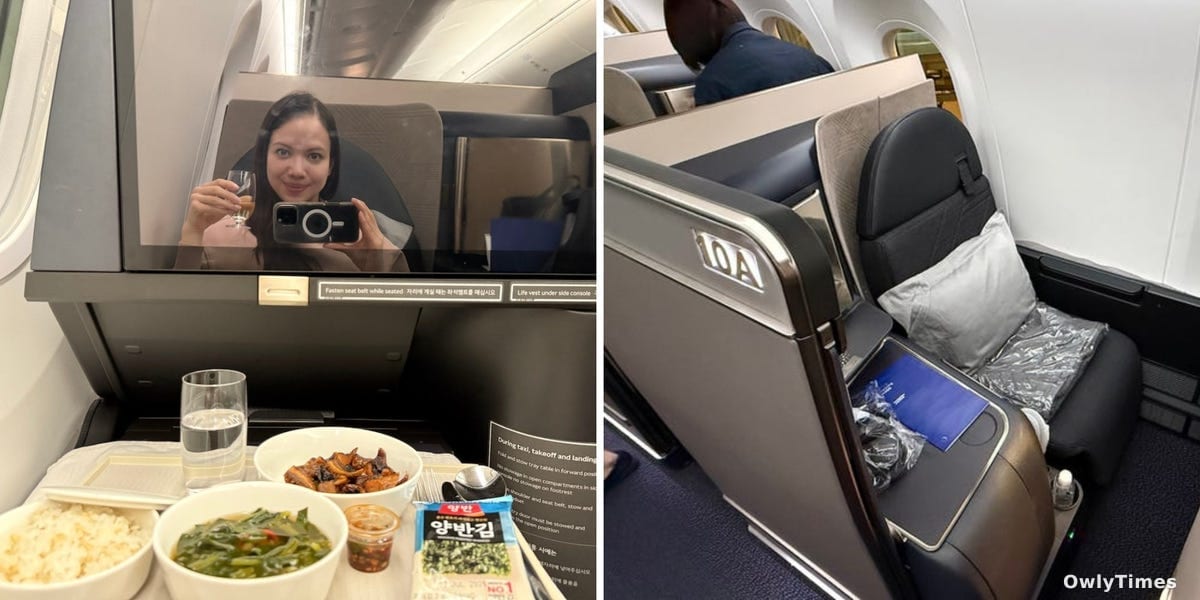
Amber Gibson’s recent experience, detailed in her flight report, underscores the core appeal of the Prestige Suites 2.0: enhanced privacy. The 1-2-1 configuration, a departure from Korean Air’s older, less private 2-3-2 layout, offers passengers a cocoon-like experience with walls exceeding four feet in height and sliding doors (currently awaiting regulatory approval for full operation). This design echoes the success of competitors like Qatar Airways’ Qsuites, which have set a new benchmark for business class privacy. The investment in this upgrade is demonstrably strategic; Korean Air is responding to a clear market demand for more secluded travel environments, particularly on long-haul routes where passengers increasingly view their flight as an extension of their personal or professional space.
However, “follow the money” reveals a more complex picture. While Korean Air is investing in the hardware of a premium experience, it’s simultaneously maintaining revenue streams from ancillary services. The availability of WiFi on the Seoul-Bangkok leg, but at a cost of $10.95 for two hours or $13.95 for full-flight access, is a telling detail. This contrasts sharply with the trend among many North American and European carriers, who now offer complimentary WiFi to business class passengers. The decision to monetize internet access on a multi-thousand dollar ticket suggests a prioritization of short-term revenue over long-term customer satisfaction. Consider that the average business class ticket on a transpacific route in 2024 cost $6,200, according to data from industry analyst Cirium – a premium Korean Air is clearly targeting, yet still nickel-and-diming for basic connectivity.
The cabin itself delivers on many fronts. Gibson praised the sleek, modern design, ample charging options (including a functional wireless charging pad that boosted her iPhone from 50% to 85% during a six-hour flight), and the quality of the in-flight entertainment system, particularly the extensive selection of K-dramas and K-pop. The culinary experience also stood out, with a focus on authentic Korean flavors, including a pre-ordered plant-based shiitake mushroom dish and a spicy roasted chicken option. The inclusion of Charles Heidsieck 2018 brut millésimé champagne further reinforces the airline’s commitment to a premium offering. These elements, however, are increasingly becoming expected in the competitive landscape of international business class travel.
The tension lies in the disparity between these high-quality features and the continued charge for WiFi. This isn’t merely a matter of convenience; it’s a signal about where Korean Air perceives its competitive advantage. Is it solely in the physical comfort of the suite, or in the holistic travel experience? The airline’s decision suggests the former, betting that passengers will prioritize privacy and cuisine over seamless connectivity. This is a calculated risk, particularly as remote work and constant communication become increasingly integral to the business traveler’s lifestyle. The lack of complimentary WiFi also positions Korean Air slightly behind competitors like Delta Air Lines and United Airlines, who have made significant investments in providing free internet access on many of their long-haul routes.
What this means for your wallet: If you’re considering a Korean Air business class flight, factor in the potential cost of WiFi, especially on longer routes. More importantly, consider whether consistent connectivity is a non-negotiable part of your travel experience. The Prestige Suites 2.0 are a clear upgrade, but the airline’s ancillary revenue strategy raises a crucial question: will the pursuit of short-term profits ultimately diminish the perceived value of its premium offering? Watch closely to see if Korean Air responds to passenger feedback and adjusts its WiFi policy – the answer will reveal a lot about its long-term vision for business class travel.





