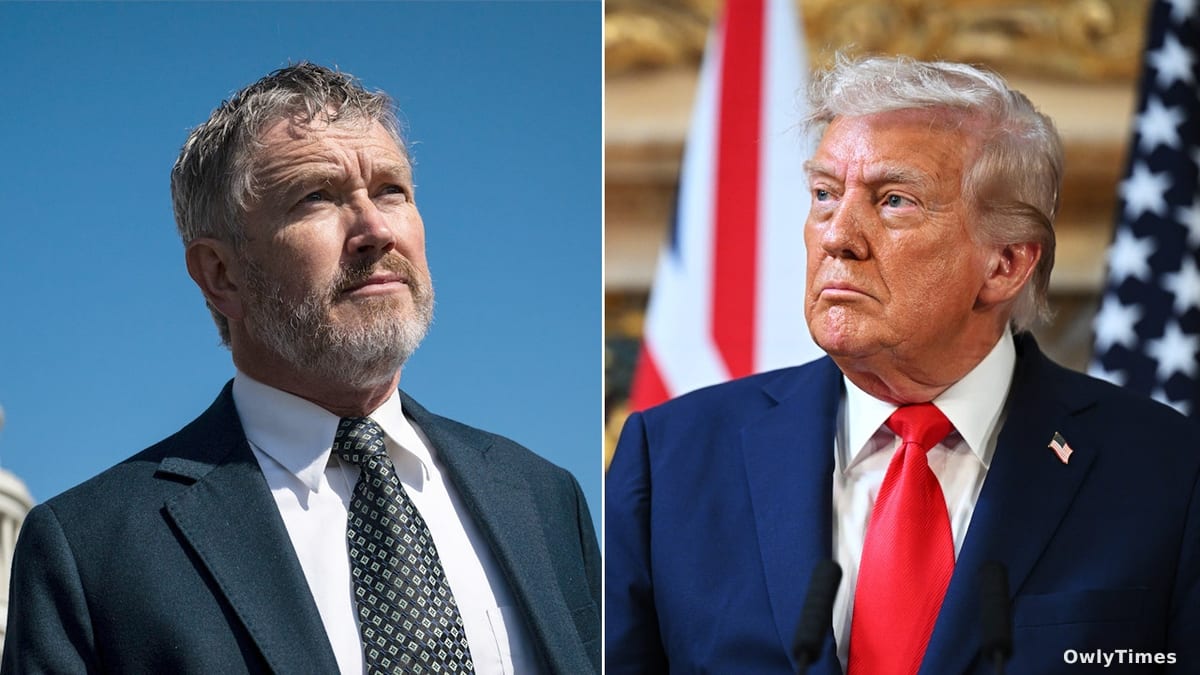

The calculated risk at the heart of the recent U.S. strikes against Iranian military targets isn’t about immediate battlefield gains, but about re-establishing a specific power dynamic – one where the executive branch asserts its authority in foreign policy while simultaneously signaling resolve to both adversaries and allies. The move by President Trump, operating outside traditional congressional authorization, isn’t an anomaly, but a continuation of a decades-long trend of executive overreach in military affairs, punctuated by moments of deliberate constitutional friction. This action, dubbed Operation Epic Fury, immediately fractured the already tenuous consensus in Washington, revealing a stark divide not along party lines, but between those prioritizing a demonstration of strength and those demanding adherence to constitutional processes.
The immediate fallout is clear: Rep. Thomas Massie (R-Ky.), a consistent critic of President Trump, aligned himself with the “Gang of Eight” – a bipartisan group of key lawmakers – to condemn the strikes as unauthorized acts of war. This isn’t simply opposition to the current administration; it’s a strategic maneuver to force a congressional reckoning with the War Powers Resolution, a law consistently circumvented by presidents of both parties. Massie’s pledge to work with Rep. Ro Khanna (D-Calif.) to compel a vote on war with Iran underscores the intent to publicly bind lawmakers to a position, effectively raising the political cost of further unilateral action. Who benefits and who loses here isn’t simply about Democrats versus Republicans, but about the legislative branch attempting to reclaim its constitutional authority versus an executive branch increasingly comfortable operating without it.
Based on the original Fox News report.
The timing of the strikes, and Trump’s pointed rhetoric – “I was the hunted, now I am the hunter” – directly references the 2020 assassination of Qasem Soleimani, commander of Iran’s Islamic Revolutionary Guard Corps. This echoes a historical pattern: presidents invoking past grievances to justify present actions, framing military interventions as necessary responses to prior attacks. Consider President James K. Polk’s justification for the Mexican-American War in 1846, citing border skirmishes as a pretext for territorial expansion. Similarly, the Bush administration used the 9/11 attacks to justify the invasion of Iraq, despite a tenuous connection between Saddam Hussein and the attacks themselves. Trump is leveraging a similar narrative, framing the current strikes as retribution for past targeting and a preemptive measure against Iran’s nuclear ambitions. This framing, however, conveniently sidesteps the constitutional requirement for congressional approval.
The internal debate within the administration itself is revealing. Secretary of State Marco Rubio’s pre-strike consultation with Speaker Mike Johnson (R-La.) suggests an attempt to manage the political fallout, but doesn’t address the fundamental constitutional question. The fact that the administration, according to a U.S. official speaking to Fox News, is targeting military targets while Israel is reportedly targeting leadership, creates a deliberate ambiguity. This division of labor allows the U.S. to claim a limited scope of action while simultaneously enabling a more aggressive campaign through its ally. This mirrors the U.S.-Israeli relationship during the Iran-Contra affair in the 1980s, where the U.S. provided covert support to Iran while publicly condemning its actions. The parallel highlights a consistent pattern of indirect engagement and deniability in U.S. policy towards Iran.
The objections raised by lawmakers like Sen. Mark Warner (D-Va.) and Sen. Tim Kaine (D-Va.) aren’t merely procedural; they reflect a deep skepticism about the lack of a clear strategic endgame. Warner’s warning about repeating “the mistakes of the past” – referencing costly nation-building efforts in Iraq and Afghanistan – underscores the concern that this intervention could escalate into a protracted conflict. Kaine’s call for a vote on his War Powers Resolution is a direct challenge to Trump’s authority, forcing a public accounting of the administration’s rationale and objectives. The fact that even Rep. Rick Crawford (R-Ark.), chair of the House Intelligence Committee, focused on the safety of U.S. forces rather than defending the legality of the strikes demonstrates the widespread unease within the Republican party. The political chess move to watch next isn’t whether further strikes will occur, but whether Speaker Johnson will allow a vote on a War Powers Resolution, and if so, whether enough Republicans will break with the administration to pass it. The outcome will determine whether Congress can effectively reassert its constitutional role in matters of war and peace, or whether the executive branch will continue to operate with unchecked authority.





