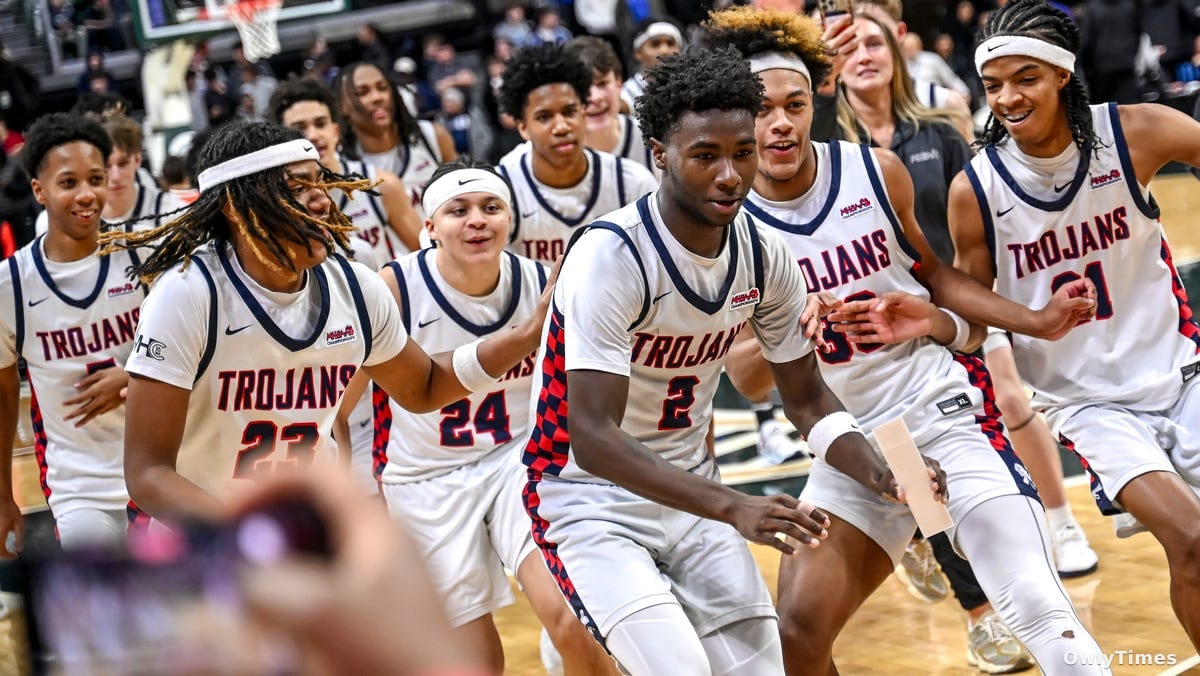

The air in the Breslin Center on Friday crackled with a tension usually reserved for March Madness, but this was high school. Not the polished, nationally televised spectacle, but the raw, heart-stopping drama of kids playing for their towns, their schools, and a moment of glory. It wasn’t just about basketball; it was about legacies forged in the crucible of competition, about the weight of expectation, and the sheer, unadulterated joy – and heartbreak – of a season culminating in a single game. The MHSAA state championship semifinals delivered, and the stage is now set for a Saturday showdown that promises to be just as electric.
The early games weren’t just wins, they were statements. Rockford and Auburn Hills Avondale engaged in a defensive battle that felt like a chess match played at breakneck speed, culminating in a breathtaking inbounds play – a three-quarters court pass from sophomore Josh Bascom to his brother, Jake Bascom, for a game-saving dunk. It was a play born of trust, of years spent honing their connection on the court, and a testament to the power of family in the high-stakes world of competitive athletics. But beyond the highlight reel, Rockford’s victory, their first trip to the final since 2012, speaks to a broader trend: the resurgence of programs built on fundamentals and brotherly bonds in an era increasingly dominated by travel teams and individual showcase events.
Drawn from freep.com.
The drama didn’t stop there. Defending champion East Lansing, led by KJ Torbert, the Hal Schram Mr. Basketball Award winner, found themselves in a genuine fight against Birmingham Brother Rice. Freshman point guard Jordan McDaniel was a revelation, relentlessly attacking the Trojans’ defense and tying the game with 15.8 seconds remaining. But Torbert, a player seemingly built for these moments, responded with a contested stepback three – a shot that wasn’t just a basket, but a declaration. It was a reminder that even in a team sport, individual brilliance can alter the course of history. This game wasn’t just about East Lansing’s pursuit of a back-to-back title; it was a microcosm of the pressure placed on star athletes to deliver when everything is on the line, and the mental fortitude required to thrive under that scrutiny.
Freeland’s upset victory over Romulus Summit Academy North was another story of defying expectations. Summit Academy North hadn’t lost to a Michigan team all season, a testament to their talent and dominance. But Wilson Huckeby and Tristan Comer, Freeland’s senior leaders, played with a poise and confidence that belied their school’s size, securing their first-ever state title game appearance. This win isn’t just a feel-good story; it’s a reminder that heart, teamwork, and smart coaching can overcome sheer athletic advantage. It’s a narrative that resonates deeply in a state where smaller schools often struggle to compete with the resources of larger programs. Hudsonville Unity Christian’s comfortable win over Detroit University Prep, however, offered a stark contrast, highlighting the growing gap in competitive balance within Michigan high school basketball.
Looking ahead to Saturday, Jared Ramsey of the Detroit Free Press predicts a Douglass victory over Concord in the early game, citing Douglass’s ability to apply relentless pressure. He’s also leaning towards another East Lansing win against Rockford, anticipating a repeat of their January matchup, though acknowledging Rockford’s rest advantage. Ramsey sees Pewamo-Westphalia edging out Arts & Technology Academy of Pontiac, emphasizing the strength of P-W’s supporting cast, and ultimately favors Hudsonville Unity Christian to overcome Freeland, citing their size advantage. Ramsey’s 19-5 record over the past two rounds demonstrates a keen understanding of the landscape, but these predictions aren’t guarantees. The unpredictable nature of tournament play is precisely what makes it so captivating.
But beyond the bracketology and the predictions, this weekend’s championships reveal a larger truth about the evolving nature of high school sports. The increasing emphasis on individual development, the rise of travel basketball, and the transfer portal are all reshaping the competitive landscape. While these forces can elevate individual talent, they also threaten the traditional values of school spirit, community pride, and the bonds forged through years of playing together. Will the smaller schools, like Freeland and Concord, continue to find ways to compete against the powerhouses? Will the emphasis on individual accolades overshadow the importance of teamwork and sportsmanship? These are the questions that will define the future of Michigan high school basketball, and the answers will be written on the floor of the Breslin Center this weekend.

