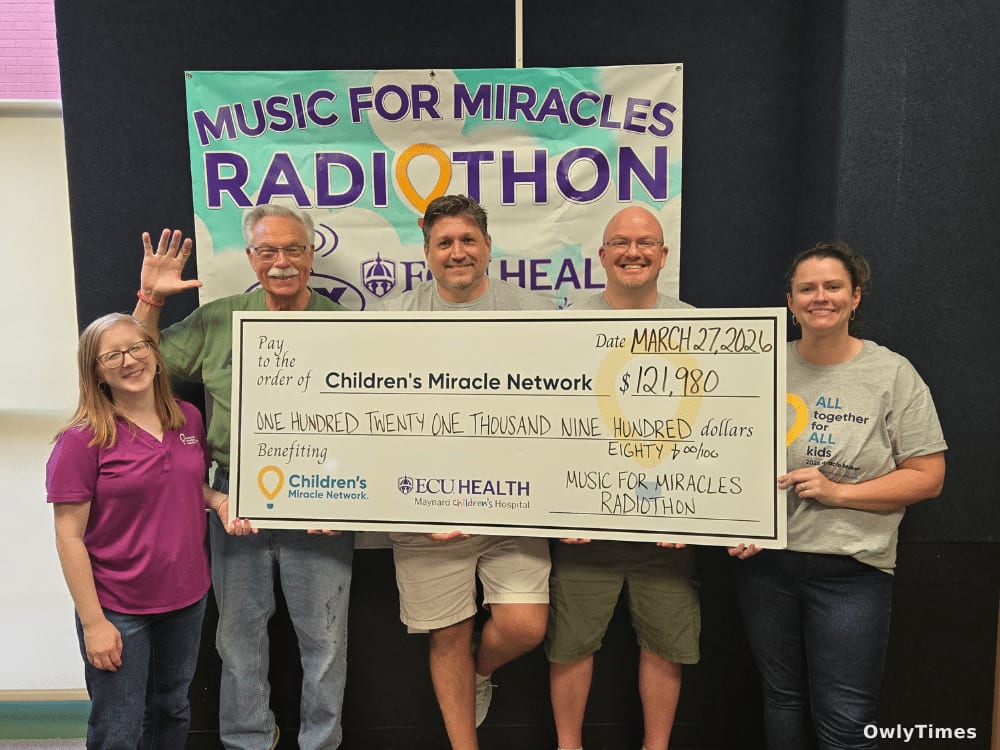

The phone lines lit up like a Christmas tree, but instead of wish lists, the requests were for pledges. For 48 hours in late March, the airwaves across eastern North Carolina crackled with stories of resilience, hope, and a community digging deep. The 29th annual Music for Miracles Radiothon, broadcast across all Inner Banks Media stations, culminated in a staggering $121,890 raised for James and Connie Maynard Children’s Hospital, a sum that feels both monumental and, given the need, achingly insufficient. But beyond the dollar amount, this annual event reveals a fascinating tension: in an era of fractured attention spans and dwindling trust in institutions, local radio continues to wield a unique power to mobilize collective empathy.
A Legacy Built on Local Voices
The radiothon isn’t a new phenomenon. It began in 1998, and this year’s total pushes the cumulative fundraising past a remarkable $4.1 million. That’s not just money; it’s 29 years of consistent, localized giving, a testament to the enduring connection between listeners and their local stations. Henry Hinton, president of Inner Banks Media, rightly points to the longevity of the event, stating, “For 29 years now, the generosity of our listeners has allowed us to raise funds for this great hospital.” But the staying power isn’t simply about habit. It’s about the intimate nature of radio itself. Unlike national campaigns, this isn’t a faceless appeal. It’s DJs you recognize, sharing stories from families you might know, all focused on a hospital serving a 29-county region. This hyper-local focus is a deliberate strategy, and one that’s proving remarkably effective when national trust in charitable organizations is declining – a 2023 study by Charity Navigator showed a 12% decrease in overall charitable giving compared to 2022.
Source material: ecuhealth.org.
The Power of Personal Stories and Matching Funds
This year’s success wasn’t solely reliant on consistent donors. A $20,000 matching gift from Craig Goess and Greenville Toyota acted as a powerful catalyst, incentivizing immediate contributions. Matching gifts are a fundraising staple, but their impact is often underestimated. They tap into a psychological principle of “loss aversion” – people are more motivated to avoid losing something (the matching funds) than to gain something of equal value. More importantly, the radiothon consistently centers the voices of families whose lives have been touched by Maynard Children’s Hospital. Elise Ironmonger, director of programs for the ECU Health Foundation, emphasized the importance of these narratives, saying, “I’m also so grateful to the families who bravely share their stories — these children truly are miracles.” These aren’t just anecdotes; they’re emotional anchors, grounding the fundraising in the very real experiences of those who benefit.
Beyond Treatment: Investing in a Regional Safety Net
The funds raised aren’t simply earmarked for cutting-edge medical equipment, though that’s certainly a crucial component. The money supports a holistic approach to pediatric care, encompassing educational opportunities for patients and staff, comforting resources for children undergoing treatment, and the development of new facilities. This is a critical point. Maynard Children’s Hospital isn’t just a place for acute care; it’s a regional hub, serving a vast geographic area where access to specialized pediatric services is often limited. The hospital’s reach across 29 counties underscores its role as a vital safety net, and the radiothon directly bolsters that function. In a state like North Carolina, where rural healthcare access is a persistent challenge, the importance of a strong regional children’s hospital cannot be overstated.
The Future of Local Fundraising in a Digital World
The Music for Miracles Radiothon’s continued success begs a question: can this model be replicated in other communities, and more importantly, can it adapt to a rapidly evolving media landscape? While the radiothon leverages the power of traditional radio, its future likely lies in a hybrid approach, integrating digital platforms and social media to broaden its reach. The fact that donations can still be made online at www.GiveToCMN.com is a start, but a more robust digital strategy – incorporating live streaming, interactive social media campaigns, and targeted online advertising – could unlock even greater fundraising potential. The enduring appeal of the radiothon isn’t just about the money raised; it’s about the power of community, the resonance of personal stories, and the enduring relevance of local media. Will other communities recognize and cultivate this power before it fades? That’s the signal worth watching for.





