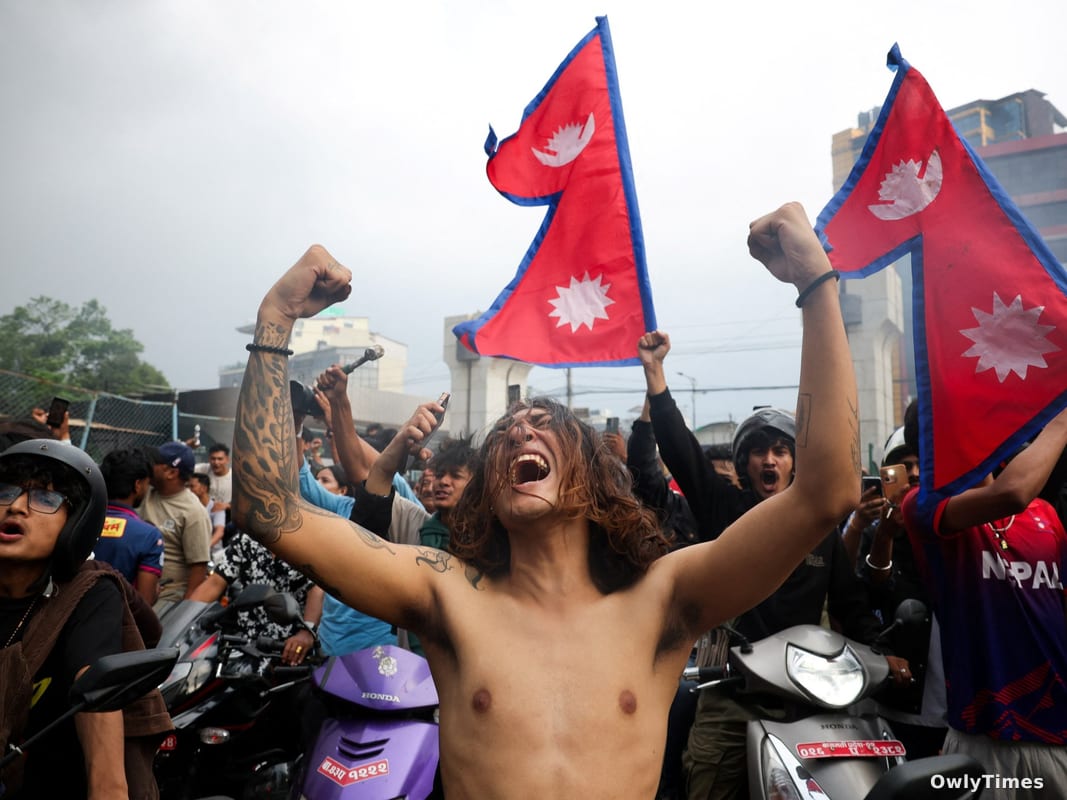

The Calculus of Disruption: Nepal’s Election and the Price of Ignoring a Generation
The upcoming parliamentary election on March 5th in Nepal isn’t simply a contest for seats; it’s a reckoning with a demographic shift in power, born from a calculated risk by the established political order that backfired spectacularly. The September protests, triggered by a seemingly minor social media ban, weren’t spontaneous combustion – they were the inevitable consequence of decades of stagnant economic opportunity, endemic corruption, and a political class perceived as fundamentally unresponsive. The ban itself, ostensibly about tax compliance and regulation, served as the catalyst, but the underlying fuel was a generation reaching a breaking point. This election is the attempt to quantify the damage and, crucially, to determine whether the old guard can convincingly feign adaptation.
Source material: Al Jazeera.
The protests, which resulted in at least 77 deaths, exposed a deep fracture between Nepal’s ruling parties – KP Sharma Oli’s Communist Party of Nepal-Unified Marxist Leninist (CPN-UML), the Nepali Communist Party, and the centrist Nepali Congress party – and a populace increasingly defined by its disillusionment. Who benefits and who loses in this scenario is starkly defined: the established parties stand to lose legitimacy, potentially even power, while Gen Z, and younger voters generally, stand to gain a voice, though whether that voice translates into tangible policy remains to be seen. The immediate outcome of the unrest was KP Sharma Oli’s resignation and the formation of an interim government, but the deeper consequence is a fundamental questioning of the existing political framework. This dynamic echoes historical precedents, notably the Arab Spring uprisings, where seemingly isolated incidents ignited widespread discontent rooted in economic hardship and political repression.
The established parties have responded to the pressure with a predictable strategy: rebranding. Manifestos are now “commitment papers” and “promise papers,” a transparent attempt to adopt the language of a generation they previously ignored. Oli’s CPN-UML, despite the protests originating from his administration’s policies, has doubled down on its leader, re-electing him as party president while simultaneously offering concessions like 10-gigabytes-per-month mobile internet packages and $10,000 cards for young business owners. This is political consumerism in action, as Sucheta Pyakurel, a political scientist, aptly describes it – an attempt to repackage a fundamentally unchanged product. The Nepali Congress (NC), perhaps sensing the greater peril, has undergone a more visible shift, electing Gagan Kumar Thapa, 49, as its new president and prime ministerial candidate, signaling an attempt to distance itself from the perceived failures of the past. Minendra Rijal, a senior NC leader, openly admitted the party’s missteps in coalition with Oli, acknowledging the “hubris” that damaged their image.
However, the sincerity of these changes is met with skepticism, particularly from those who spearheaded the protests. Rakshya Bam, a central figure in the September uprising, emphasizes that the debate shouldn’t be framed as “old versus new,” but rather as a demand for genuine reform. Her perspective highlights a crucial tension: the willingness to accept change from any quarter, provided it delivers on the core demands of anti-corruption and good governance. This pragmatism is shared by many young voters, like Rajesh Chand, a business student in Kathmandu, who expresses disinterest in party labels, focusing instead on tangible progress. The fact that parties are incorporating the movement’s language into their platforms is “welcomed,” according to Bam, but accompanied by a firm declaration: “We will be watching.” This isn’t merely a threat; it’s a statement of intent to maintain external pressure, regardless of the election outcome.
The complexities of Nepal’s mixed electoral system – combining first-past-the-post and proportional representation – further complicate the picture. This system historically fosters coalition governments and political instability, with Nepal having seen 14 governments and nine prime ministers since becoming a republic in 2008. This instability is a primary anxiety for Gen Z, who fear a return to the “musical chairs” of power-sharing that have consistently failed to deliver on promises. The emergence of new political figures, like rapper and former Kathmandu mayor Balen Shah, contesting against Oli in Jhapa-5, represents a challenge to the established order, but also raises questions about ideological coherence. While immensely popular with young voters, Shah is dismissed by some within the establishment as lacking a robust ideological foundation, a criticism that highlights the inherent distrust of newcomers. The question isn’t simply whether Shah can win, but whether his popularity represents a genuine ideological shift or merely a rejection of the status quo.
The political chess move to watch next isn’t the election results themselves, but the formation of the subsequent government and, more importantly, its response to sustained pressure from outside the traditional political structures. Will the winning coalition genuinely address the systemic issues of corruption and economic stagnation, or will it revert to the patterns of the past? The true test will be whether the established parties can resist the temptation to simply “repack and resell” themselves, and instead embrace a fundamental restructuring of power that acknowledges the demands of a generation that has demonstrably changed the rules of the game. The vigilance of figures like Rakshya Bam and the continued mobilization of Gen Z will be the determining factor in whether Nepal’s political revolution truly takes root.





