
Beyond Equilibrium: How Sound Waves Are Challenging Newton’s Laws
For centuries, Isaac Newton’s Third Law of Motion – for every action, there is an equal and opposite reaction – has been a cornerstone of our understanding of the physical world. It’s a principle seemingly woven into the fabric of reality, explaining everything from the propulsion of rockets to the simple act of walking. But recent research from New York University (NYU) is prompting physicists to reconsider this fundamental law, not by disproving it, but by demonstrating a system where it simply doesn’t apply. This isn’t about overturning established physics, but rather expanding our understanding of where its boundaries lie, and opening doors to potentially revolutionary technologies. The discovery, published in Physical Review Letters in February 2026, centers around a newly created “time crystal” levitated by sound, a system exhibiting interactions that defy the principle of balanced forces.
The initial excitement surrounding this research, as reflected in many headlines, focuses on the idea of “breaking” Newton’s Third Law. However, the study doesn’t suggest the law is incorrect – it reveals a specific scenario where it’s not a governing principle. The researchers, led by physicist David Grier and Mia Morrell, haven’t found a way to nullify action-reaction pairs universally. Instead, they’ve engineered a system where interactions are mediated by sound waves in a way that creates nonreciprocal forces. This distinction is crucial; it’s not a violation of physics, but an exploration of its limits within a carefully constructed environment. The team’s work builds on the theoretical foundation laid in 2012 by Frank Wilczek, a Nobel Prize-winning physicist at the Massachusetts Institute of Technology, who first proposed the concept of time crystals.
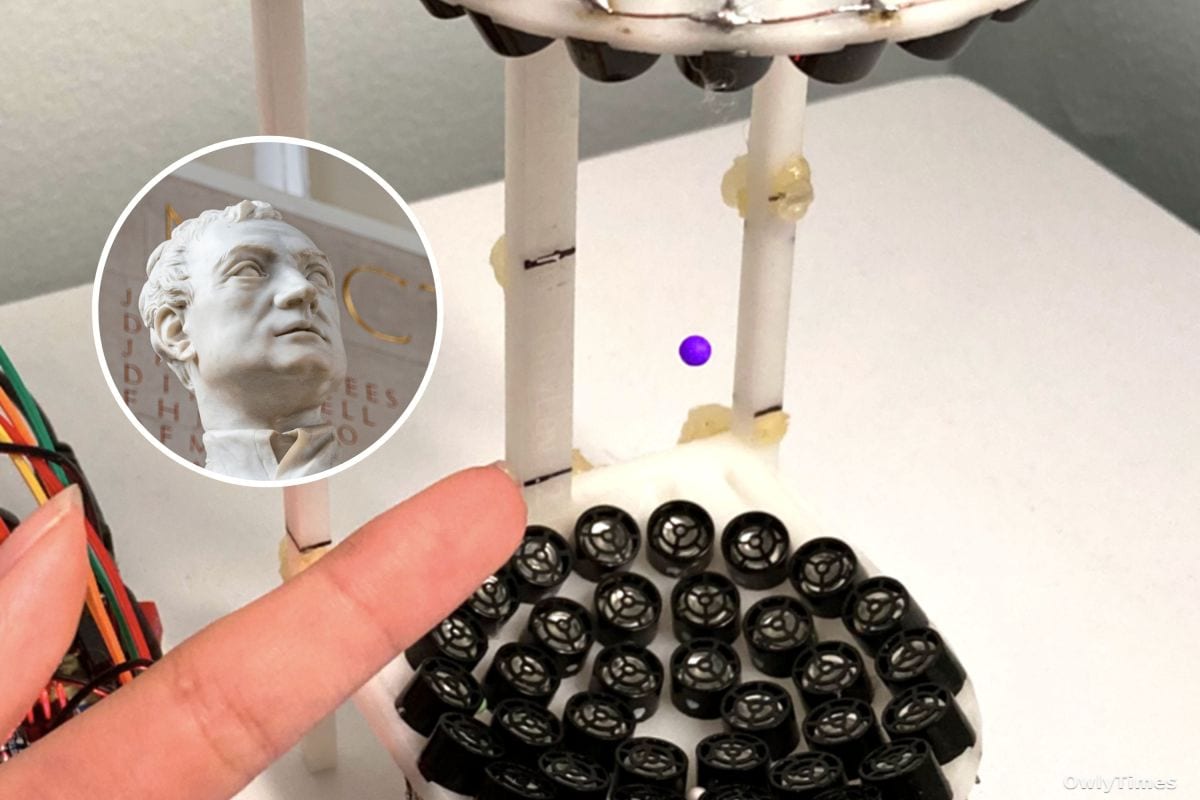
So, what exactly is a time crystal? Traditional crystals, like diamonds or salt, exhibit repeating patterns in space. Time crystals, however, are organized in repeating patterns across time. Imagine a system that oscillates, not towards equilibrium, but in a perpetual, predictable cycle without requiring energy input. This isn’t a perpetual motion machine – a concept long debunked – but a quantum system leveraging the unique properties of time and matter. The NYU team created their time crystal using simple polystyrene beads, the kind often found in packaging, suspended between two arrays of speakers roughly six inches apart. These beads aren’t just floating; they’re held aloft by a “standing wave” of sound, a phenomenon where sound waves interfere with each other, creating points of high and low pressure.
Based on the original newsweek.com report.
The key to the nonreciprocal interactions lies in the size difference between the beads. As Morrell explains, “Sound waves exert forces on particles—just like waves on the surface of a pond can exert forces on a floating leaf.” Larger beads scatter more sound than smaller ones, meaning they exert a greater force on smaller beads than vice versa. This asymmetry, akin to two ferries of different sizes creating unequal waves at a dock, breaks the balanced exchange of forces predicted by Newton’s Third Law. The beads aren’t simply bouncing off each other; they’re influencing each other’s movement in a distinctly unequal way, resulting in the self-sustaining, cyclical motion characteristic of a time crystal. Grier emphasizes the simplicity of the system, stating, “Our system is remarkable because it’s incredibly simple.” This accessibility is significant, as it allows for easier experimentation and a deeper understanding of the underlying principles.
However, it’s important to acknowledge the limitations to consider. This experiment is conducted in a highly controlled laboratory setting. The time crystals are fragile, susceptible to disruption from even minor environmental fluctuations. Scaling up this system – creating larger, more robust time crystals – presents a significant engineering challenge. Furthermore, while the potential applications in areas like data storage and quantum computing are exciting, they remain largely theoretical at this stage. The leap from a small-scale demonstration to a functional technology is substantial. The current system also relies on continuous energy input to maintain the sound field, meaning it isn’t a source of energy itself.
The next crucial research steps involve exploring different materials and configurations to create more stable and scalable time crystals. Researchers are also investigating the potential connection between these nonreciprocal interactions and biological systems, specifically circadian rhythms and biochemical networks. The team notes that some processes within our bodies, like the breakdown of food, also exhibit nonreciprocal interactions. Understanding these parallels could offer new insights into the fundamental mechanisms governing life itself. The question now isn’t simply whether we can create time crystals, but where else these unusual, non-equilibrium dynamics might be at play, and how we can harness them. Will future research reveal time crystal-like behavior in unexpected biological processes, leading to breakthroughs in medicine or biotechnology? That’s the frontier now being explored.