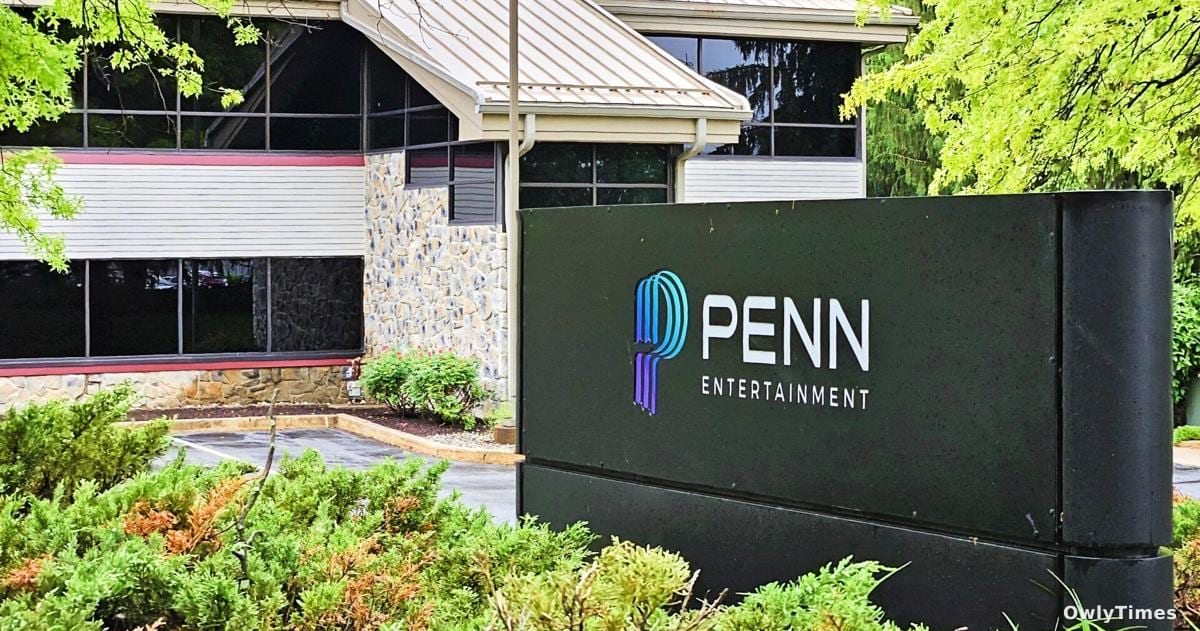

$1.4 Billion Revenue Miss Signals Deeper Trouble at PENN Entertainment, Despite Stock Surge
A 16.75% jump in PENN Entertainment’s stock price yesterday masks a fundamental weakening of the company’s financial position, revealed in its fourth quarter and full-year 2025 results. While the market reacted positively to a truce with activist investor HG Vora Capital Management, a closer look at the numbers – specifically the $350 million revenue shortfall against analyst expectations – demonstrates a business increasingly reliant on financial engineering and optimistic projections to maintain investor confidence. Follow the money, and the picture isn’t about a turnaround; it’s about a company attempting to restructure its way out of a deepening crisis.
This article draws on reporting from wfmz.com.
The headline figure – a fourth quarter EPS of $0.07 – is deliberately misleading. It’s a positive number, yes, but it’s strategically presented alongside a revenue figure of $1.4 billion, significantly below the $1.76 billion analysts predicted. This discrepancy isn’t a minor miss; it represents a 20% underperformance, a gap that cannot be explained away by “poor weather in December,” as ViewJay Snowden, CEO and President, attempted to do. The retail adjusted EBITDAR growth, while year-over-year, is being propped up by new property openings in Joliet and Las Vegas – capital expenditures that, while generating revenue, also increase debt. This is a classic tactic: using expansion to mask underlying operational weaknesses.
The appointment of three new independent directors – Heather Ace, Jeffrey Fox, and Fabio Schiavolin – coupled with the cooperation agreement with HG Vora, is the core of the market’s optimistic reaction. HG Vora had previously engaged in a proxy battle with PENN, and the settlement, which includes dropping the lawsuit, signals a potential shift in strategy. However, this isn’t a benevolent intervention. HG Vora’s involvement is a direct consequence of PENN’s declining stock price (down over 28% since March 2025) and a financial health assessment from Investing Pro that labels the company as “weak.” The new directors aren’t there to oversee growth; they’re there to oversee a restructuring, likely involving asset sales and cost-cutting measures dictated by the activist investor.
The Interactive segment, encompassing online sports betting and iCasino, offers a glimmer of hope, with a 52% year-over-year revenue increase. The rebranding to theScore Bet® and positive adjusted EBITDA in December are touted as successes. However, this growth is heavily reliant on iCasino, a segment facing increasing regulatory scrutiny and potential saturation. The 73% growth in online sportsbook revenue is also partially attributable to a low base from the previous year, and the company acknowledges the need for “disciplined cost management” – a euphemism for further layoffs and reduced marketing spend. PENN’s claim of 20% segment adjusted EBITDAR growth in 2026 feels less like a forecast and more like a target necessary to appease investors and justify the current stock valuation.
Looking at the balance sheet, the situation is stark. Net loss for the year reached $843.1 million, a significant increase from the $311.5 million loss in 2024. Total liquidity stands at $1.1 billion, but this is offset by $2.2 billion in traditional net debt. PENN is increasingly reliant on sale-leaseback transactions with Gaming and Leisure Properties, Inc. (GLPI) – a former entity linked to PENN’s founders – to raise capital. The $150 million funding from GLPI for the M Resort expansion and the anticipated $225 million for the Hollywood Casino Aurora relocation are not signs of financial strength; they’re indicators of limited access to traditional financing and a willingness to cede long-term control for short-term liquidity. The company expects to reduce lease adjusted net leverage by more than 1 turn and traditional net leverage by more than 2 turns, but this is predicated on successful execution of cost-cutting measures and continued reliance on these asset sales.
What this means for your wallet: Don’t be fooled by the stock’s temporary bounce. PENN Entertainment is a high-risk investment. While the company promises shareholder returns, those returns are contingent on a successful restructuring and a favorable regulatory environment for iCasino. Consumers should expect to see further consolidation in the gaming industry, potentially leading to reduced competition and fewer promotional offers. The key question investors should be asking isn’t whether PENN can achieve 20% EBITDAR growth in 2026, but whether it can survive long enough to see that growth materialize – and at what cost to its long-term viability.