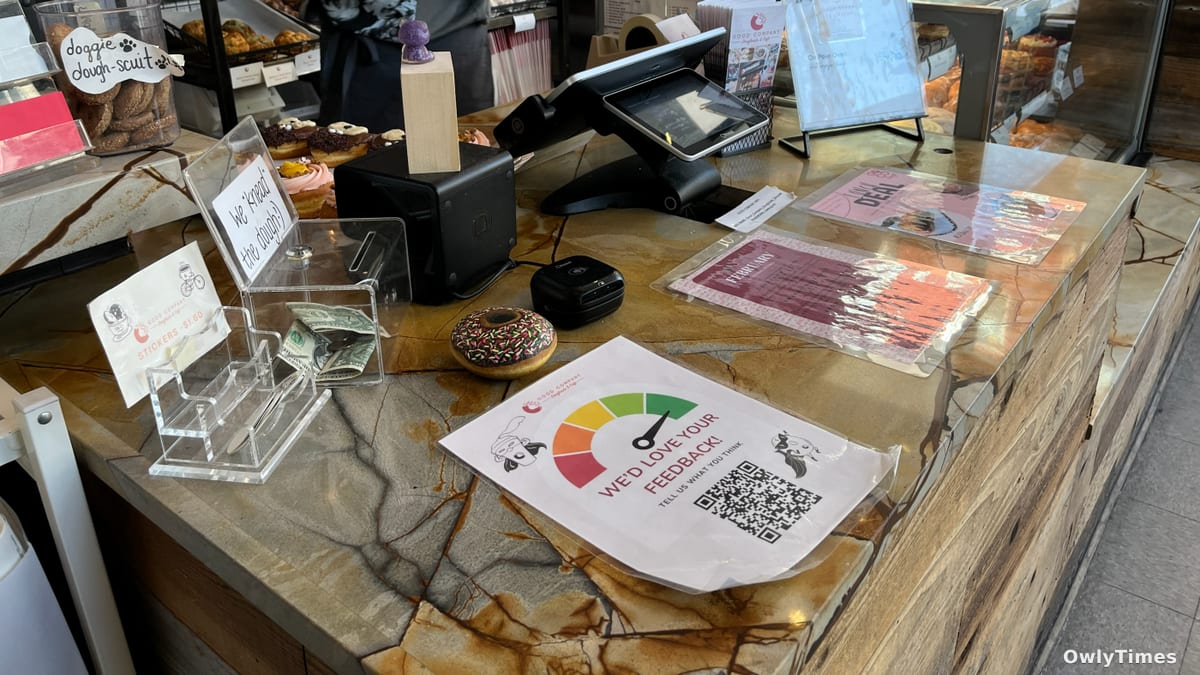

97% of consumers now consult online reviews before making a purchase, a figure that underscores a fundamental shift in the economic landscape – and a growing fatigue with the constant demand for feedback. This isn’t simply about annoyed customers like Audrey Morris, declining to rate her BLT at Good Company Doughnuts in Arlington, Virginia; it’s about a system, initially designed to empower consumers, now straining under its own weight and potentially distorting market signals. Follow the money, and you’ll find that the relentless pursuit of positive reviews isn’t driven by a desire for genuine improvement, but by algorithms prioritizing visibility and, ultimately, revenue.
The genesis of this “feedback frenzy” can be traced directly to Amazon. As Prasad Vana, an associate professor of marketing at the University of Oxford, explains, Amazon’s early adoption of a standardized five-star rating system – and its willingness to display even overwhelmingly negative reviews – established a precedent. While seemingly counterintuitive, this transparency was initially intended to benefit consumers. However, as Amazon’s marketplace ballooned, the equation changed. The company’s search algorithm, while shrouded in secrecy, demonstrably favors listings with a higher volume of reviews and a favorable average rating. This creates a powerful incentive for sellers to aggressively solicit feedback, effectively turning customer experience into a data-mining operation.
This article draws on reporting from NPR.
This dynamic isn’t unique to Amazon. Platforms like Google Maps, Facebook, Yelp, and Tripadvisor have all become battlegrounds for online reputation, forcing businesses to dedicate resources to managing their online presence. Andrea Flynn, a professor of marketing at the University of San Diego, notes a broadening scope: “We may have typically looked for reviews…on products…10 years ago. Now we're looking for ratings on doctors and dentists and banks.” This expansion reflects a fundamental reset in consumer expectations, driven by the convenience of online shopping and the perceived safety of “social proof.” The psychological principle at play is simple: people tend to mimic the behavior of others, and reviews provide a readily available blueprint for decision-making.
The economic implications are significant. Businesses are now compelled to invest in review management tools and strategies, diverting capital from other areas. More subtly, the system incentivizes a focus on maximizing review quantity over quality. As Vana points out, automated email requests – easily scheduled with “a couple of clicks” – are now ubiquitous. This constant bombardment of requests creates a feedback loop where even neutral experiences are solicited, skewing the overall picture. The result is a distorted representation of customer satisfaction, where a high volume of positive reviews doesn’t necessarily equate to superior service or product quality. This is particularly problematic because, as both Vana and Flynn emphasize, those with merely “acceptable” experiences are far less likely to leave a review, creating a bias towards extreme opinions.
The potential for manipulation further complicates the landscape. While consumers are aware that fake reviews exist, they continue to rely on ratings, highlighting a fundamental tension between skepticism and convenience. This reliance creates a vulnerability for unscrupulous sellers who can artificially inflate their ratings, gaining an unfair competitive advantage. The cost of this deception is borne by both consumers, who may make ill-informed purchasing decisions, and legitimate businesses, who struggle to compete against artificially boosted rivals. Charles Kachadoorian, co-founder of Good Company Doughnuts, describes it as a “love-hate relationship,” acknowledging the necessity of playing the review “game” while lamenting the loss of genuine, in-person feedback.
To mitigate “review fatigue,” businesses must adopt a more nuanced approach. Wendy Smith, a senior manager of research science at SurveyMonkey, advises focusing on relevance and demonstrating a commitment to acting on feedback. Flynn’s research suggests a “tipping point” where excessive review requests can actually decrease purchase frequency. Proactive strategies, such as soliciting feedback after every third purchase or focusing on high-value items, can help strike a balance. Timing is also crucial; requesting reviews immediately after a demonstrably positive experience is more likely to yield favorable results.
What this means for your wallet: expect to see businesses increasingly experimenting with review solicitation strategies. Watch for a shift away from blanket requests towards more targeted and personalized approaches. More importantly, be a discerning consumer. Don’t rely solely on star ratings; read reviews critically, looking for patterns and red flags. And consider: if the vast majority of reviews for a product or service are overwhelmingly positive, is that a sign of genuine quality, or a carefully curated facade? The future of online commerce may depend on our ability to navigate this increasingly complex feedback ecosystem.





