
Beyond the Void: Rethinking the Source of the Universe’s Most Energetic Particles
For decades, the origin of the most extreme cosmic rays – particles hurtling through space at nearly the speed of light with unimaginable energy – has remained one of astrophysics’ most persistent mysteries. These aren’t the steady stream of radiation we shield ourselves from daily; they are singular events, incredibly rare and powerful. Now, new research challenges a leading theory about where these particles come from, suggesting the universe’s accelerators might be closer, and more common, than previously thought. The focus of this investigation is the “Amaterasu particle,” detected in 2021, and what its journey can tell us about the environments capable of producing such phenomenal energy.
Reporting from space.com informs this analysis.
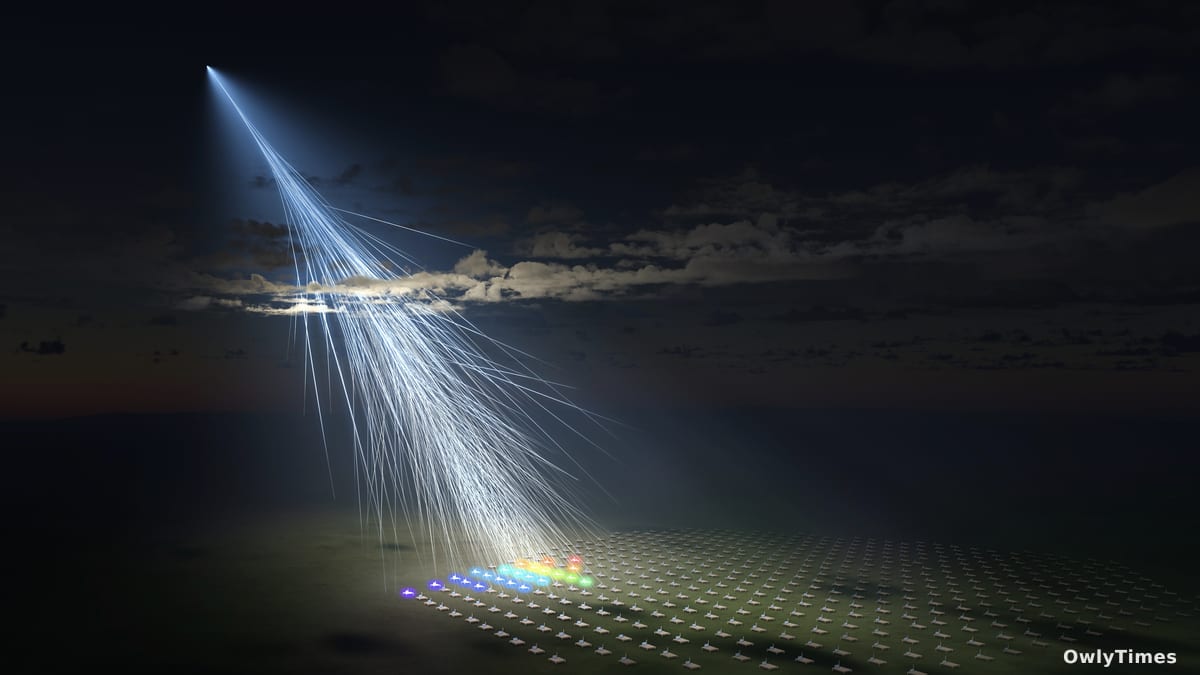
The Amaterasu particle, named after the Japanese sun goddess, registered an energy 40 million times greater than that achieved by the world’s most powerful accelerator, the Large Hadron Collider. This places it as the second-highest-energy cosmic ray ever observed, trailing only the infamous “Oh-My-God” particle detected back in 1991. The sheer energy of these particles demands an explanation: what cosmic process could possibly accelerate matter to such velocities? The prevailing hypothesis centered on the vast, relatively empty regions of space known as cosmic voids, theorizing that particles could gain energy over immense distances with minimal deflection. However, a new analysis by Francesca Capel and Nadine Bourriche at the Max Planck Institute for Physics is casting doubt on this assumption.
What the study, published January 28th in The Astrophysical Journal, actually found isn’t a definitive source for Amaterasu, but a significant narrowing of the possibilities. Headlines proclaiming a “solved mystery” are premature. Instead, Bourriche and Capel employed a sophisticated statistical technique called Approximate Bayesian Computation (ABC) to model the particle’s trajectory. ABC doesn’t directly show where Amaterasu came from; it compares the results of numerous simulations – each representing a different potential origin point and accounting for the influence of intervening magnetic fields – against the actual observational data. The simulations that best matched the observed path were then weighted as more probable. This approach, as Bourriche explains, “works by comparing the results of realistic, physics-based simulations with actual observational data to infer the most probable source locations.” The resulting “probability maps” pointed not towards the Local Void, but towards more densely populated regions, specifically nearby star-forming galaxies like M82.
This shift in potential origin points is crucial because it implies that ultra-high-energy cosmic rays aren’t necessarily produced in the most desolate corners of the universe. M82, for example, is a galaxy undergoing intense star formation, a process often accompanied by powerful supernova explosions and energetic outflows. These events are already known to accelerate particles, but typically not to the extreme energies observed in Amaterasu. The implication is that we may be underestimating the capacity of these “ordinary” galactic environments to produce these extraordinary particles. It also suggests that the universe may be teeming with more cosmic ray sources than previously imagined, simply because star-forming galaxies are far more common than vast cosmic voids.
However, it’s important to acknowledge the limitations to consider. ABC relies heavily on the accuracy of the simulations used to model particle propagation. Our understanding of interstellar magnetic fields, while improving, is still incomplete. Variations in magnetic field strength and direction could significantly alter the calculated trajectories, potentially shifting the probability maps back towards the void. Furthermore, the analysis is based on a single particle – Amaterasu. While its energy is remarkable, it’s still a single data point. A larger sample size of ultra-high-energy cosmic rays is needed to confirm whether Amaterasu is representative or an outlier.
The next crucial research step involves refining these simulations with more accurate magnetic field models and, critically, detecting more of these elusive particles. Future experiments, like upgrades to the Telescope Array experiment that initially detected Amaterasu, will be vital. But beyond simply identifying more particles, researchers are aiming to develop more advanced statistical methods, as Capel notes, “to exploit the available data to its full potential.” The question now isn’t just where these particles come from, but how – what specific mechanisms within these star-forming galaxies are capable of accelerating matter to such incredible energies? And, perhaps most importantly, if M82 is a likely source for Amaterasu, how many other similar galaxies are contributing to the flux of ultra-high-energy cosmic rays reaching Earth? The answer could fundamentally reshape our understanding of the universe’s most powerful engines.





