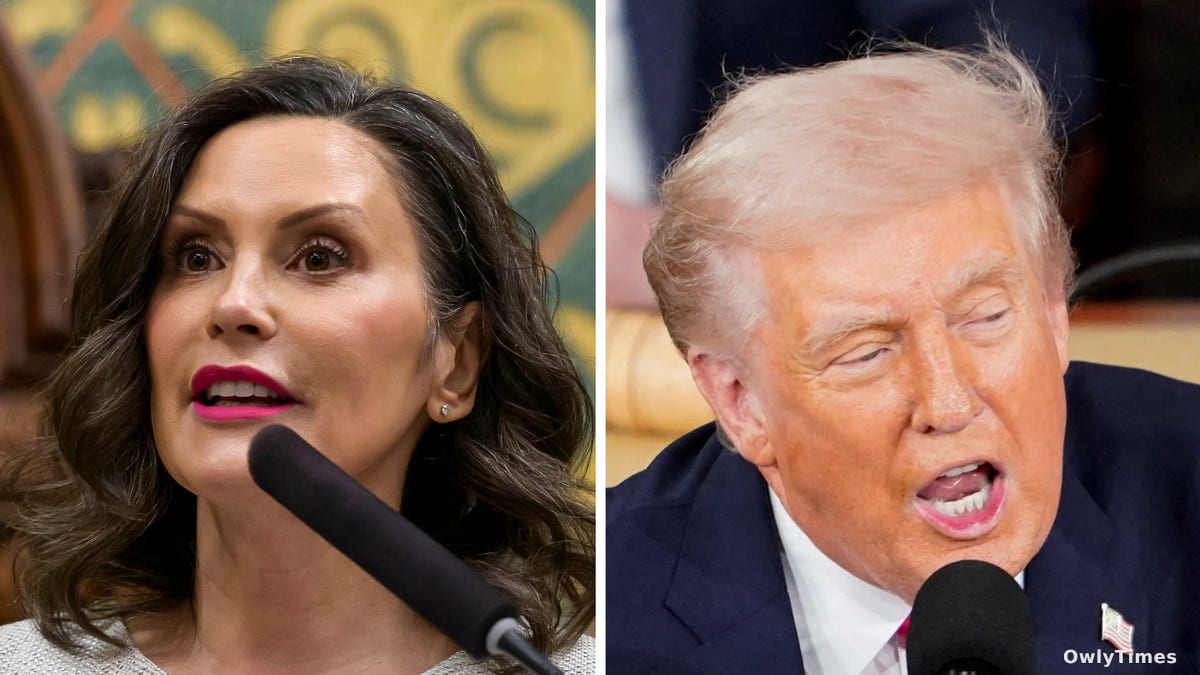

The strategic calculation behind Governor Gretchen Whitmer’s final State of the State address wasn’t about outlining a legacy, but about establishing leverage. Facing a divided Legislature and a looming special election that could further shift the balance of power in the Senate, Whitmer’s call for bipartisanship wasn’t a plea for unity, but a calculated move to define the terms of engagement for her final year in office. The speech, delivered just a day after President Donald Trump’s sharply partisan State of the Union address, served as a deliberate contrast – and a subtle assertion of political strength through the appearance of reasonableness. Who benefits and who loses from this positioning is immediately clear: Whitmer attempts to cast herself as a pragmatic leader capable of bridging divides, while simultaneously framing Republicans as potential obstacles to progress.
The juxtaposition with Trump’s speech, as noted by Aaron Kall, director of the University of Michigan’s debate program, was “diametrically opposed.” This wasn’t accidental timing; it was a strategic deployment of optics. Trump, emboldened by a Congress fully under his party’s control, doubled down on division, openly criticizing Democrats. Whitmer, by contrast, highlighted areas of past bipartisan cooperation, naming specific Republican lawmakers – Representative Tim Kelly and Senator Dayna Polehanki among them – and framing collaboration as the defining characteristic of Michigan’s identity. This echoes a historical pattern: leaders facing legislative headwinds often attempt to occupy the “reasonable center” to pressure opponents into compromise, or to shift blame when negotiations fail. Think of Lyndon B. Johnson’s masterful manipulation of Southern Democrats to pass civil rights legislation, or Bill Clinton’s “triangulation” strategy in the 1990s.
The immediate challenge for Whitmer is the composition of the Legislature. Republicans control the House, and the Senate is precariously balanced at 19-18, with a special election in the Tri-Cities region in May potentially tipping the scales. This dynamic necessitates a delicate dance. While Speaker Matt Hall has signaled a desire for fewer laws in 2026 – a clear indication of resistance to Whitmer’s agenda – the governor needs Republican votes to achieve her stated priorities: improving literacy rates, addressing rising healthcare costs, and tackling the housing crisis. The proposed housing package, led by Representative Joe Aragona, exemplifies this tension. While presented as a bipartisan solution, it has already drawn criticism from local leaders like Riverview Mayor Andrew Swift, who fear a loss of local control. This foreshadows a recurring pattern: Whitmer will likely push for statewide solutions, while Republicans prioritize local autonomy.
The governor’s attempt to secure a budget agreement “on time” – a pointed reference to last year’s delays – is another key indicator of the strategic stakes. The projected $1.8 billion shortfall adds another layer of complexity, with Republicans already rejecting elements of Whitmer’s proposed budget. The incentive to reach a deal before the election season intensifies is clear, but the ideological gulf remains substantial. This mirrors the budget battles of the early 2010s, when then-Governor Rick Snyder faced a similar situation with a Democratic-controlled Senate and a Republican-controlled House. The resulting compromises were often incremental and politically fraught. The fact that Michigan lawmakers have already spent approximately $1 billion over the last decade attempting to boost students' reading scores, with limited success, underscores the difficulty of achieving meaningful progress even with bipartisan intent.
Based on the original The Detroit News report.
Even a seemingly conciliatory gesture – thanking President Trump for securing the F-15EX mission for Selfridge Air National Guard Base – served a strategic purpose. It demonstrated Whitmer’s willingness to work with the opposing party when it benefits Michigan, further reinforcing her image as a pragmatic leader. However, the swift rebuke from Senator Jim Runestad, chairman of the Michigan Republican Party, who dismissed her entire tenure as a “disaster,” reveals the deep-seated animosity that still exists. This highlights a fundamental contradiction: Whitmer is attempting to build bridges with a party that appears determined to obstruct her agenda. The political chess move to watch next isn’t whether Whitmer can secure bipartisan agreements on specific policies, but whether the outcome of the Tri-Cities special election will fundamentally alter the power dynamics in Lansing, and whether a Republican victory will embolden the opposition to reject compromise altogether.





