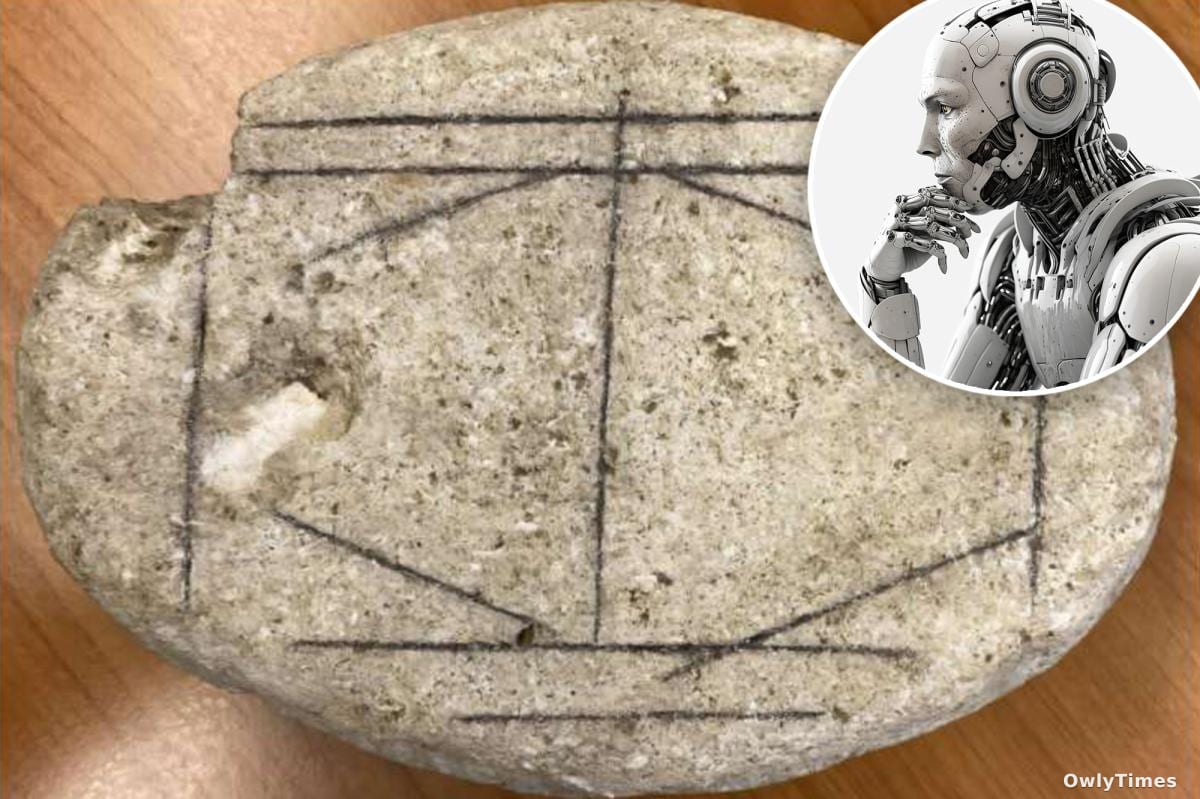

The chipped limestone sat in a Dutch museum for a century, a silent puzzle. Etched with a grid of lines, it hinted at a game, but no Roman text described it, no historical record confirmed its rules. It was a beautiful, frustrating enigma – a relic of daily life from an empire obsessed with conquest and engineering, reduced to a tantalizing whisper. Now, that whisper has a voice, and it’s speaking in algorithms. Researchers at Maastricht University haven’t just rediscovered a Roman game; they’ve demonstrated a new power dynamic in archaeology, one where artificial intelligence isn’t just assisting discovery, but actively leading it.
A Century of Stone-Faced Silence
The story begins in 1907, in Herleen, Netherlands, built atop the ruins of the Roman town of Coriovallum. A 20cm limestone tablet was unearthed, immediately recognized as something more than just a decorative stone. The lines carved into its surface suggested a board, but for what? The Het Romeins Museum, dedicated to the Roman presence in the region, displayed the artifact, a question mark in stone. For decades, scholars speculated, but without textual evidence, the game remained stubbornly undefined. The breakthrough came not from poring over ancient scrolls, but from 3D imaging revealing subtle wear patterns on the stone – evidence of pieces sliding along the carved lines, a ghostly echo of hands long gone. Walter Crist, an archaeologist at Leiden University specializing in ancient games, noted, “We can see wear along the lines on the stone, exactly where you would slide a piece. The appearance of the stone, combined with this wear, strongly suggests it’s a game.” But knowing that it was a game wasn’t enough; they needed to know how it was played.
Based on the original the New York Post report.
When the Machine Takes the Lead
That’s where Ludii enters the picture. Designed by Dennis Soemers, a researcher at Maastricht University, Ludii isn’t just another AI; it’s a gameplaying AI, capable of understanding and executing the rules of hundreds of games. Soemers programmed Ludii with the rules of roughly one hundred medieval and older games from the same cultural area as the Roman stone. Then, he let the machine play – against itself, thousands of times. Ludii generated dozens of potential rulesets for the Coriovallum game, then rigorously tested each one, simulating 1,000 rounds of play for every iteration. This wasn’t about finding the one correct answer, but identifying rulesets that produced engaging, logical gameplay. The AI, in essence, was reverse-engineering a pastime from the physical evidence, a feat previously unimaginable.
Blocking Games and Shifting Timelines
The results pointed to a blocking game, a two-player pursuit akin to tic-tac-toe, where the goal is to trap your opponent’s pieces. Players would have moved pieces – likely crafted from glass, bone, or earthenware – along the board’s lines, attempting to corner their opponent. This discovery is significant because it pushes back the known origins of this type of blocking game in Europe by centuries. Previously, historians believed these games didn’t emerge until the Middle Ages. The implications are subtle but profound. It suggests a more complex and interconnected cultural landscape in Roman Europe than previously understood, a world where leisure and strategic thinking flourished alongside military campaigns and political maneuvering. Now, anyone can experience the “Coriovallum Game” online through Ludii, a digital resurrection of a forgotten pastime.
Beyond the Headlines: The Future of Archaeological Inquiry
Soemers himself is cautious, acknowledging that Ludii’s results-based programming means the AI will always find rules that fit the pattern. “If you present Ludii with a line pattern like the one on the stone, it will always find game rules,” he admits. “Therefore, we cannot be sure that the Romans played it in precisely that way.” But even with that caveat, the impact is undeniable. Véronique Dasen, an archaeologist at the University of Fribourg who wasn’t involved in the study, called the discovery “groundbreaking,” suggesting it could revolutionize how we interpret ancient graffiti and potentially unlock the secrets of countless other unidentified artifacts. This isn’t just about solving a single puzzle; it’s about fundamentally changing the archaeological process. What happens when we routinely turn to AI not just to analyze data, but to generate hypotheses, to play with the past in ways we never thought possible? Will it democratize archaeological inquiry, allowing citizen scientists to contribute to the deciphering of history? Or will it create a new form of interpretive bias, where the algorithms dictate our understanding of the past? The Coriovallum Game has been played, but the real game – the one about how we uncover and interpret history – has just begun.