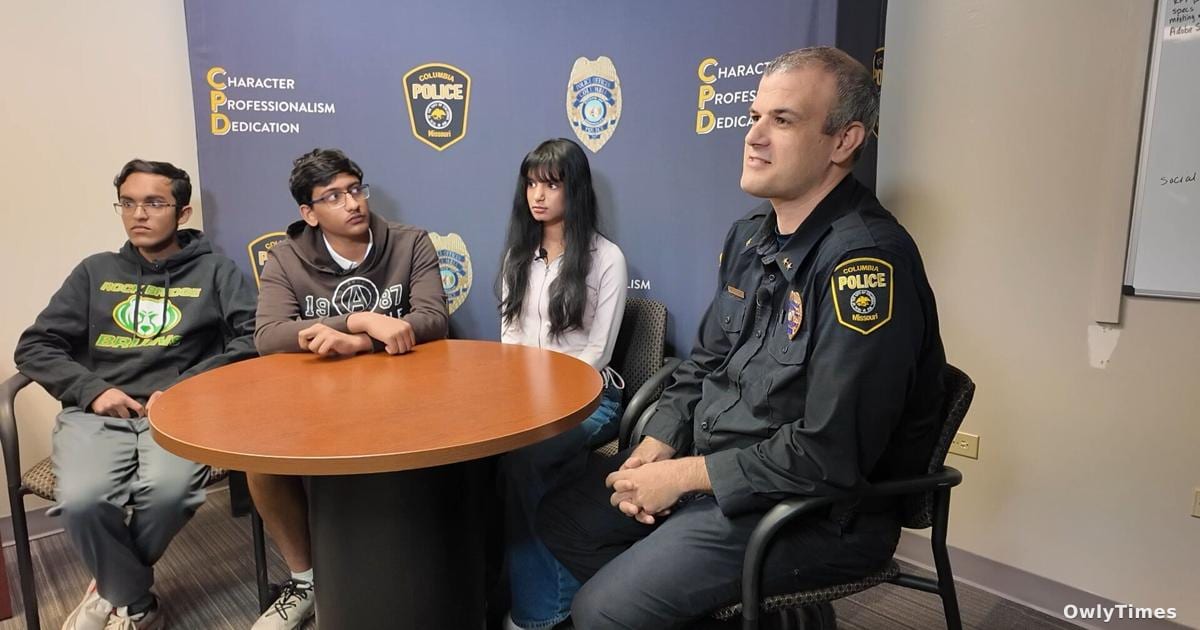

Is Silicon Valley’s obsession with “AI for Good” actually good, or just a convenient PR narrative? We’re constantly bombarded with stories of artificial intelligence solving the world’s problems, from climate change to cancer. But the real story here isn’t the utopian potential of AI – it’s who gets to define the problems it solves, and who benefits from those solutions. Take, for example, the work of three high school students in Columbia, Missouri: Aneesh Calyam, Aayan Behura, and Aanya Shetty of Rock Bridge High School. They’re state champions in the 2026 Presidential AI Challenge, building tools to assist the Columbia Police Department. It’s a feel-good story, sure, but it also raises uncomfortable questions about the increasing reliance on algorithmic “solutions” to deeply human problems.
These aren’t kids tinkering with a chatbot. Calyam, Behura, and Shetty have developed AI-powered tools for 911 call analysis, video surveillance, and police reporting. They’ve essentially built a system to predict crime, based on data provided by the University of Missouri Police Department and, later, the Columbia Police Department. As Shetty explained to KOMU 8, they “look at data from 911 calls and create graphs and trends of each sector of crime.” The goal, according to the students, is to help police with “more tedious aspects of the job.” But “tedious” often translates to the core functions of policing – investigation, judgment, and ultimately, the application of force. The students themselves acknowledge the ethical tightrope they’re walking, emphasizing that the AI “is never making the last decision.”
Based on the original komu.com report.
That’s a crucial caveat, but it doesn’t erase the inherent biases baked into the system. Calyam explained the process: “You have to teach (AI) based on a big data set or a bunch of examples…You tell it what is happening and you do that over millions of times.” But who decides what constitutes a “crime” worthy of those millions of examples? Historical policing data is notoriously skewed, reflecting decades of discriminatory practices and over-policing in marginalized communities. Feeding that data into an AI doesn’t magically erase the bias; it amplifies it, automating and legitimizing existing inequalities. The system learns to identify “crime” based on patterns that already disproportionately target certain populations.
The Columbia Police Department’s enthusiasm is tempered by practical concerns. Assistant Chief Mark Fitzgerald praised the students’ work as “incredibly impressive,” but also revealed that the tools aren’t currently being implemented due to “security concerns” surrounding sensitive law enforcement data and cybersecurity risks. This isn’t a rejection of the technology itself, but a stark reminder that even the most well-intentioned AI projects face real-world hurdles. It also highlights a fundamental tension: the desire for innovation clashes with the need to protect privacy and prevent misuse. Fitzgerald rightly points out that implementation requires “support and encouragement from the community and being a part of a community wide conversation.” That conversation, however, is often missing.
The students are heading to the regional competition on April 13th, hoping to further refine their tools and “change the perception of AI a little bit more for the positive.” That’s admirable, but the bigger challenge isn’t changing public perception – it’s confronting the uncomfortable truth that AI isn’t a neutral force. It’s a reflection of the values, biases, and power structures of those who create it. The real impact of this project, and others like it, won’t be measured in competition wins or technological advancements, but in how it reshapes the relationship between communities and the institutions that police them.
Here’s what to watch for: in the next six months, expect to see a surge in similar “AI for Good” initiatives targeting local law enforcement. But pay less attention to the press releases and more attention to the data. Specifically, track whether these tools lead to a demonstrable reduction in crime across all communities, or simply a more efficient targeting of already over-policed neighborhoods. The success of these projects won’t be about building better algorithms; it will be about building a more just system.