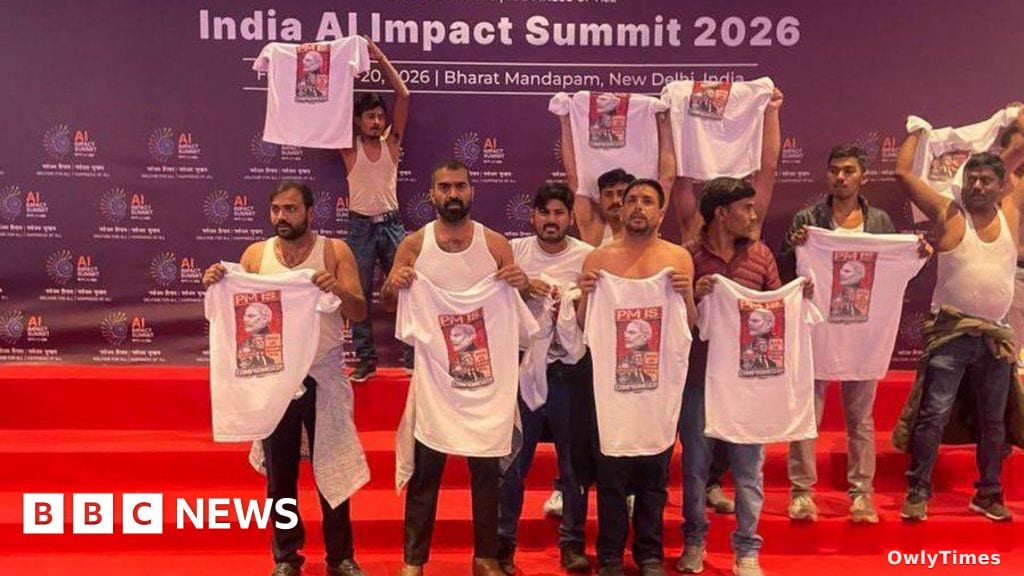

The arrests stemming from a “shirtless” protest at the India AI Impact Summit weren’t a spontaneous outburst, but a calculated, if provocative, maneuver by the Indian National Congress to disrupt the narrative surrounding the Narendra Modi government’s push for technological advancement and international partnerships. The incident, occurring on February 20th, wasn’t about the AI summit itself, but about leveraging its high-profile status – featuring figures like Sam Altman and Dario Amodei – to amplify grievances regarding unemployment and a contentious trade deal with the United States. This wasn’t a case of a protest at an event, but a deliberate attempt to hijack its global visibility.
The Stakes of Disruption: Who Benefits and Who Loses?
The immediate losers are, predictably, the BJP. Modi himself directly addressed the incident, framing it as a deliberate attempt to “tarnish” India’s image on the world stage. This framing is crucial; the government has heavily invested in projecting an image of India as a rising tech power, a stable partner for foreign investment, and a responsible global citizen. The protest, with its deliberately disruptive imagery, directly undermines that carefully constructed narrative. However, the Congress believes the potential gains – forcing a conversation about economic anxieties and perceived threats to domestic industries – outweigh the risk of being labeled reckless. The arrests of eight Youth Congress members, including national president Uday Bhanu Chib, are not simply punitive, but a demonstration of power intended to deter future disruptions. The fact that police allege Chib was the “mastermind” despite his claims of absence underscores the government’s desire to target the leadership of the protest.
Source material: the BBC.
A History of Provocation: Echoes of Indian Political Protest
This tactic – employing deliberately provocative demonstrations to seize media attention – isn’t new to Indian politics. The Congress, and opposition parties more broadly, have a long history of utilizing disruptive protests, often involving symbolic acts of defiance. Consider the salt satyagraha led by Mahatma Gandhi against British rule, a deliberate violation of law designed to galvanize public opinion. While the scale and context are vastly different, the underlying principle remains the same: to force a confrontation that exposes perceived injustices and challenges the legitimacy of the ruling power. The current protest, however, operates in a media landscape saturated with visual content, making the “shirtless” element particularly potent for social media virality. The risk, as highlighted by editorials in The Print, is that such tactics can be perceived as performative and lacking in substantive policy critique.
Beyond the Headlines: The Trade Deal at the Core
The protest’s focus on the proposed India-US trade deal is a critical, and often overlooked, element. The Youth Congress alleges the deal will harm farmers, small businesses, and youth employment. While details of the deal remain under negotiation, concerns about potential impacts on India’s agricultural sector and domestic industries are legitimate. The BJP has positioned the trade deal as a win for India, opening up new markets and attracting investment. The Congress, however, is attempting to frame it as a capitulation to US interests, exacerbating existing economic inequalities. This resonates with a segment of the Indian population already feeling the pressures of globalization and economic liberalization. The timing of the protest, coinciding with the AI summit, was designed to juxtapose the promise of a high-tech future with the anxieties of those potentially left behind.
The Next Chess Move: Will the Congress Escalate?
The immediate political fallout has seen further protests by Youth Congress members following Chib’s arrest, and a hardening of positions on both sides. Rahul Gandhi’s characterization of the arrests as evidence of “dictatorial tendencies” signals the Congress’s intention to portray the government as increasingly authoritarian. The key question now is whether the Congress will escalate its tactics. Will they attempt further disruptions of high-profile events, or will they shift to a more conventional parliamentary strategy? The government’s response to any further provocations will be equally telling. Will they continue to prioritize maintaining India’s international image, even at the cost of appearing heavy-handed in suppressing dissent? The next move to watch is whether Chib’s legal defense will focus on challenging the evidence of “criminal conspiracy” – a claim that, if substantiated, could significantly damage the Congress’s credibility.





