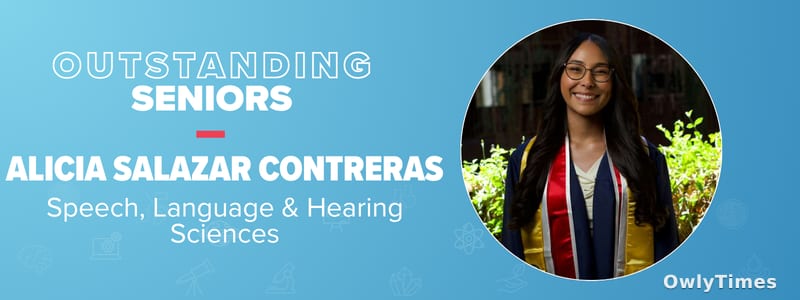

In a nation increasingly rich in linguistic diversity, the question of how to provide equitable and effective healthcare services, particularly in specialized fields like speech-language pathology, becomes paramount. How do we ensure that assessment tools and therapeutic interventions are not only clinically sound but also culturally and linguistically appropriate for all populations? This pressing scientific and societal challenge is precisely what students like Alicia Salazar Contreras are beginning to tackle, exemplified by her recent recognition as an outstanding senior in the University of Arizona's College of Science.
Alicia Salazar Contreras was among 12 outstanding seniors recognized this spring for their contributions both within and outside the classroom. Her journey into Speech, Language & Hearing Sciences was deeply rooted in a personal understanding of bilingualism, having grown up as a Spanish-English speaker. This foundational experience sparked an early interest in the development of language in bilingual children and, critically, the profound need for bilingual speech-language pathologists. Her experiences highlighted the significant barriers individuals can face when seeking speech and language services, fostering a critical shift in her perspective towards enhancing service availability for underserved populations across the United States.
Bridging Linguistic Gaps in Speech Pathology
A superficial glance at student achievements might celebrate a research project simply for its completion, but Salazar Contreras's work represents a deeper, more urgent contribution to the field. Rather than just fulfilling an academic requirement, her undergraduate research culminated in the development of "Sopa de Pescado," a Spanish language passage specifically designed to assist in the assessment of motor speech disorders. This isn't merely a translation; it’s an adaptation that acknowledges the linguistic nuances required for accurate diagnostic evaluation in Spanish-speaking contexts. This innovation directly addresses a critical gap, demonstrating how existing professional frameworks can be thoughtfully adapted to serve populations historically overlooked by predominantly English-centric assessment tools.
Her studies, particularly the Bilingualism, Multiculturalism, and Language Varieties course, profoundly influenced her approach. It opened her eyes to the diverse ways clinicians can tailor their services, even when they don't share a language with their clients. The impact of such insights is far-reaching, advocating for practices that are culturally and linguistically aligned, rather than imposing a one-size-fits-all model that can lead to misdiagnosis or inadequate care. The University of Arizona's commitment to fostering such impactful student research is a positive indicator for future advancements in equitable healthcare, as detailed on their news portal outlining the outstanding seniors in the College of Science.
Limitations and Future Directions
While the development of "Sopa de Pescado" is a commendable step forward, it is important to contextualize its current scope. As an undergraduate research contribution, it represents a proof-of-concept—a single, targeted passage. The broader application and validation of such a tool would typically require extensive clinical trials, peer review, and integration into wider diagnostic protocols. This initial development, however, provides a vital foundation, signaling a promising direction for future research and development in this critical area of speech-language pathology. The challenge now lies in expanding this framework to a comprehensive suite of tools, ensuring they meet rigorous scientific standards for reliability and validity across diverse Spanish-speaking communities.
Looking ahead, Alicia Salazar Contreras is not stopping here. She will be returning to the University of Arizona to pursue graduate studies, enrolling in the Master of Sciences in Speech-Language Pathology program. Her ultimate goal is to become a certified bilingual speech-language pathologist, a profession in high demand that directly addresses the disparities she identified. This next phase of her academic and clinical training will be crucial for translating the innovative spirit of "Sopa de Pescado" into broader clinical practice and further research. The continued development of culturally and linguistically competent professionals, coupled with rigorous research into adaptable assessment tools, will be key to truly bridging the resource gap for Spanish speakers and other underserved populations within the United States. Further information on the field of speech-language pathology can be found via the American Speech-Language-Hearing Association (ASHA).