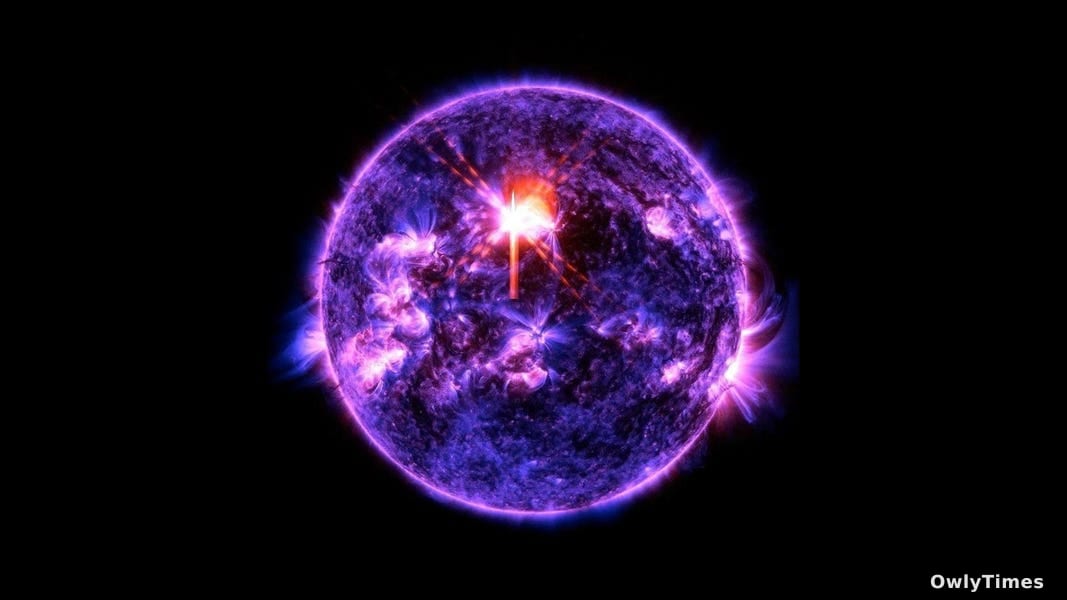

How can we predict the most violent outbursts from the star that sustains us, particularly when our modern technological infrastructure is increasingly vulnerable to its temper? While space weather forecasting has long focused on short-term warnings, a new approach suggests we might be able to anticipate the sun’s most extreme “superflares” on a much longer timeline. By identifying rhythmic patterns in solar plasma, researchers are attempting to move from reactive observation to proactive risk assessment.
Forecasting the Solar Rhythm
The study, published in the Journal of Geophysical Research: Space Physics, introduces a probabilistic system for identifying "S-class" solar flares. These are defined as eruptions exceeding X10 intensity on the standard scale. Unlike standard flares, which often catch satellite operators and power grid managers by surprise, this methodology focuses on the underlying solar rhythms that precede such events. An international team led by scientists at the National Autonomous University of Mexico identified two specific cycles—lasting roughly 1.7 years and seven years—linked to oscillations in the sun’s plasma known as magneto-Rossby waves.
When these cycles align in a positive phase, the likelihood of an S-class event climbs significantly. By applying machine learning to data collected between 1975 and 2025 from the Geostationary Operational Environmental Satellites, the researchers have isolated specific windows for these potential eruptions. The model points to two primary periods for Solar Cycle 25: one spanning mid-2025 through mid-2026, and another anticipated for early-to-mid 2027.
Distinguishing Probability from Prediction
It is critical to distinguish what this study offers from the sensationalism often found in space weather reporting. The researchers are not claiming they can pinpoint the exact second a flare will ignite; rather, they are providing a strategic window of increased risk. While the sun is currently waning from its solar maximum—estimated by NOAA and NASA to have occurred in October 2024—the magnetic energy remaining in the system remains formidable.
The data highlights a compelling trend: every solar cycle since the late 1970s has produced at least one Earth-directed superflare, with the notable exception of the current one. This statistical "gap" leads the researchers to suggest we may be overdue. For context, the largest solar flare recorded so far in 2026 reached an X8.3 intensity on Feb. 1, a powerful event that nonetheless fell short of the S-class threshold. The recent capture of a flare by NASA’s Solar Dynamics Observatory on Feb. 4, 2026, serves as a reminder of the sun's constant activity, but the study reminds us that the true danger lies in the far-reaching X10-plus events that have thus far eluded us in this cycle.
Limitations to Consider
While the prospect of a one-to-two-year warning system is enticing, the model faces significant hurdles. Solar physics is inherently chaotic; even if the background conditions for an S-class flare are met, the actual trigger remains elusive. Furthermore, the study notes that during May 2024, scientists observed flares on the far side of the sun—including estimated X11.1 and X16.5 eruptions—that occurred outside of the primary forecasted windows. These events prove that the sun can generate extreme energy even when its visible disk appears relatively calm. Reliance on this forecasting system must therefore be tempered by the reality that our understanding of solar magnetism remains a work in progress.
The next reading of the solar cycle’s magnetic intensity and the frequency of smaller flares will show whether this probabilistic window holds true. As mission planning for future human exploration, such as the Artemis III and Artemis IV programs, continues to evolve, these long-range forecasts will become increasingly vital for protecting both orbital assets and the astronauts who depend on them.