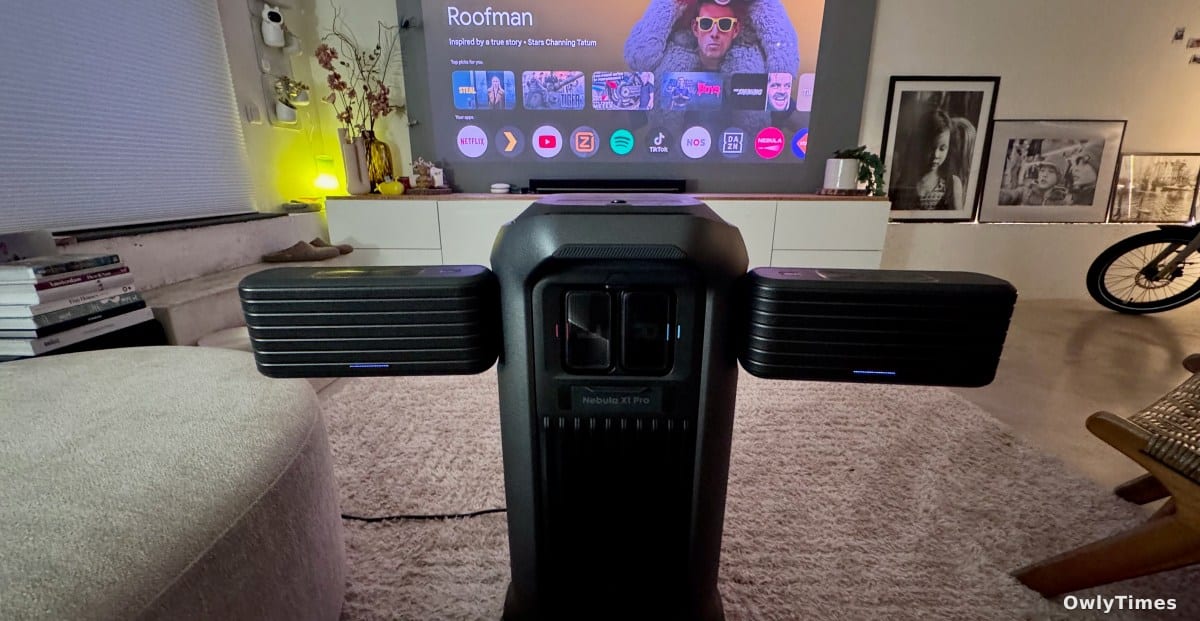

The bass rattled my ribcage before I even fully processed the robotic whir of unfolding speakers. It wasn’t just loud; it was a physical presence, a declaration that home theater had officially left the living room. Anker’s Soundcore Nebula X1 Pro isn’t simply a portable projector – it’s a statement, a $4,999 (or £4,499, €4,999.98) assertion that you can, in fact, have a complete Dolby Atmos surround sound system on wheels. And frankly, it’s a little bit terrifying how well it pulls it off. This isn’t about incremental upgrades or refining existing tech; it’s about a company throwing a gauntlet down, asking if anyone dares to build something this absurdly ambitious.
The X1 Pro builds on the foundation of last year’s Nebula X1, a highly-regarded 4K projector, and then…well, it just adds things. A lot of things. We’re talking a 3500 ANSI lumen projector, capable of a remarkably bright and vivid picture, crammed into a chassis that houses a thumping subwoofer and four battery-powered speakers that automatically deploy like the wings of some futuristic audio bird. It’s a feat of engineering, yes, but more importantly, it’s a reflection of a growing desire for experiences that obliterate the boundaries between convenience and quality. For years, “portable” meant compromise. The X1 Pro suggests we’re entering an era where that’s no longer true, even if it means accepting a device that weighs in at a hefty 32.8kg (72.31 pounds).
This isn’t just about a better movie night; it’s about the democratization of immersive entertainment. Historically, a setup comparable to the X1 Pro – a 4K projector paired with a full Dolby Atmos sound system – would require dedicated space, professional installation, and a budget exceeding five figures. Anker is collapsing that complexity into a single, albeit expensive, unit. This speaks to a broader cultural shift: a demand for premium experiences delivered on our terms. We want the concert hall sound, the cinematic visuals, but we want it in the backyard, on the patio, or easily moved from room to room. The X1 Pro isn’t catering to audiophiles who already have dedicated home theaters; it’s targeting those who want one, but are constrained by space, budget, or simply the desire for flexibility.
Drawn from The Verge.
Beyond the headlines about its sheer audacity, the X1 Pro reveals a fascinating tension within the tech industry. We’re constantly told to embrace minimalism, to declutter our lives, to prioritize portability. Yet, simultaneously, there’s a surging appetite for maximalism, for devices that do everything, even if it means sacrificing some degree of elegance or practicality. The X1 Pro embodies this contradiction perfectly. It’s undeniably bulky, occasionally struggles with Wi-Fi connectivity (a frustrating issue reported during testing, requiring frequent reboots), and is, let’s be honest, almost laughably over-engineered. But it also delivers an astonishingly immersive experience, capable of rivaling dedicated home theater systems. Thomas Ricker of The Verge noted the sound quality rivaled his 5.1 Sonos system, a testament to the power packed into this portable powerhouse.
The success of the X1 Pro, or devices like it, will hinge on whether consumers are willing to pay a premium for that all-in-one convenience. While the $4,999 price tag is undeniably steep – significantly higher than the $3,999 of the original Nebula X1 – it’s still less than the cost of building a comparable system from scratch. But the real question isn’t just about the price; it’s about the perceived value. Will consumers see the X1 Pro as a luxury item, a status symbol, or a genuinely practical solution to their entertainment needs? And, crucially, will other manufacturers respond with their own equally ambitious, all-in-one entertainment systems? Because if the X1 Pro signals anything, it’s that the future of home entertainment might just be…on wheels. We’re about to see if the industry is willing to roll with it.