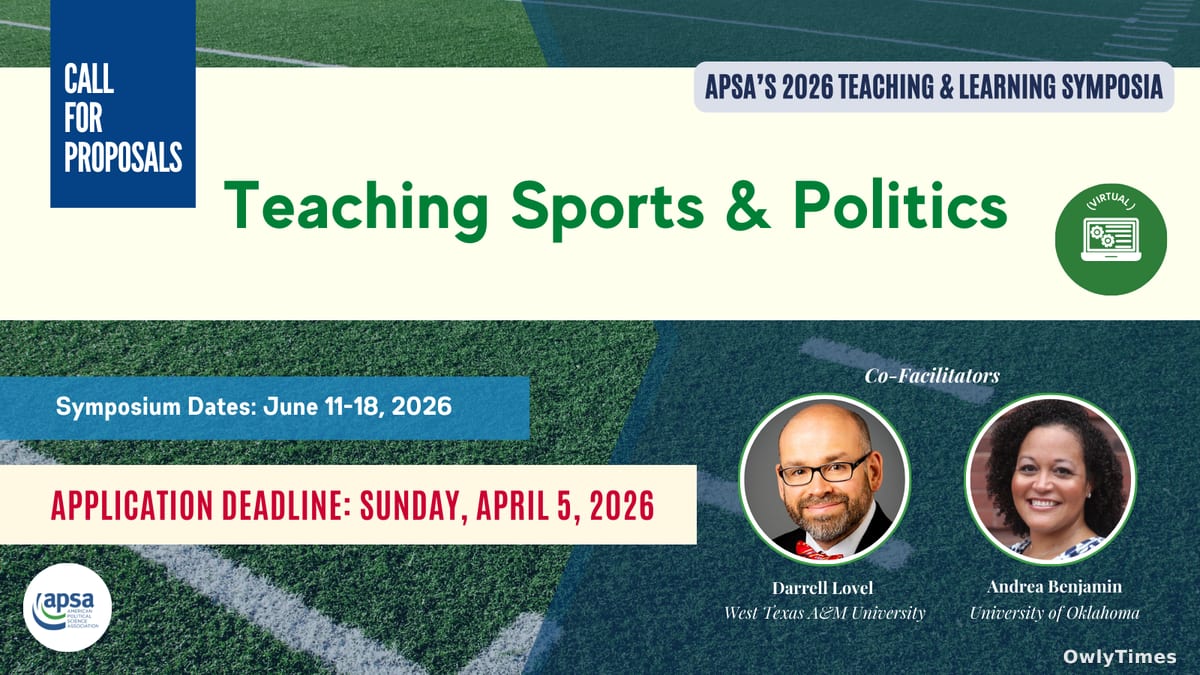

The American Political Science Association’s (APSA) upcoming symposium on “Teaching Sports and Politics” isn’t simply an academic exercise in broadening pedagogical approaches; it’s a calculated response to a shifting political landscape where the lines between athletics, policy, and public discourse are increasingly blurred. The June 11-18, 2026, virtual event, led by Darrell Lovell of West Texas A&M University and Andrea Benjamin of the University of Oklahoma, signals a recognition within the discipline that traditional civic education methods are failing to engage students with contemporary power dynamics. The call for proposals, with a deadline of April 5, 2026, isn’t about finding better ways to teach about politics – it’s about finding better ways to reach students through a cultural touchstone they already understand.
The strategic rationale is clear. Declining civic engagement among young people, coupled with increasing political polarization, demands innovative approaches. Sports, with its inherent drama, competition, and readily identifiable heroes and villains, provides a compelling entry point. The symposium’s focus on topics like Name, Image, and Likeness (NIL) policies, Title IX, and athlete activism directly addresses issues that are already dominating headlines and student conversations. Lovell’s own research on NIL, culminating in his book Name, Image, and Likeness (NIL) Policies: Institutional Impact and State Responses, underscores the academic rigor being brought to bear on these previously under-examined areas. This isn’t about dumbing down political science; it’s about contextualizing it within a framework that resonates with a generation accustomed to instant information and visual storytelling.
Who benefits and who loses from this initiative? Faculty in political science, public administration, and related fields stand to gain access to a collaborative network and updated teaching resources. The symposium’s goal of contributing materials to APSA Educate, a virtual teaching resource library, promises to elevate the quality of instruction across the discipline. Students, particularly those disengaged by traditional lecture formats, are the primary beneficiaries of more relevant and engaging coursework. However, the potential exists for a backlash from those who view the politicization of sports as inherently detrimental. Conservative commentators, for example, might criticize the inclusion of topics like athlete activism or the challenges of teaching about race and gender in athletics as injecting “woke” ideology into the classroom. This tension reflects a broader cultural war over the role of identity politics in public life.
Historically, attempts to integrate popular culture into academic curricula have met with mixed success. In the 1990s, the rise of hip-hop studies faced similar resistance, with critics dismissing it as unserious scholarship. However, hip-hop studies ultimately gained legitimacy by demonstrating its analytical value in understanding issues of race, class, and power. The “Teaching Sports and Politics” symposium appears to be anticipating this pattern. The emphasis on rigorous research – as evidenced by Benjamin’s work on racial coalition building and her publications in journals like Journal of Politics and Urban Affairs Review – suggests a commitment to establishing the academic credibility of this emerging field. The symposium isn’t simply inviting instructors to share anecdotes; it’s demanding evidence-based pedagogical approaches.
Source material: politicalsciencenow.com.
The symposium’s structure itself reveals its strategic intent. The combination of individual presentations, small-group collaborations, and a dedicated resource-creation phase is designed to foster both intellectual exchange and tangible outcomes. The week-long format, broken into focused sessions with independent work periods, acknowledges the demands on faculty time while maximizing opportunities for meaningful engagement. The July 3 deadline for submitting resources to APSA Educate ensures that the symposium’s impact extends beyond the immediate participants, creating a lasting legacy of innovative teaching materials. The $20/$35 registration fee, while modest, serves as a barrier to entry, ensuring a level of commitment from attendees.
The political chess move to watch next isn’t within APSA itself, but within university departments. Will department chairs and curriculum committees actively encourage faculty to participate in the symposium and integrate sports-related content into their courses? Or will resistance from more traditional faculty members stifle the initiative? The success of this program hinges not just on the quality of the resources developed, but on the willingness of institutions to embrace a new, more engaging approach to civic education. The question isn’t whether sports can be used to teach politics, but whether political science departments will allow it to happen.





