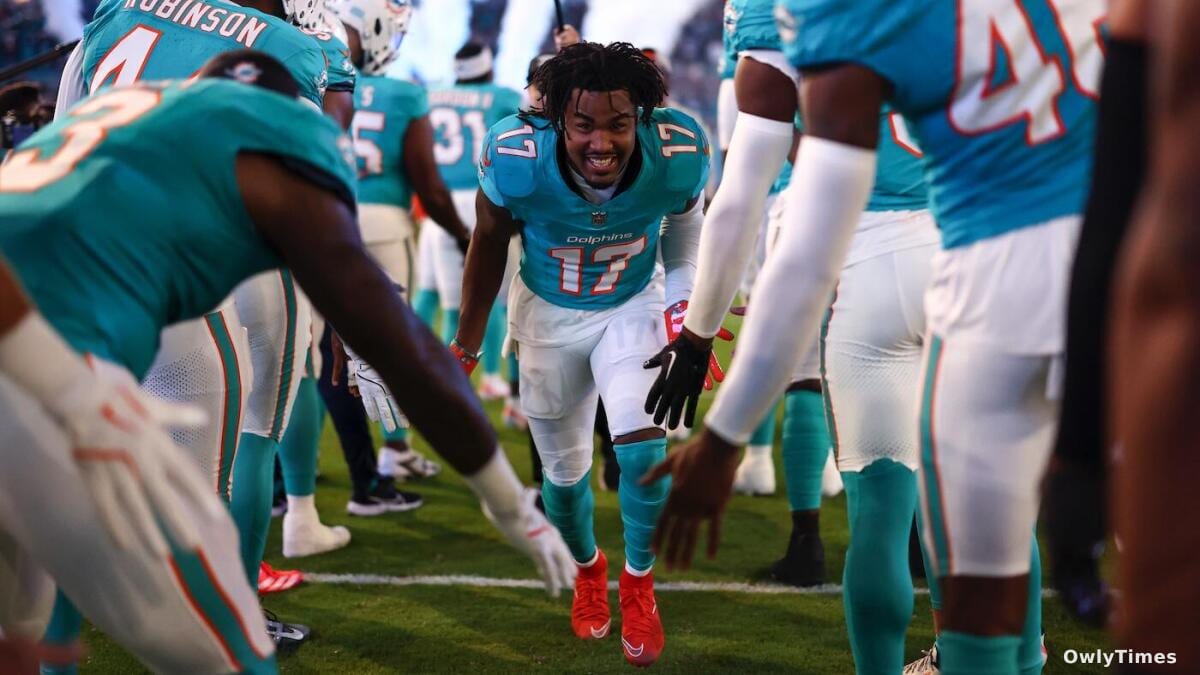

$84.75 million is the price tag attached to the Denver Broncos’ aggressive bet on their Super Bowl window. Tuesday’s acquisition of wide receiver Jaylen Waddle from the Miami Dolphins wasn’t simply about adding a talented playmaker; it was a calculated financial maneuver predicated on maximizing the value of a uniquely cheap quarterback contract. Follow the money, and the Broncos’ strategy becomes clear: spend aggressively now, while Bo Nix’s rookie deal keeps the salary cap flexible, before looming contract extensions and potential declines force a reckoning.
The Broncos, fresh off a 14-3 season and an AFC Championship appearance cut short by a late-game injury to Nix, surrendered their first-round pick (No. 30 overall) and two additional draft selections to secure Waddle and a fourth-round pick. This isn’t a rebuild move; it’s a win-now push. Despite the team’s recent success, the AFC is a gauntlet, and the Broncos recognize that sustained contention requires maximizing every available advantage. The cost – a premium draft capital – is justified by the urgency created by Nix’s contract situation. He accounted for a mere 1.5% of the Broncos’ salary cap last season, a figure dwarfed by division rivals like Patrick Mahomes (9.8%) and Justin Herbert (13.2%).
This disparity is the engine driving Denver’s current strategy. Over the next two seasons, Nix’s cap hit will remain under 2%, according to Over the Cap, providing the financial breathing room to absorb Waddle’s three-year, $84.75 million extension. This is a critical window. The fifth-year option on Nix’s rookie contract looms in 2028, and extension talks will begin after the 2027 season. Once Nix’s second contract kicks in, the Broncos’ financial flexibility will diminish significantly, making similar blockbuster trades far more difficult. GM George Paton understands this, and the Waddle acquisition is a direct response to the ticking clock.
This piece references the CBS Sports report.
Beyond Nix, the Broncos have proactively addressed key player contracts, securing long-term commitments from pass rusher Nik Bonitto ($106 million through 2029), cornerback Patrick Surtain II ($96 million through 2029), wide receiver Courtland Sutton ($92 million through 2029), and guard Quinn Meinerz ($80 million through 2028). However, potential free agent departures in 2027 – including wideout Marvin Mims and guard Ben Powers – and in 2029 – with Waddle, Garett Bolles, and Meinerz all potentially hitting the market – create future challenges. The 2029 offseason, coinciding with Nix’s potential second contract, represents a critical inflection point for the franchise’s core.
The AFC West itself presents a complex landscape. While the Broncos currently hold the upper hand, the Kansas City Chiefs, despite Patrick Mahomes’ ACL tear, remain a formidable opponent. The Chargers, with a healthy Justin Herbert and a revamped offensive line, pose a significant threat. Even the rebuilding Raiders, poised to select quarterback Fernando Mendoza with the No. 1 overall pick, represent a future challenge. The Broncos’ window, however, is now. With Mahomes’ recovery uncertain and the Chargers still seeking consistency, the next two seasons offer Denver its clearest path to a Super Bowl berth.
What this means for your wallet: Broncos fans should expect ticket prices and merchandise costs to remain elevated as the team capitalizes on its Super Bowl aspirations. The team’s aggressive spending signals a commitment to winning, which will likely translate to increased demand and higher prices for fans. More importantly, watch closely how the Broncos manage the 2029 offseason. Will they be able to retain key players like Waddle and Meinerz while navigating Nix’s likely substantial contract extension? The answer to that question will determine whether this current window of contention extends beyond the next two seasons.

