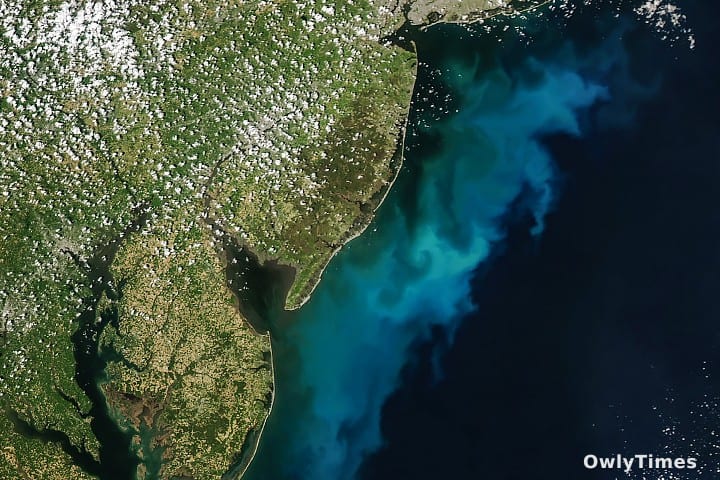

How do we discern the subtle shift of life within the "noisy" coastal waters that have long defied clear satellite observation? For years, the Mid-Atlantic Bight—the shallow region where the Raritan Bay, Delaware Bay, and Chesapeake Bay meet the Atlantic Ocean—has been a blind spot for oceanographers. The confluence of sediment-heavy river runoff and seasonal storm turbulence creates a complex, murky optical environment that masks the biological activity beneath the surface.
Beginning in early April, satellite imagery began detecting unusual brownish and blue-green patches lingering off the coasts of New Jersey, Delaware, Maryland, and Virginia. While the standard interpretation might attribute this color to terrestrial sediment churned up by spring weather, current data suggests a more active biological narrative. The integration of high-resolution spectral data from the PACE (Plankton, Aerosol, Cloud, Ocean Ecosystem) mission, which launched in 2024, is now allowing researchers to peel back these layers of "noise" with unprecedented clarity.
Moving Beyond the Murk
The central question for the NASA science team is whether these colors represent mere runoff or the foundation of the marine food web. Anna Windle, a research scientist at NASA's Goddard Space Flight Center, notes that the evidence points toward significant phytoplankton activity. While diatoms historically define the early spring cycle, the detection of coccolithophores alongside them suggests a shifting ecological composition in these coastal waters.
It is critical to distinguish what the satellite data is actually reporting versus the broader assumptions often made in ocean color analysis. Headlines might suggest a massive biological event, but the study finds a more nuanced, mixed-species bloom. PACE data confirms the presence of these organisms by mapping chlorophyll concentrations, effectively distinguishing between suspended minerals and living primary producers.
The Biological Signatures
Diatoms and coccolithophores are not merely aesthetic color variations in the water; they represent distinct functional roles in the marine environment. Diatoms, which typically present as greenish hues, thrive on the nutrient-rich upwellings common in early spring. Conversely, the presence of coccolithophores—indicated by a chalkier, turquoise appearance—suggests a transition in the water’s chemistry. These organisms construct plates of calcium carbonate, and their prevalence is a significant indicator of global biogeochemical cycling, as they are responsible for approximately one-half of modern calcium carbonate precipitation in the ocean.
However, there are limitations to consider regarding the longevity of these observations. As Rutgers University oceanographer Oscar Schofield explains, these blooms are highly sensitive to nutrient availability. The spring surge of nitrogen and phosphorus is finite; as the bloom expands, it inevitably depletes its own fuel source. Unless further storms or river outflows inject new nutrients into the shallow coastal zone, this specific display of biological productivity is likely to subside.
Observing the Next Transition
The primary value of this observation lies in the capability of the PACE mission to differentiate between these biological signatures in historically "dirty" water. The ability to monitor these transitions in real-time provides a clearer picture of how primary producers—the grasses of the sea—are responding to the seasonal shifts in the Mid-Atlantic.
Whether these blooms persist or fade will be determined by the interaction between nutrient depletion and environmental replenishment. The next reading of chlorophyll levels and reflectance data in the Mid-Atlantic Bight will serve as the primary indicator of whether these blooms are entering a state of decline or if the coastal ecosystem is experiencing an extended period of productivity. By watching these metrics, scientists can better understand the pulse of the ocean’s most complex coastal zones.





