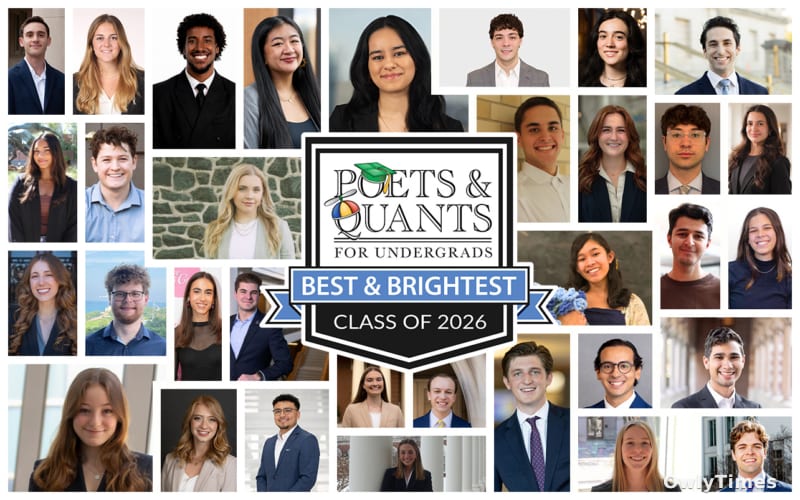

A perfect 4.0 GPA, coupled with a $1.5 billion in monthly views generated by a student-founded media venture – these aren’t isolated achievements, but indicative of a new breed of business school graduate demanding a re-evaluation of ROI for higher education. Ty Keough of USC’s Marshall School isn’t simply excelling in business school; he’s operating a scaled business through it, and his story, as highlighted by Poets&Quants’ “Best & Brightest Business Majors” list, reveals a shift in how top students are leveraging academic resources for tangible, immediate impact. Follow the money: Keough’s JAA Media, sold after attracting 22 million viewers, demonstrates a clear path from classroom learning to entrepreneurial success, a trajectory increasingly common among elite business programs.
Keough’s case isn’t unique within the “Best & Brightest” cohort, but it’s arguably the most concentrated example of parallel achievement. While many students balance academics with extracurriculars, Keough simultaneously built a successful company, excelled as a teaching assistant – earning a perfect 5.0 rating from 26 students on Rate My Professors – and advised major corporations like Chipotle and the World Health Organization through the Trojan Consulting Group. This isn’t simply time management; it’s a strategic deployment of skills and network, amplified by the Marshall School’s focus on emerging technologies like AI, where Keough assisted Kyle Mayer, the Vice Dean of MBA Programs. The school’s investment in AI programming isn’t just an academic pursuit; it’s a direct pipeline to students like Keough who can immediately monetize those skills.
Based on the original poetsandquantsforundergrads.com report.
The broader trend revealed by the “Best & Brightest” list – representing 68 schools globally – is a surge in student entrepreneurship and a focus on demonstrable impact. Samantha Asprelli of Northeastern University, for example, built Give n’ Glow into a $2 million operation distributing beauty products to women in need, securing partnerships with e.l.f. Cosmetics and Glossier. This isn’t philanthropy as an afterthought; it’s a business model built on social responsibility, attracting both investment and brand recognition. Compare this to the traditional post-MBA trajectory of joining established firms like McKinsey, Deloitte, or Goldman Sachs – employers who, notably, are still actively recruiting from this cohort (McKinsey hiring 5, Deloitte, Goldman Sachs, and JPMorgan Chase each hiring 3). The difference is agency: these students aren’t waiting for a corporate ladder, they’re building their own.
This entrepreneurial drive is further underscored by Matthew Merril of Cornell University, whose “Dormz” campaign with Amazon aired during the 2024 Paris Olympics. The scale of this exposure – across Hulu, cable television, social media, and even New York City taxis – represents a significant marketing win for Amazon, but also a powerful demonstration of a student’s ability to deliver high-impact content. This contrasts sharply with the historical model of internships as primarily learning experiences; Merril’s work directly contributed to a major brand’s national campaign. The fact that Amazon specifically sought a student creator highlights a growing recognition of Gen Z’s influence and their ability to connect with their peers.
However, the narrative isn’t solely about entrepreneurial success. Grace Zaucha of Notre Dame, graduating at 19 with an Accounting degree, and Valeria Serenil of the University of Houston, running a general contracting firm generating nearly $800,000 annually, demonstrate different facets of this high-achieving cohort. Zaucha’s mother’s journey – immigrating with $700 and subsequently earning an MBA and CPA – provides a powerful context for her success, highlighting the role of intergenerational ambition and the American Dream. Serenil’s recognition as the youngest recipient of the Houston Business Journal’s Women Who Mean Business Award underscores the increasing visibility of female entrepreneurs. These stories, while distinct, share a common thread: a proactive approach to opportunity and a commitment to exceeding expectations.
The emphasis on “trust” articulated by Keough – “Competence gets you in the room. Integrity and follow-through keep you there” – is a crucial takeaway. These students aren’t just accumulating credentials; they’re building reputations for reliability and execution. This is particularly relevant in an era of increasing skepticism towards traditional institutions. The fact that faculty consistently praise these students for their work ethic and willingness to go above and beyond – as evidenced by Professor Rajiv Garg’s description of Yashonandan Kakrania at Emory University (“always thinking about what more he can build”) – suggests a fundamental shift in the student-faculty dynamic. It’s no longer about passively receiving knowledge, but actively contributing to the learning ecosystem.
What this means for your wallet: the rising caliber of business school graduates like Keough, Zaucha, and Merril signals increased competition for top talent, potentially driving up salaries and benefits. More importantly, it suggests a future where entrepreneurial ventures are increasingly viable alternatives to traditional career paths, offering greater autonomy and potential for financial reward. Investors should watch for companies founded by these “Best & Brightest” graduates – they’re not just equipped with the latest business tools, they’re driven by a demonstrable track record of success and a commitment to building trust. The question now is: will established firms adapt to attract and retain this new generation of high-impact talent, or will they be disrupted by the businesses these graduates create?





