
The sheer power of a cataclysmic volcanic eruption often leaves us contemplating destruction, yet these dramatic geological events also present unique opportunities for scientific inquiry. A fundamental question in atmospheric chemistry revolves around the natural mechanisms that regulate the levels of greenhouse gases like methane. While volcanoes are known to emit methane, could they also play an unexpected role in its removal? A recent study, focusing on the extraordinary 2022 Hunga Tonga-Hunga Ha'apai eruption, suggests a surprising affirmative, revealing a previously unobserved atmospheric phenomenon that could redefine our understanding of natural methane cycles and inform future climate mitigation strategies.
Unveiling Methane's Rapid Atmospheric Breakdown
What scientists observed following the explosive Hunga Tonga-Hunga Ha'apai eruption in the South Pacific was truly remarkable. Satellites detected formaldehyde within the volcano's massive plume of ash and gas. This detection was a critical piece of evidence, indicating that a significant portion of the methane released by the volcano was undergoing rapid destruction. As Maarten van Herpen, an atmospheric scientist at Acacia Impact Innovation BV in the Netherlands and first author of the new study, explains, "It is known that volcanoes emit methane during eruptions, but until now it was not known that volcanic ash is also capable of partially cleaning up this pollution." This finding, published in Nature Communications (), marks a crucial step in understanding the complex interplay between geological forces and atmospheric chemistry.
It’s important to clarify what this study actually found versus what might be sensationalized. While the detection of formaldehyde confirms methane destruction, the volcano did not "clean up its own mess" entirely. The researchers estimated that approximately 900 metric tons of volcanic methane were destroyed by chlorine oxidation per day. However, this figure stands against an estimated 330-kiloton total methane output from the eruption. This means that while a natural cleanup mechanism was demonstrably at work, it was far from sufficient to neutralize the volcano's overall methane contribution. The true significance lies in the observation and quantification of this process, offering a proof of concept for chlorine-mediated methane cleanup in the atmosphere.
The Chemistry Behind the Plume's Surprising Effect
Methane is a potent greenhouse gas, naturally present in the atmosphere and essential for maintaining a habitable planet below certain thresholds. However, excessive methane, largely from human activity, exacerbates the greenhouse effect, trapping heat and contributing to global warming. Scientists have long sought ways to reduce atmospheric methane levels. One known pathway for rapid methane breakdown involves chlorine, a highly reactive element. When chlorine reacts with methane, it initiates a chain reaction that breaks down methane into other compounds, with formaldehyde appearing as a transient intermediate link in this process.
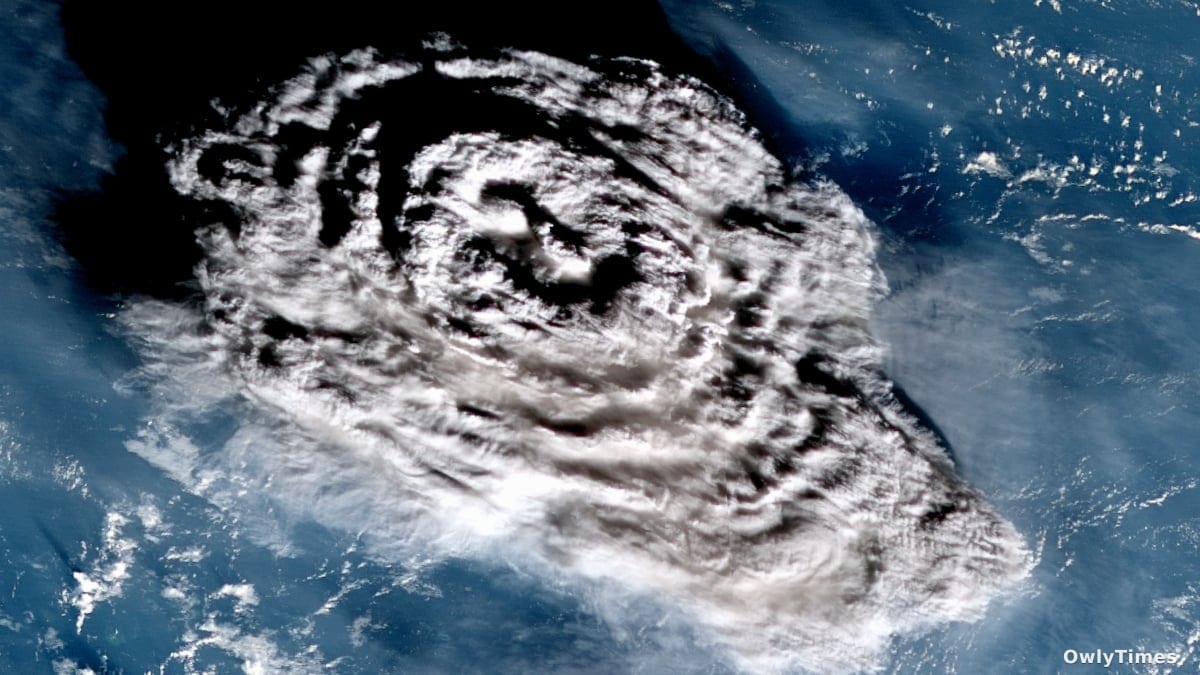
A photograph of the ash cloud, captured from the International Space Station the day after the eruption, vividly illustrates the scale of this event. The Hunga Tonga-Hunga Ha'apai volcano erupted from beneath the Pacific Ocean, blasting immense quantities of seawater and vapor high into the atmosphere. This unique circumstance provided a critical mix of ingredients. The colossal plume reached the highest altitude ever recorded, injecting not only methane but also salt and other mineral particles high above the Earth's surface. Researchers theorized that the combination of sunlight, water vapor, and salt particles within the plume led to the formation of reactive chlorine radicals, which then triggered the observed rapid disintegration of methane. This mirrors a process van Herpen's team previously observed in 2023, triggered by dust from the Sahara and ocean spray, suggesting a broader natural mechanism at play (). The ability to track the formaldehyde cloud for 10 days, all the way to South America, was key; since formaldehyde typically exists for only a few hours, its prolonged presence confirmed continuous methane destruction.
Limitations to Consider and the Path Forward
While groundbreaking, this research also highlights several limitations. The Hunga Tonga-Hunga Ha'apai eruption was an extraordinary event, both in its power and its unique oceanic context. Replicating such conditions, or harnessing this natural process on a scale relevant to global methane levels, presents considerable challenges. The partial nature of the cleanup, where only a fraction of the emitted methane was destroyed, also underscores that natural phenomena alone may not be sufficient to counteract anthropogenic methane emissions.
Looking ahead, this study opens new avenues for research into atmospheric chemistry and climate intervention. The ability to observe and quantify chlorine-mediated methane removal, even in an extreme natural event, provides valuable data. The next crucial steps involve thoroughly understanding the precise chemical pathways and environmental factors that facilitate this process. As chemist Matthew Johnson of the University of Copenhagen notes, "It's an obvious idea for industry to try to replicate this natural phenomenon — but only if it can be proven to be safe and effective." Future research will likely focus on laboratory experiments and atmospheric modeling to refine our understanding of these reactions. Furthermore, the "satellite method" developed in this study offers a promising tool for monitoring and evaluating any future human-engineered attempts to slow global warming through similar chemical processes, emphasizing the critical need for safety and efficacy assessments before any large-scale implementation.





