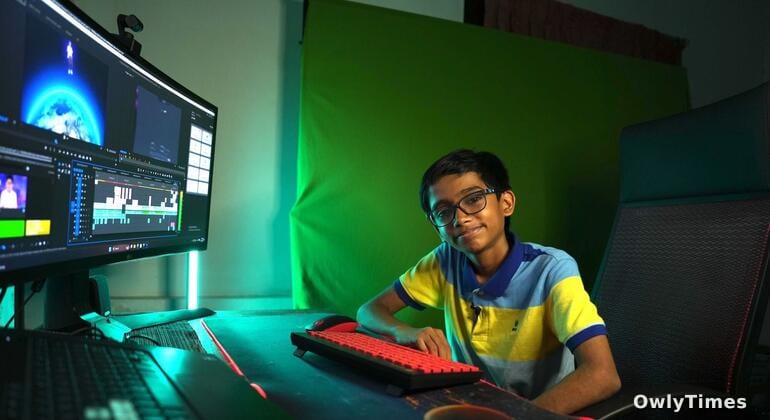

Is the future of artificial intelligence going to be built by venture capitalists in Silicon Valley, or a 19-year-old self-taught coder from Kerala? The narrative around AI is overwhelmingly focused on billion-dollar valuations and existential risk, but the real story here isn't about the next tech unicorn – it’s about democratizing access to the tools that will reshape our world, and the surprising places innovation is already taking root. At the 2026 India AI Summit in New Delhi, Raul John Aju, dubbed the “AI Kid of India,” wasn’t pitching investors; he was advising the UN on how to safeguard children in an AI-driven future. That shift in focus is critical.
From Video Editing to AI Realm Technologies
Raul’s journey began, unsurprisingly, with a creative pursuit: video editing. Access to Adobe’s premium tools through his father’s employment sparked an early fascination, quickly evolving beyond editing into the underlying technology. He built his first robot, “MeBot,” for a school science project at age 12, a feat most adults wouldn’t attempt. But this wasn’t just a hobby; it was the foundation for AI Realm Technologies, the company he founded to consolidate the ten-plus AI tools he’d already developed. In a landscape where “AI-powered” is slapped onto everything from toasters to toothbrushes, Raul is actually building the intelligence, not just marketing around it. The decision to brand his work wasn’t about ego, he explained to UN News, but about creating a unified platform – and, crucially, a simplified payment system for users without traditional banking access. This speaks to a core difference in approach: many Silicon Valley startups target affluent early adopters; Raul is thinking about accessibility from the start.
This article draws on reporting from news.un.org.
Bridging the Justice Gap with Rescue AI
One of Raul’s most compelling projects is “Rescue AI.” It’s not another chatbot promising to write your emails. This tool is designed to provide immediate guidance during emergencies, connect users with legal counsel, and even assist lawyers in building case strategies by analyzing thousands of precedents. Consider the implications: in a world where legal representation is often a privilege, Rescue AI offers a potential lifeline. The tool isn’t intended to replace lawyers, but to level the playing field, offering a baseline of support to those who might otherwise navigate the legal system alone. This isn’t about automating jobs; it’s about addressing systemic inequalities. The fact that a teenager is tackling a problem that governments and established legal tech firms have largely ignored is a pointed commentary on where innovation truly lies.
The Power of Free Education: ThinkCraft Academy
Beyond building tools, Raul is focused on education. ThinkCraft Academy offers free courses, empowering over seven million people to learn about AI and even build their own applications. This isn’t a lead-generation tactic for AI Realm Technologies; it’s a genuine effort to democratize knowledge. The current AI boom is fueled by a massive skills gap. Companies are scrambling for qualified engineers, while the average person feels increasingly bewildered by the technology. Raul’s approach – free, accessible education – directly addresses this problem. It’s a model that prioritizes empowerment over profit, a refreshing contrast to the often-opaque world of AI training programs.
Learning from Experience: The Value of a Veteran’s Insight
Raul’s decision to hire his father, a veteran of tech giants like Amazon, Adobe, Wipro, and IBM, raised eyebrows. It wasn’t just a family affair; it was a strategic move to bridge the gap between theoretical knowledge and real-world experience. He recognized that his own self-taught expertise, while impressive, lacked the nuanced understanding that comes from decades in the industry. He also admitted it was “good for my marketing!” – a refreshingly honest acknowledgement of the realities of building a brand. This highlights a crucial point: mentorship and intergenerational knowledge transfer are vital in the rapidly evolving field of AI. The tendency to glorify the “lone genius” overlooks the importance of collaboration and learning from those who came before.
The Human Element in an AI World
Throughout his work, Raul consistently emphasizes the importance of maintaining our humanity. He tells his students to embrace AI but not to lose sight of their own values and empathy. “The most important skill in the world of AI is to be as human as possible,” he says. This isn’t a sentimental platitude; it’s a pragmatic observation. AI excels at processing data and automating tasks, but it lacks the critical thinking, emotional intelligence, and ethical judgment that are uniquely human. As AI becomes more pervasive, these qualities will become even more valuable. Raul’s message is a powerful antidote to the dystopian narratives that often dominate the AI conversation.
The real question isn’t whether AI will change the world – it already is. The question is who will shape that change. And in the next decade, I predict we’ll see a surge of innovation not from the established tech hubs, but from unexpected corners of the globe, driven by individuals like Raul John Aju who prioritize accessibility, education, and, above all, the human element. Watch for the rise of “AI for the rest of us” – tools built not to disrupt, but to empower. The next big AI breakthrough won’t be a new algorithm; it will be a new user.