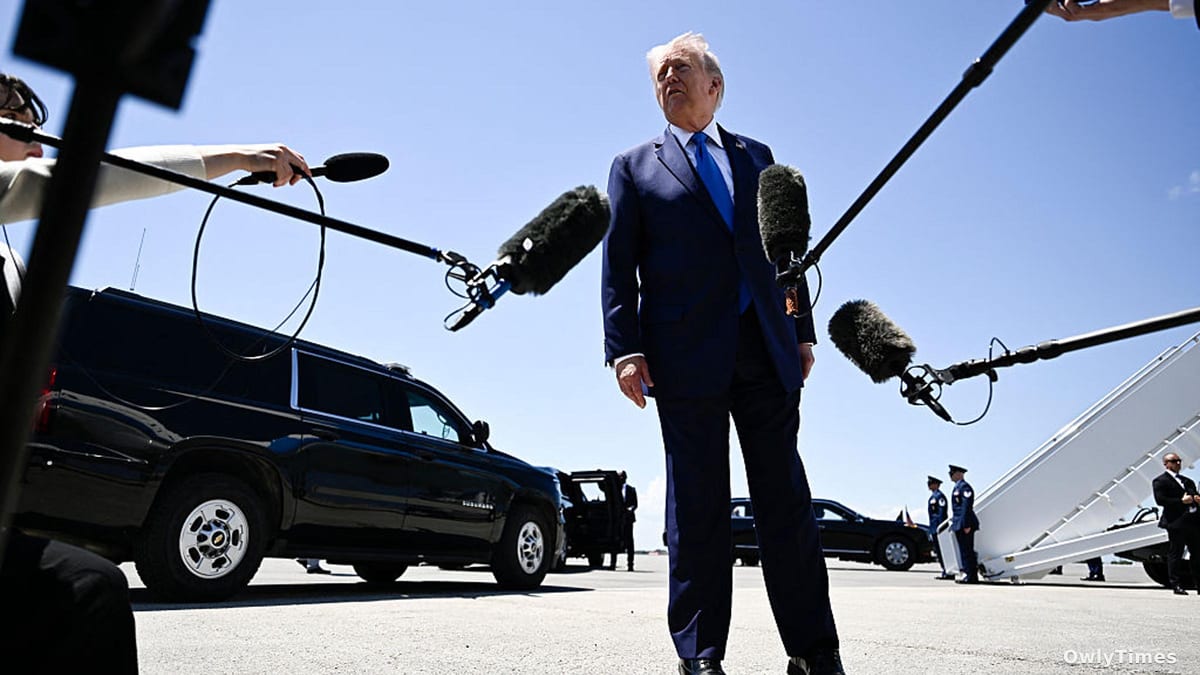

President Donald Trump’s abrupt decision to scrub a high-stakes diplomatic mission to Islamabad reveals a shift in the administration’s leverage strategy: moving from a policy of active engagement to one of coercive indifference. By grounding special envoy Steve Witkoff and Jared Kushner hours before their scheduled departure, the President is attempting to reframe the conflict as a test of Iranian desperation rather than American urgency. The strategic calculus here is clear—Trump is betting that by withdrawing the physical presence of his negotiators, he can force Tehran to abandon its internal power struggles and come to the table on his terms.
The Calculus of Physical Presence
The cancellation, announced via Truth Social and later reaffirmed by the President in West Palm Beach, signals that the administration has grown impatient with the pace of negotiations. Trump’s stated rationale—that there is “tremendous infighting” within the Iranian leadership—suggests the White House believes it has identified a point of weakness. By declaring that Iran can simply “call” the U.S. if they want to negotiate, Trump is shifting the burden of effort entirely onto the Iranian side.
This move follows a pattern of last-minute retrenchment, mirroring the earlier cancellation of a trip planned for Vice President J.D. Vance. Who benefits and who loses in this diplomatic vacuum remains to be seen. While the administration gains the political optics of a "strongman" negotiator who refuses to waste time on fruitless meetings, the immediate losers are the regional stakeholders relying on the U.S. to stabilize the volatile energy corridor.
Regional Instability and the Strait of Hormuz
The urgency of these talks is underscored by the state of the Strait of Hormuz, a vital maritime artery that has effectively ceased functioning as a global trade route. Shipping data from Friday confirms that only five ships navigated the Strait, a staggering collapse from the pre-war volume of over 130 ships observed before Feb. 28. This chokehold has triggered a global energy crisis, with Brent crude futures climbing to over $105 a barrel.
The economic pressure is compounding, as evidenced by an 11% rise in oil prices over the past week alone. While White House press secretary Karoline Leavitt had expressed optimism regarding a tentative cease-fire extended by the President, the reality on the ground is markedly different. Iranian Foreign Minister Abbas Araghchi departed Islamabad for Oman just before the U.S. team was set to arrive, signaling that the diplomatic bridge is crumbling at both ends.
Contradictions in the Cease-Fire
The instability is further complicated by the divergence between diplomatic talk and military action. Israeli Prime Minister Benjamin Netanyahu has explicitly directed the military to execute “powerful strikes” against Hezbollah targets in Lebanon, despite the existence of a formal cease-fire. This contradiction creates a dangerous environment for any potential peace broker.
The Pakistani officials acting as mediators are finding their role increasingly difficult as the U.S. demands a "good enough" document that Tehran seems unwilling or unable to provide. The next reading of shipping volumes through the Strait of Hormuz will indicate whether this latest diplomatic freeze is pushing the region toward a total economic collapse or if the pressure tactic successfully forces a change in Iranian leadership behavior.





