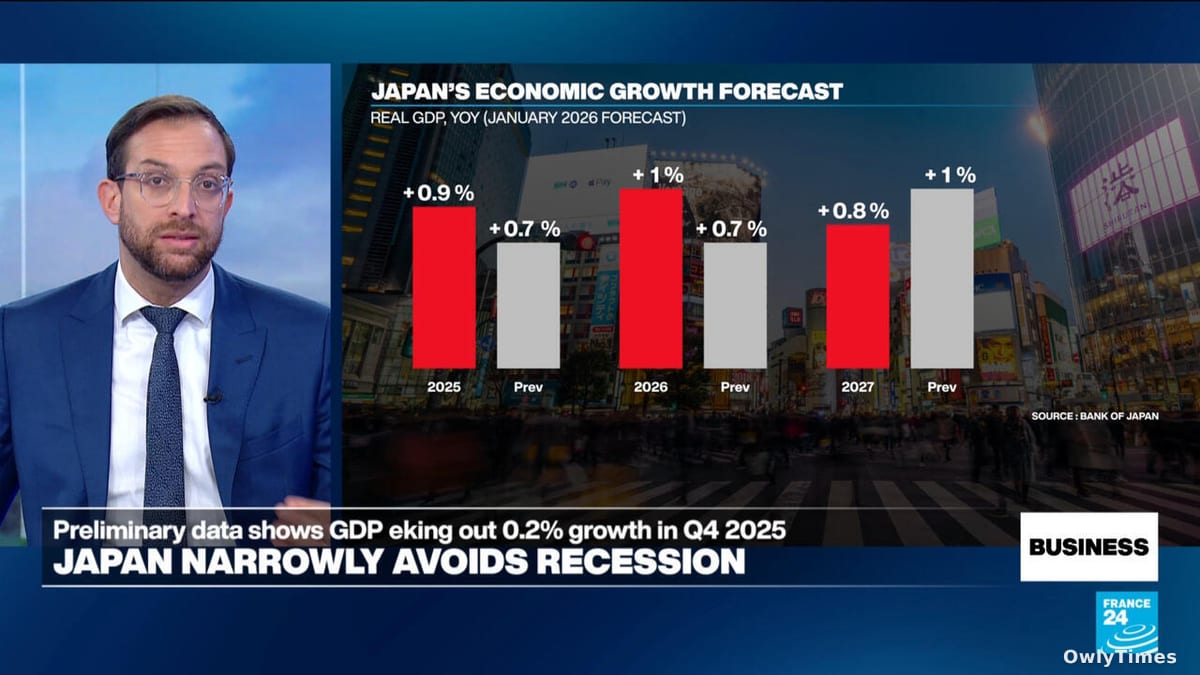

Japan’s 0.2% Growth Signals Deeper Structural Issues
A mere 0.2% annual growth rate in Japan’s final quarter of 2025 – revealed in preliminary data released Monday – isn’t just a miss against the anticipated 1.6% expansion; it’s a flashing warning sign about the efficacy of current economic policies and the underlying health of the world’s third-largest economy. While a rebound from the previous quarter’s contraction is technically positive, the magnitude of the shortfall demands a closer look at where the money isn’t flowing, and why. This isn’t a cyclical dip; it’s a potential indicator of a prolonged period of stagnation, and the implications extend far beyond Tokyo.
Based on the original france24.com report.
The Yen’s Role in Dampened Export Performance
Follow the money, and a significant portion of the story leads to currency fluctuations. The Japanese Yen experienced considerable volatility throughout 2025, and while a weaker Yen typically boosts exports, the effect hasn’t materialized as expected. Export volume actually decreased by 1.8% in the last quarter, despite a nearly 15% devaluation of the Yen against the US dollar over the same period. This suggests that global demand for Japanese goods is weakening, or that Japanese manufacturers are struggling to capitalize on price advantages due to supply chain constraints and rising input costs. Comparing this to South Korea, which saw a 3.2% export increase despite similar global headwinds, highlights Japan’s specific vulnerabilities.
Warner Bros. Discovery & Paramount Skydance: A Distraction from Fundamental Growth
The concurrent reporting that Warner Bros. Discovery is revisiting potential sale talks with Paramount Skydance might seem unrelated, but it’s a symptom of the same underlying anxiety: a search for growth in a slowing global economy. These media conglomerates aren’t seeking mergers to achieve synergies; they’re seeking scale to survive a potential downturn in consumer spending. The entertainment sector is often a leading indicator, and the renewed M&A activity suggests a lack of confidence in organic growth prospects. The combined market capitalization of Warner Bros. Discovery and Paramount Global has decreased by 8.7% since the initial sale talks fell apart in Q3 2025, demonstrating investor skepticism.
China’s “Winter Economy” – A Model or an Outlier?
The mention of China’s “winter economy” as a potential blueprint for bolstering domestic consumption is intriguing, but requires careful scrutiny. China’s success – driven by ice and snow tourism and related spending – is largely attributable to government investment in infrastructure and targeted promotional campaigns. While a 12% increase in winter tourism revenue is impressive, replicating this model in Japan, with its aging population and different cultural preferences, is far from guaranteed. Japan’s winter tourism revenue only increased by 3.5% during the same period, despite similar promotional efforts. The fundamental difference lies in China’s ability to mobilize large-scale government spending, a capacity Japan is increasingly constrained from due to its high public debt.
What This Means for Your Wallet
Japan’s economic slowdown isn’t just a problem for Japanese investors; it has ripple effects globally. A weaker Japanese economy translates to reduced demand for raw materials and intermediate goods from other countries, particularly in Asia. For consumers, this could mean slower wage growth and potentially higher prices for imported goods. More immediately, the stalled growth increases the likelihood of further Yen depreciation, making Japanese exports cheaper but also eroding the purchasing power of Japanese consumers – and potentially triggering competitive devaluations from other nations. The key question now is whether the Bank of Japan will intervene to stabilize the Yen, and if so, at what cost to its already strained fiscal position. Watch for the BOJ’s next policy meeting on March 15th; the decisions made there will signal whether Japan is prepared to address these structural issues head-on, or continue down a path of prolonged stagnation.