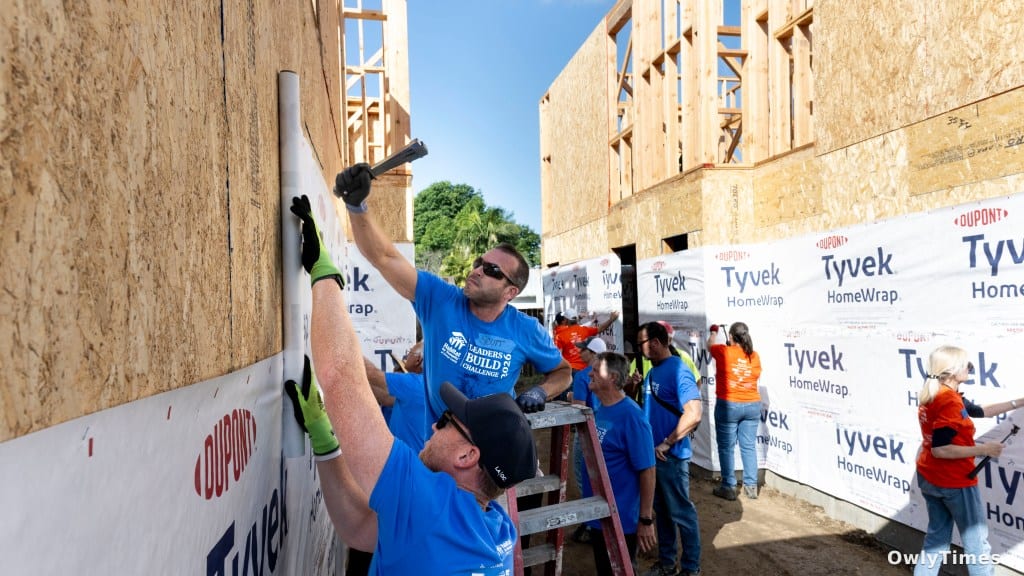

$1.8 million. That’s the cumulative impact of Habitat for Humanity of Orange County’s (HabitatOC) annual Leaders Build Challenge, a figure that, while laudable, obscures a more pressing economic reality: the escalating cost of simply existing in Orange County, and the increasingly precarious position of the workforce that keeps the region functioning. The 17th annual event, held March 5, 2026, saw 48 volunteers from companies like City National Bank – including CJ Bibolet, pictured playfully on the construction site – trade power suits for tool belts to begin building six townhomes on West Washington Avenue in Santa Ana. But this isn’t charity as a feel-good exercise; it’s a direct response to a widening affordability gap, and a signal of where corporate social responsibility is being strategically deployed.
Follow the money, and the picture becomes stark. HabitatOC’s $1.8 million fundraising total, accumulated over years of these challenges, is significant, but it barely scratches the surface of the housing deficit. Orange County’s median home price currently sits at $1,050,000 – a figure 137% higher than the national average, according to recent data from the California Association of Realtors. These six townhomes, each approximately 1,430 square feet, represent a targeted intervention, but they are a drop in the bucket compared to the estimated 85,000 affordable housing units the county needs. The fact that five of the six future homeowners are actively participating in the construction itself highlights the depth of need and the limited availability of affordable options.
Source material: ocregister.com.
The participation of corporate volunteers isn’t purely altruistic. Companies are increasingly aware of the link between employee housing stability and workforce retention. A recent study by the National Low Income Housing Coalition found that employees facing housing insecurity are 40% more likely to experience job turnover. For businesses like City National Bank, with a substantial Orange County workforce, investing in affordable housing through initiatives like the Leaders Build Challenge is a calculated risk mitigation strategy. It’s a proactive attempt to address a systemic problem that directly impacts their bottom line. The playful team-building activities – nail-driving competitions, oversized pong, and even hatchet throwing – are a veneer over a serious investment in local economic stability.
However, the reliance on volunteer labor and fundraising events also reveals a critical failure of public policy. HabitatOC’s success is impressive, but it shouldn’t be the primary solution to a problem that demands large-scale government intervention. California’s housing crisis is driven by restrictive zoning laws, lengthy permitting processes, and a chronic underinvestment in affordable housing development. While HabitatOC can build six homes, systemic change requires policy shifts that incentivize density, streamline construction, and allocate significant public funds to address the affordability gap. The $1.8 million raised is a testament to community spirit, but it’s dwarfed by the billions needed to truly address the crisis.
The June move-in date for these six families is a concrete victory, but it also sets a crucial benchmark. Will this model – corporate-sponsored, volunteer-built affordable housing – scale effectively? Or will it remain a localized solution, perpetually chasing a problem that outpaces its resources? Investors and consumers should watch closely for the next phase: whether HabitatOC can leverage this momentum to secure larger public-private partnerships and advocate for policy changes that address the root causes of Orange County’s housing crisis. What this means for your wallet is simple: unless the supply of affordable housing increases dramatically, expect continued upward pressure on rents and home prices, impacting not just low-income families, but the entire Orange County economy.