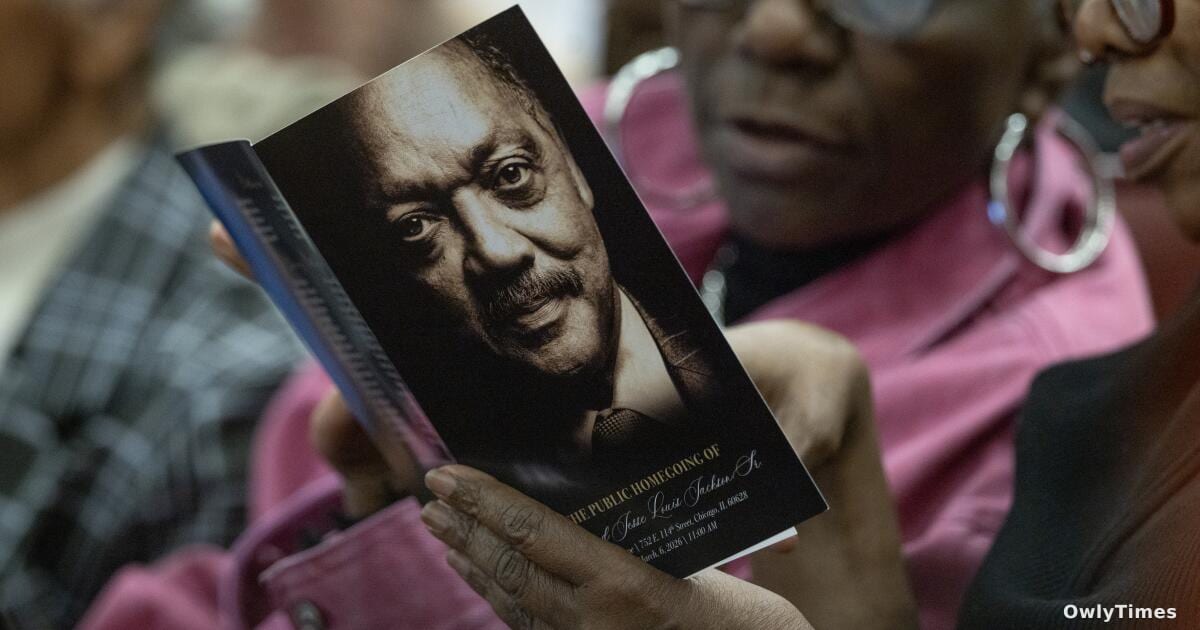

Is anyone actually paying attention to the right lessons from history? As the U.S. stumbles further into a volatile Middle East, the chatter in Washington focuses on strategic calculations and geopolitical maneuvering. The real story here isn't about containing Iran – it’s about the gaping hole in domestic politics where a cohesive, progressive vision once stood, a vision that understood war isn’t fought in a vacuum, but bleeds directly into the struggles of everyday Americans. And the recent passing of Rev. Jesse Jackson offers a stark reminder of what’s been lost.
For many, Jackson will be remembered as a towering figure in the Civil Rights Movement, and rightfully so. But his two presidential bids, in 1984 and 1988, weren’t simply symbolic gestures. They were a deliberate attempt to fuse economic justice with a staunch anti-war stance, echoing the powerful critique laid out by Martin Luther King Jr. in his 1967 speech condemning the Vietnam War, economic exploitation, and racial injustice. Jackson didn’t just talk about connecting these issues; he built a campaign – the Rainbow Coalition – around them.
This piece references the the Los Angeles Times report.
His candidacies arose during a period eerily similar to our own. The social contracts built by the labor, civil rights, and women’s movements were unraveling. Deindustrialization was gutting communities, Reaganism was enriching the few while dismantling protections for the many, and a pro-corporate consensus was solidifying across the political spectrum. Sound familiar? In 1984, the unemployment rate hovered around 7.4%, a significant jump from the previous decade, and manufacturing jobs were already in steep decline – a precursor to the economic anxieties that would define the coming decades. Jackson recognized this wasn’t just about numbers; it was about the lived experience of millions.
The Rainbow Coalition wasn’t just a collection of interest groups politely agreeing to coexist. It was a deliberate attempt to unite constituencies that the political establishment deemed incompatible: Black voters in the South, industrial workers in the Midwest, struggling family farmers, Latino and Native organizers, Arab American activists, peace advocates, and progressive whites. This wasn’t about adding symbolic diversity to a campaign; it was about recognizing the shared material interests that bound these groups together. Farmers facing foreclosure weren’t an afterthought; the farm crisis was front and center. Deindustrialized workers weren’t rhetorical props; trade, jobs, and industrial policy were core tenets of his platform.
Crucially, Jackson, like King before him, understood that economic populism couldn’t be divorced from anti-militarism. At the height of the Cold War, while Reagan was dramatically increasing military spending – a budget that ballooned to over $277 billion in 1985, representing nearly 7% of GDP – Jackson argued that those funds were being diverted from essential services like education, healthcare, and housing. He didn’t see Pentagon budgets as abstract line items; he saw them as resources stolen from communities. He connected the violence of economic abandonment at home to the violence of intervention abroad, and his campaign explicitly called for redirecting military spending towards human needs and prioritizing diplomacy. When he famously declared we should “choose the human race over the nuclear race,” it wasn’t just a catchy slogan; it was the logical conclusion of his moral and economic framework.
Jackson’s 1988 campaign, despite ultimately falling short, was a remarkable achievement. He captured millions of votes, won primaries and caucuses across the country, and forced issues into the Democratic Party that party elites actively avoided. He proved that a progressive agenda grounded in the realities of ordinary people – rural collapse, urban disinvestment, plant closures, racial injustice, and war – could resonate with a national electorate. But after his final campaign, the organizational infrastructure of the Rainbow Coalition was largely absorbed into the Democratic Party, a move intended to broaden its reach but ultimately resulting in its dissipation. The progressive anchor was lost, and the momentum stalled.
Today, we’re facing a similar rightward shift, fueled by concentrated corporate power and a normalized militarism. The current defense budget, exceeding $886 billion in 2023, dwarfs spending on social programs and continues to prioritize military solutions over diplomatic ones. And, just as in Jackson’s time, there’s a tendency to deflect blame onto convenient scapegoats – immigrants, for example – rather than addressing the systemic issues driving economic insecurity. The recent protests across the country, sparked by instances of police brutality, demonstrate a deep-seated frustration with the status quo, but protest alone isn’t enough to dismantle the structures of power.
The lessons of the Rainbow Coalition aren’t about nostalgia; they’re about strategy. We need to move beyond narrow electoral bargains and build a broad-based coalition rooted in shared material demands. We need to understand that racial justice, labor rights, rural survival, gender equality, and anti-war politics aren’t competing priorities, but interconnected components of a larger struggle. Rishi Awatramani and Manuel Pastor are right to point out that hope must be organized, and peace must be part of prosperity.
Watch for this: in the next six months, as the 2024 election cycle intensifies, pay attention to whether any candidate attempts to genuinely synthesize a critique of military spending with a concrete plan to address economic inequality. Don’t look for rhetoric; look for policy proposals. The candidate who can credibly articulate a vision where investing in people doesn’t come at the expense of peace – and vice versa – will be the one who truly understands the legacy of Jesse Jackson.





