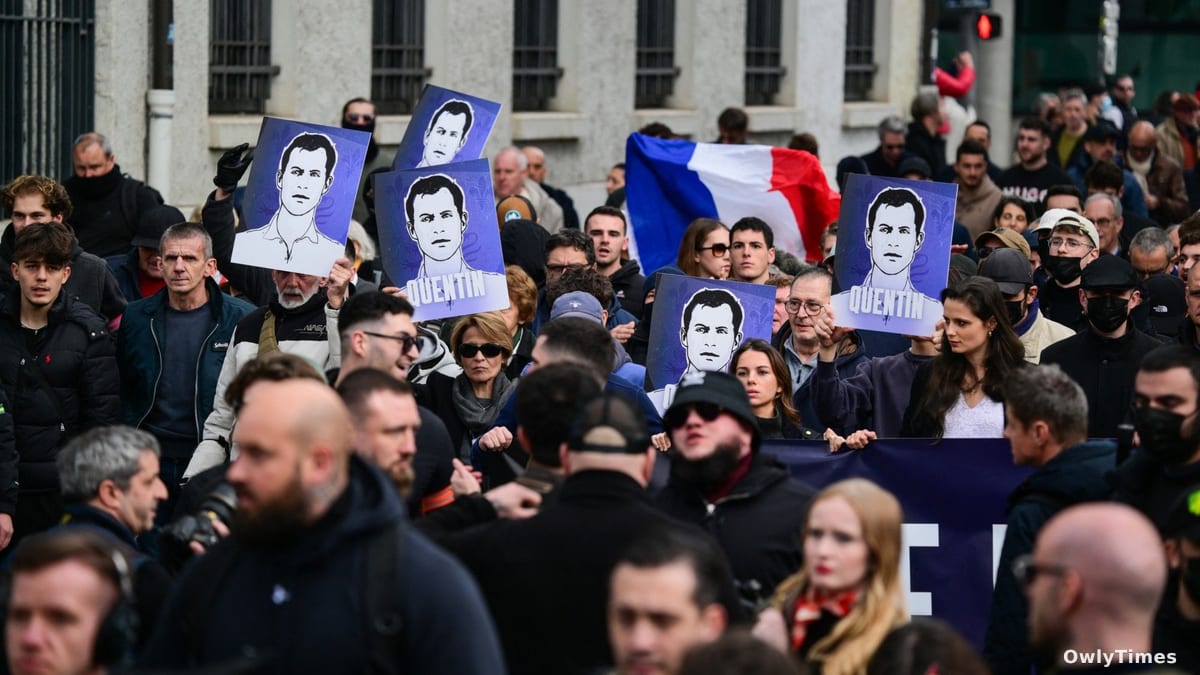

The calculus in Lyon wasn’t about a single street fight; it was about escalating a fracture line in French politics to a breaking point. The brutal killing of Quentin Deranque, a far-right activist, on February 12th, and the subsequent arrests revealing ties between the attackers and figures connected to Jean-Luc Mélenchon’s La France Insoumise (LFI) party, isn’t simply a law-and-order issue. It’s a strategic maneuver – albeit one born of violence – to redraw the political map of France, leveraging outrage to consolidate support for both the far-right and, paradoxically, to potentially isolate and dismantle a key left-wing force. As Renaud Dély observed on France Info, the situation carries a “whiff of near civil war,” a sentiment reflecting the deliberate escalation of rhetoric and action.
The immediate fallout is stark: eleven arrests, most linked to the banned “Young Guard” group, with at least three reportedly employed by LFI MP Raphaël Arnault. This connection is the fulcrum upon which the current political crisis balances. While Mélenchon insists his party abhors violence, the proximity of the perpetrators to his political circle is devastating, particularly given LFI’s already precarious position in the polls at 10%. The timing is critical; with next year’s presidential election looming, the incident provides ammunition for opponents to paint LFI as tacitly endorsing extremism. Who benefits and who loses is clear: Marine Le Pen’s National Rally (RN), currently leading in polls, stands to gain significantly from the disarray on the left, while LFI faces potential electoral annihilation.
See the original theweek.com story for the full account.
This isn’t an isolated incident, but a continuation of a pattern. As Paul Sugy points out in Le Figaro, the Left’s “anti-fascist” movement has a history of advocating physical violence, and the Young Guard, founded by Arnault in 2018, was explicitly ordered to disband for inciting violence and offering street-fighting lessons. The historical parallel here isn’t difficult to draw: the 1930s saw similar cycles of escalating street violence between communist and fascist groups, creating an atmosphere of instability that ultimately paved the way for authoritarianism. While France today is a robust democracy, the deliberate normalization of political violence – regardless of its source – erodes the foundations of civic discourse. The killing of Deranque, as Le Monde notes, “mimics the methods of the ‘fascists’ whom they say they are fighting,” effectively handing a martyr to their adversaries and undermining the moral high ground.
The response has been predictably polarized. The right and far-right, led by Jordan Bardella, are accused of “shamefully exploiting” the tragedy, as Anthony Cortes argues in L’Humanité, attempting to demonize the entire Left while downplaying instances of far-right brutality, such as the recent beating of a Syrian student near Lyon. This is a classic tactic of deflection, attempting to equate the actions of a fringe group with the broader political movement. However, the attempt to create a unified front against LFI, mirroring the historical ostracization of the RN, reveals the strategic intent: to isolate and marginalize a political force perceived as a threat to the established order. The bomb threat against LFI’s Paris HQ and attacks on party offices are not simply acts of vandalism, but calculated attempts to intimidate and silence opposition.
Despite the alarming rhetoric, calls for calm, like those from Fabienne Lemahieu in La Croix, emphasize that the current situation, while serious, doesn’t yet reach the level of “meticulously planned clashes” seen in the 1970s and 80s. This is a crucial distinction. However, the call for LFI to undertake a “genuine internal reassessment,” as urged by Loup Besmond de Senneville, highlights the party’s responsibility to distance itself from extremist elements and to engage in constructive dialogue rather than inflammatory rhetoric. The key political chess move to watch next isn’t whether the RN continues to lead in the polls – that’s almost a certainty at this point – but whether Mélenchon and LFI can successfully navigate this crisis without imploding, and whether they can demonstrate a genuine commitment to non-violent political engagement. The future of the French left, and potentially the stability of French democracy, hinges on their response.





